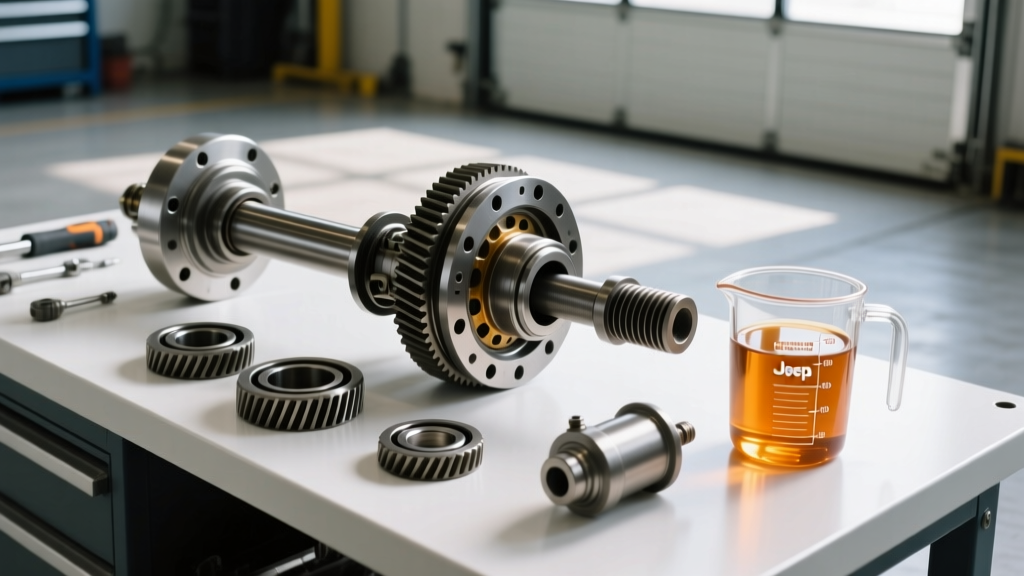
The Financial and Mechanical ROI of a Jeep Wrangler Differential Fluid Change
Performing a routine Jeep Wrangler differential fluid change is one of the highest-ROI maintenance tasks any owner can undertake in 2026. Whether you are daily-driving a Sport S or crawling boulders in a Rubicon, the hypoid ring and pinion gears inside your Dana axles generate immense shear forces and heat. Over time, extreme pressure (EP) additives deplete, and off-road water crossings inevitably lead to fluid emulsification. Yet, many owners defer this service due to uncertainty surrounding gear oil specifications, friction modifier requirements, and the true cost of professional axle service.
This comprehensive cost analysis and specification guide breaks down exactly what you will spend at a dealership versus your own garage, while diving deep into the tribology of Dana 30 and Dana 44 gear oil requirements.
2026 Cost Breakdown: Dealership vs. Independent 4x4 Shop vs. DIY
Labor rates have climbed steadily, and in 2026, dealership service centers charge a premium for what is fundamentally a straightforward drain-and-fill procedure. Below is a comparative cost analysis for servicing both the front and rear axles on a standard JL or JK Wrangler.
| Service Provider | Front Axle Cost | Rear Axle Cost | Total (Both Axles) | Time Investment |
|---|---|---|---|---|
| OEM Dealership | $160 - $190 | $180 - $220 | $340 - $410 | 1.5 - 2 Hours |
| Independent 4x4 Shop | $130 - $160 | $150 - $180 | $280 - $340 | 1.5 Hours |
| DIY (Synthetic Fluid) | $35 - $45 | $45 - $60 | $80 - $105 | 2 - 3 Hours |
The DIY Advantage: By turning your own wrenches, you save upwards of $250. More importantly, you control the quality of the lubricant. Many dealerships bulk-fill with conventional 80W-90 mineral oil to keep margins high, whereas a DIY approach allows you to install premium synthetic formulations that resist thermal breakdown during low-speed, high-torque crawling.
Differential Gear Oil Specifications: Viscosity and API Ratings
The core of any axle maintenance strategy lies in selecting the correct differential gear oil specifications. Wrangler axles utilize hypoid gearsets, where the pinion gear sits below the centerline of the ring gear. This geometry creates a sliding, wiping action that requires specialized lubrication.
The API GL-5 Mandate
You must exclusively use gear oils rated API GL-5 for Jeep Wrangler differentials. GL-5 fluids contain high levels of sulfur-phosphorus extreme pressure (EP) additives. Under the immense shock loads of off-roading or launching from a stop, these additives react with the metal surfaces to form a sacrificial tribofilm, preventing micro-welding and gear spalling. Using a GL-4 fluid (commonly found in manual transmissions) will result in catastrophic ring and pinion failure in a hypoid axle.
Viscosity Grades: 75W-85 vs. 75W-90 vs. 80W-90
- SAE 75W-85 (OEM Standard): Stellantis transitioned to 75W-85 synthetic for most JL and JT Dana 44 applications to meet CAFE fuel economy targets. It offers excellent cold-weather flow and adequate high-temperature protection for stock vehicles.
- SAE 75W-90 (The Enthusiast Standard): For modified Wranglers running 35-inch tires, lower gear ratios (e.g., 4.88 or 5.13), or frequent towing, a full synthetic 75W-90 provides a thicker protective film at high operating temperatures without sacrificing cold-start lubrication.
- SAE 80W-90 (Heavy-Duty/Commercial): Often used in severe commercial applications. While it offers robust protection, it can cause sluggish differential response and increased parasitic drag in sub-freezing climates.
The Friction Modifier Variable: Trac-Lok vs. Tru-Lok
One of the most common mistakes during a Jeep Wrangler differential fluid change is mismanaging friction modifiers. The requirement depends entirely on your specific axle and differential carrier:
Rule of Thumb: Clutch-based limited-slip differentials require a friction modifier. Mechanical lockers and open differentials do not.
- Trac-Lok (Clutch LSD): Found in many non-Rubicon Sport and Sahara models. You must add a friction modifier (such as Mopar P/N 05010320AA) to prevent clutch chatter during tight, low-speed turns. Typically, 2 to 4 ounces per axle is sufficient.
- Tru-Lok (Rubicon Electronic Locker): Uses a mechanical dog-clutch mechanism. It requires zero friction modifier. Adding it can actually reduce the locking efficiency and cause the locker mechanism to slip under load.
- Open Differentials: Do not require friction modifiers, though adding a small amount will not cause harm.
2026 Gear Oil Product Matrix and Pricing
When sourcing fluids, reference this matrix to ensure you are buying the correct specification. Prices reflect early 2026 retail averages.
| Brand & Product | Viscosity | OEM / Part Number | Price per Quart | Best Application |
|---|---|---|---|---|
| Mopar Gear & Axle Lubricant | 75W-85 | 68218655AB | $14.50 - $18.00 | Stock JL/JT daily drivers under warranty |
| AMSOIL Severe Gear | 75W-90 | SVGPK-EA | $22.00 - $25.00 | Modified rigs, 35in+ tires, rock crawling |
| Valvoline High Performance | 80W-90 | VV831 | $9.00 - $12.00 | Budget builds, high-mileage conventional swaps |
| Red Line ShockProof | 75W-90 (Heavy) | 50304 | $24.00 - $28.00 | Competition crawling, extreme shock loads |
For deeper technical data on synthetic base stock shear stability, consult the AMSOIL Product Lookup database or review the latest technical service bulletins via Mopar Official Lubricants.
Hidden Costs: Gaskets, RTV, and Crush Washers
A true cost analysis must account for the hardware surrounding the differential. Reusing old, compressed gaskets or stripped drain plugs is a false economy that leads to leaks and gear whine.
Differential Cover Sealing
- OEM RTV Silicone: The factory method. A tube of Permatex Ultra Black (approx. $8) or Mopar Silicone Adhesive Sealant is required. You must thoroughly scrape the old RTV from the axle housing and cover, which adds 45 minutes of labor to your DIY time.
- Reusable Gaskets (The Upgrade): Products like the Lube-Locker ($35 - $45 per axle) use a steel core with an elastomer bead. While they increase the upfront DIY cost by $70 for both axles, they eliminate the messy RTV scraping process and make future fluid changes significantly faster and cleaner.
Fill and Drain Plug Hardware
Many Dana 44 axles use a 3/4-inch hex or 1/2-inch square drive for the fill and drain plugs. The crush washers (if equipped on aftermarket covers) should be replaced. If your factory plugs are rounded out from previous improper service, budget $15 for a set of magnetic billet aluminum replacement plugs. Magnetic plugs are highly recommended to capture metallic wear debris from the ring and pinion break-in process.
Capacities and Torque Specifications
Precision is critical when reassembling Dana axles. Over-torquing cover bolts will warp the differential cover, leading to immediate leaks and potential bearing preload issues.
Dana 30 (Front Axle - JK/JL Non-Rubicon)
- Fluid Capacity: 2.5 Pints (1.18 Liters)
- Cover Bolt Torque: 30 lb-ft (Use a crisscross pattern)
- Fill/Drain Plug Torque: 25 - 35 lb-ft
Dana 44 (Rear Axle & Rubicon Front/Rear)
- Fluid Capacity: 3.5 Pints (1.65 Liters)
- Cover Bolt Torque: 35 lb-ft (Use a crisscross pattern)
- Fill/Drain Plug Torque: 25 - 35 lb-ft
Pro-Tip: Always remove the fill plug first before removing the drain plug or dropping the cover. If the fill plug is seized or stripped, you do not want to be left with an empty differential and no way to refill it. For comprehensive torque sequences and advanced axle rebuilding procedures, reference the engineering data provided by Valvoline Global Operations and OEM service manuals.
The Hidden Cost of Water Ingress
The owner manual may state that your Jeep Wrangler differential fluid change interval is 50,000 miles under normal driving conditions. However, the moment your axle housings are submerged in a river crossing or deep mud bog, the internal axle cools rapidly, creating a vacuum that pulls water past the axle seals and breather tubes. Water emulsifies GL-5 gear oil, turning it into a milky, acidic sludge that strips the protective EP additive layer from your hypoid gears. If you wheel in water, your maintenance interval drops to immediately after the trip. Factoring in the cost of a premature fluid change ($80 DIY) is vastly cheaper than replacing a scored ring and pinion gearset ($1,200+ in parts and machine shop labor).
Final Verdict
Mastering the specifications and costs associated with your Wrangler's axles empowers you to make informed maintenance decisions. By investing $80 to $105 in high-quality synthetic 75W-90 gear oil, reusable gaskets, and the correct friction modifiers, you secure the longevity of your drivetrain while avoiding the steep $350+ dealership service fees. Keep your torque wrench calibrated, respect the API GL-5 requirement, and your Dana axles will survive whatever the trail throws at them.