The Real Cost of Servicing the 2005 Jeep Grand Cherokee Front Differential
When maintaining the legendary WK platform, the 2005 Jeep Grand Cherokee front differential is often the most neglected drivetrain component. Unlike the older solid-axle WJ generation, the 2005 model year introduced Independent Front Suspension (IFS), fundamentally changing the axle architecture, service procedures, and long-term maintenance costs. Because the front IFS differential is tucked high into the engine cradle and sealed from the elements, many owners mistakenly assume it is a "lifetime" unit. In reality, the hypoid gear sets inside the Dana 30 and Dana 44 IFS housings require strict adherence to API GL-5 fluid intervals to prevent catastrophic bearing and gear failure.
As we navigate the automotive service landscape in 2026, dealership labor rates have surged, making the DIY service route one of the highest-return maintenance tasks a WK owner can perform. Below, we break down the exact costs, fluid specifications, and engineering "gotchas" associated with the WK front differential.
2026 Pricing Breakdown: DIY vs. Independent Shop vs. Dealership
The front IFS differential on the WK is remarkably easy to service compared to older solid axles because it features dedicated drain and fill plugs. There is no need to scrape RTV silicone or replace cork gaskets. This simplicity drastically reduces labor time.
| Service Route | Estimated Cost (2026) | Time Required | Cost Breakdown & Variables |
|---|---|---|---|
| DIY (Home Garage) | $18 - $32 | 30 - 45 Minutes | Cost covers 2 quarts of 80W-90 GL-5 gear oil and replacement copper crush washers. Requires a 3/8" square or 14mm hex socket and a fluid pump. |
| Independent 4x4 Shop | $115 - $165 | 0.5 - 0.8 Hours | Based on an average 2026 independent shop rate of $145-$175/hr. Includes fluid markup and a standard chassis inspection. |
| CDJR Dealership | $190 - $260 | 1.0 Hour | Dealerships typically bill a 1-hour minimum for drivetrain services at $190-$220/hr. They will use OEM Mopar-branded fluids, which carry a premium markup. |
The IFS Paradigm Shift & The Friction Modifier Myth
One of the most expensive mistakes WK owners make is blindly purchasing Mopar Limited Slip Friction Modifier for the front differential. This stems from a misunderstanding of the Quadra-Drive II system. According to the official Jeep owner's manual archives, the Quadra-Drive II system on the 2005-2010 Grand Cherokee utilizes an Electronic Limited Slip Differential (ELSD) in the rear axle and a clutch-based NV245 transfer case.
The front differential, however, is an open unit. Front-axle traction control is managed electronically by the Bosch ESP/ABS system, which applies brake pressure to the spinning wheel (a system known as Brake Lock Differential, or BLD). Because there are no clutch packs inside the factory front Dana 30 or Dana 44 IFS housing, no friction modifier is required or recommended. Adding it is a waste of $12 and can actually reduce the shear stability and extreme-pressure (EP) protection of the gear oil. Standard API GL-5 80W-90 is all you need.
Fluid Specifications and Capacities
Selecting the correct viscosity is critical for the IFS front differential, especially if you use your WK for towing or off-road trail riding in low-range 4WD. As noted in Quadratec's comprehensive Jeep differential guide, identifying your specific axle is the first step.
- Dana 30 IFS (Standard 3.7L V6 & 4.7L V8): Fluid capacity is approximately 1.1 to 1.3 quarts (1.04 - 1.23 liters).
- Dana 44 IFS (5.7L Hemi, 6.1L SRT8, & Overland): Fluid capacity is approximately 1.3 to 1.5 quarts (1.23 - 1.42 liters).
Viscosity Recommendations:
- Daily Driving & Commuting: 80W-90 API GL-5 (e.g., Valvoline Daily Protection or Mobil 1 Synthetic).
- Heavy Towing & Extreme Off-Road: 75W-140 Synthetic API GL-5. As detailed in AMSOIL's Severe Gear technical bulletins, heavier synthetic fluids maintain their film strength under the extreme heat generated by low-speed, high-torque crawling in 4-Low.
Step-by-Step Service Guide & Critical Torque Specs
The WK front differential is mounted high, but accessing the plugs requires removing the front skid plate (if equipped) and maneuvering around the front driveshaft CV joint.
- Level the Vehicle: The WK must be on a flat, level surface. Because the IFS differential is integrated into the cradle, lifting the vehicle by the suspension will alter the fluid level inside the housing. Use a floor jack to lift the frame rails and support with jack stands.
- Remove the Fill Plug First: Always remove the upper fill plug before the lower drain plug. If the fill plug is seized or strips, you do not want to be left with an empty differential and no way to refill it.
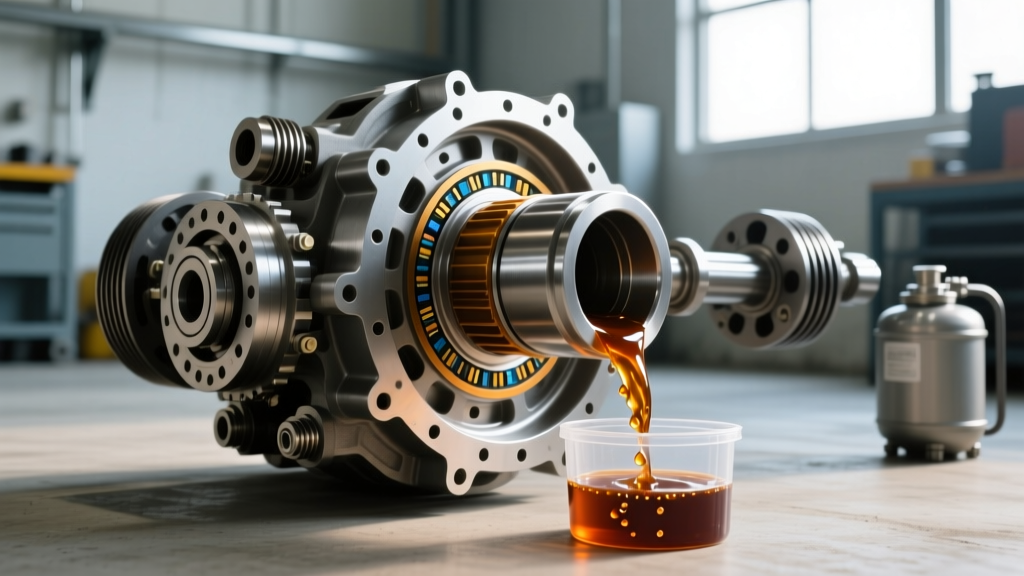
- Drain the Fluid: Remove the lower drain plug. Expect the fluid to be dark; a slight metallic sheen on the magnet (if equipped) is normal for hypoid gears, but chunky metal shards indicate internal bearing failure.
- Refill to the Weep Hole: Pump the new GL-5 fluid into the fill hole until it begins to drip out onto your finger. The correct level is exactly at the bottom of the fill hole threads.
- Torque to Spec: Clean the threads, apply a small amount of Teflon tape or a fresh copper crush washer, and reinstall the plugs.
Expert Warning: Aluminum Housing Vulnerability
The IFS differential housings on the WK are cast aluminum, while the factory drain and fill plugs are often steel. In rust-belt states, galvanic corrosion welds these plugs to the housing. Never use an impact wrench to remove them. Apply penetrating oil 24 hours prior, and use a high-quality 6-point socket. The torque specification for both the drain and fill plugs is strictly 25 ft-lbs (34 Nm). Overtightening will strip the aluminum threads, resulting in a $400+ repair requiring a Helicoil insert or a complete housing replacement.
Diagnosing Front Diff Noise vs. CV Axle Binding
A common reason owners rush to change their front differential fluid is the presence of a whining or clicking noise from the front end. Before spending money on fluid or rebuild kits, you must accurately diagnose the source of the noise. The IFS platform introduces CV axles, which are prone to their own failure modes.
- Differential Whine (Gear Wear): A steady, pitch-rising whine that correlates exactly with vehicle speed (not engine RPM) and changes tone between acceleration and deceleration usually indicates worn ring and pinion gears or failing pinion bearings inside the IFS housing.
- CV Axle Clicking (Joint Failure): A rhythmic clicking or popping noise that occurs primarily during tight, low-speed turns (like pulling into a driveway) is almost never the differential. It is a failing outer CV joint on the half-shaft.
- Transfer Case Bind (4WD System): If you hear a clunking or binding noise from the front end only when 4WD is engaged on dry pavement, this is normal "axle bind" caused by the part-time nature of the Quadra-Trac I / II systems. Never operate 4-High or 4-Low on high-traction surfaces.
Final Verdict: Is the Dealership Worth It?
From a purely financial and mechanical standpoint, paying a dealership $250 to service the 2005 Jeep Grand Cherokee front differential is difficult to justify in 2026. The IFS design with dedicated drain and fill plugs makes this a 30-minute driveway job requiring minimal tools. By investing $25 in high-quality synthetic 80W-90 or 75W-140 gear oil and a $15 fluid pump, you not only save over $200 per service interval, but you also gain the peace of mind that comes from personally inspecting the drain plug magnet for early signs of internal catastrophic wear. Treat your front IFS diff with the same respect as your rear axle, and it will easily outlast the 200,000-mile mark.