The Critical Role of U-Joints in Modern Drivetrain Layouts
The universal joint (U-joint) remains a cornerstone component across many types of drivetrain configurations, particularly in Rear-Wheel Drive (RWD) and solid-axle Four-Wheel Drive (4WD) layouts. While Constant Velocity (CV) axles dominate Front-Wheel Drive (FWD) and independent-suspension All-Wheel Drive (AWD) systems, the Cardan-style U-joint is still the undisputed king of high-torque, high-articulation applications. As of 2026, with heavy-duty trucks pushing well over 1,000 lb-ft of torque from the factory and off-road platforms demanding extreme suspension articulation, understanding U-joint failure modes, precise diagnostic symptoms, and exact replacement protocols is critical for drivetrain survival.
Unlike the enclosed, oil-bathed gears inside a transmission or differential, U-joints are exposed to the elements, road debris, and extreme operating angles. When they fail, the resulting driveline shockwave can obliterate yokes, snap pinion shafts, and destroy transfer cases. This technical deep-dive explores the exact symptoms of U-joint degradation across different drivetrain types and provides a master-level replacement guide featuring exact torque specifications and part numbers.
The Physics of U-Joint Failure: Why Cardan Joints Degrade
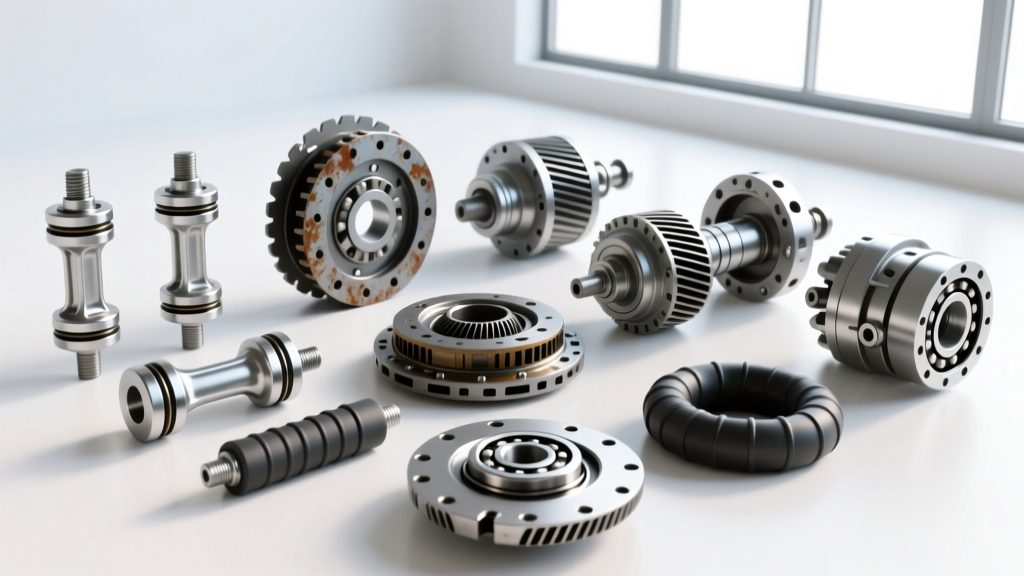
To diagnose a failing U-joint, you must first understand the mechanical forces destroying it. A standard Cardan U-joint operates on a cross-and-bearing cap design. Needle bearings inside the cap rotate around the cross trunnion. Failure typically occurs via three distinct mechanisms:
- Brinelling (False Brinelling): Occurs when the drivetrain is subjected to high static loads or vibrations without rotation. The needle bearings hammer into the bearing race, creating microscopic indentations. This is incredibly common in 4WD types of drivetrain layouts that sit unused for long periods between off-road excursions.
- Cap Walk and Galling: If the U-joint is improperly seated or the snap rings (C-clips) are not fully seated in the yoke grooves, the bearing cap will 'walk' or spin inside the yoke ear. This galls the soft cast or forged steel of the yoke, ruining the driveshaft or axle shaft entirely.
- Seal Failure and Centrifugal Purge: At highway speeds (e.g., 3,000+ RPM at the driveshaft), centrifugal force pushes grease outward against the lip seals. If the seal degrades, grease purges out, water ingresses, and the needle bearings rapidly rust and seize.
Diagnostic Matrix: U-Joint Symptoms by Drivetrain Type
Symptoms of a failing U-joint vary wildly depending on the specific types of drivetrain layouts and their inherent operating angles. Use the diagnostic matrix below to isolate the failure point.
| Symptom | Operating Condition | Drivetrain Layout | Probable Root Cause |
|---|---|---|---|
| Metallic 'Clunk' on engagement | Shifting from Reverse to Drive | RWD / 4WD (Solid Axle) | Excessive trunnion-to-cap clearance (wear) or loose yoke strap bolts. |
| High-frequency vibration (50-70 mph) | Cruising under light load | RWD (Independent Rear) | U-joint binding due to excessive operating angle or missing balance weights. |
| Cyclic 'Chirp' or 'Squeak' | Low-speed crawling / Idling in gear | 4WD (Leaf Spring Solid Axle) | Dry needle bearings; grease has purged or degraded into a hard waxy solid. |
| Harsh shudder on acceleration | Heavy throttle from a stop | Lifted 4WD / Modified RWD | Operating angle exceeds 3-5 degrees; U-joint velocity fluctuation causing bind. |
Pro-Tip for Diagnostics: To confirm a worn U-joint without a press, drop the vehicle in neutral, safely support it on jack stands, and violently rotate the driveshaft back and forth by hand while observing the cross. Any visible radial or axial play before the yoke moves indicates the joint is scrap.
Part Selection: Greaseable vs. Non-Greaseable & Exact Part Numbers
A common misconception among DIYers is that greaseable U-joints are universally superior because they allow for maintenance. However, for high-speed highway applications found in modern half-ton RWD trucks, non-greaseable (sealed) U-joints are the engineering standard. The zerk fitting requires drilling a void through the center of the cross, which inherently weakens the trunnion and reduces the needle bearing count. Furthermore, the zerk fitting hole is a prime location for cap blowouts under extreme torque.
Recommended OEM & Aftermarket Part Numbers
- Spicer 5-1350X: The gold standard for 1-ton and heavy-duty 3/4-ton 4WD types of drivetrain applications (e.g., Dana 60 front axles, 14-bolt rear axles). Non-greaseable, 1350 series, 3.625-inch cap width.
- Spicer 5-760X: The definitive replacement for inner Dana 30 and Dana 44 steering knuckles (Jeep Wrangler, Ford Super Duty front ends). Features a snap-ring design for axle retention.
- Moog 369: A reliable, greaseable 1310 series joint often used in older CJ/YJ Jeep applications or light-duty RWD steering shafts where low-speed articulation is prioritized over high-RPM strength.
The Replacement Protocol: Pressing, Staking, and Phasing
Replacing a U-joint is not simply about pressing out the old and pressing in the new. The procedure requires strict adherence to tooling and alignment protocols.
Step 1: Phasing and Marking
Before unbolting the driveshaft, use a paint pen or center punch to mark the alignment between the driveshaft tube yoke and the differential/transmission yoke. Driveshafts are dynamically balanced as a complete assembly. Reassembling the shaft even one spline off-phase will introduce a secondary-order vibration that no amount of wheel balancing can fix.
Step 2: Dealing with Staked U-Joints (Modern RWD Aluminum Shafts)
In many modern RWD types of drivetrain systems (such as the GM Silverado/Sierra 1500 aluminum two-piece shafts), the factory does not use C-clips. Instead, the bearing caps are held in place by deformed (staked) yoke metal. To remove these:
- Cut the staked metal away using a high-speed rotary tool (Dremel) with a carbide burr, or a specialized staking removal chisel.
- Press the caps out using a 12-ton hydraulic press and a U-joint press kit (e.g., OTC 7248).
- Critical Decision: You must either use a specialized staking tool (like the OTC 7248-10) to re-stake the new joint, or replace the entire aluminum driveshaft assembly. Attempting to use aftermarket C-clips in a yoke designed for staking will result in cap walk and catastrophic shaft separation at highway speeds.
Step 3: Pressing and Snap Ring Seating
When pressing in the new Spicer universal joints, ensure the needle bearings are not folded over (trapped) at the bottom of the cap. This happens if the cross is pushed off-center during pressing.
The 'Whack' Test: After installing the snap rings (C-clips), strike the yoke ears firmly with a brass or dead-blow hammer. This seats the snap rings into the outer grooves of the bearing caps, ensuring zero axial play and proper alignment. If a snap ring will not seat, do not force it; the joint is likely bound, or dirt is trapped in the groove.
Torque Specifications and Reassembly Data
Improper torque on yoke strap bolts is a leading cause of U-joint failure. Over-torquing stretches the bolts and distorts the bearing caps, causing immediate binding. Under-torquing allows the cap to walk. Always use new, high-grade (Grade 8 or Metric 10.9) hardware and a calibrated torque wrench.
| U-Joint Series | Fastener Type | Thread Size | Target Torque Spec |
|---|---|---|---|
| 1310 Series | Strap Bolts | 5/16" - 24 UNF | 15 - 20 lb-ft |
| 1350 Series | Strap Bolts | 3/8" - 24 UNF | 70 - 90 lb-ft |
| 1410 Series | Strap Bolts | 7/16" - 20 UNF | 110 - 130 lb-ft |
| Dana 44 / 60 | Pinion Yoke Nut (Crush Sleeve) | 7/8" - 14 or 1-1/16" | 200 - 250 lb-ft (Inch-lb rotational drag dependent) |
Note on Pinion Nuts: If your U-joint replacement requires removing the differential pinion yoke, you are dealing with a crush-sleeve setup (unless converted to a solid spacer). Mark the pinion nut and shaft threads before removal. Re-torqueing a crush sleeve nut requires measuring rotational drag with an inch-pound torque wrench to avoid over-crushing the sleeve, which will destroy the differential bearings within 500 miles.
Conclusion: Preserving Driveline Integrity
Whether you are maintaining a classic leaf-sprung 4WD crawler or a modern independent-suspension RWD performance truck, the U-joint remains the vital link transferring rotational energy. By recognizing the nuanced symptoms across different types of drivetrain layouts, selecting the correct sealed or greaseable architecture, and adhering strictly to torque and phasing specifications, you ensure the longevity of the entire powertrain. Never ignore a cyclic chirp or a subtle driveline clunk; in the world of high-torque drivetrains, a $30 U-joint failure left unchecked will quickly evolve into a $3,000 differential replacement.