The Dealership Dilemma: Powertrain vs. Drivetrain System
If you have ever sat across from a service advisor trying to decipher a repair estimate or a warranty booklet, you have likely encountered the confusing jargon surrounding your vehicle's mechanical anatomy. Two terms are constantly conflated, misused, and misunderstood: powertrain and drivetrain system. While they both share the ultimate goal of moving your vehicle down the road, from an engineering and financial standpoint, they represent entirely different mechanical ecosystems.
Understanding the exact boundary between these two systems is not just academic trivia. It dictates whether a $3,500 repair bill is covered under your factory warranty, which specialized tools a mechanic needs to diagnose a vibration, and how you should approach long-term maintenance. In this comprehensive guide, we will dissect the mechanical boundaries, explore real-world component mappings, and provide the exact torque specifications and fluid requirements you need to maintain both systems.
The Powertrain: The Heart and Muscle of Generation
To put it simply, the powertrain is responsible for generating power and converting it into usable rotational force. It is the combination of the engine and the transmission, along with all the internal components that make those two massive assemblies function.
Core Powertrain Components
- The Engine Block and Internals: Pistons, connecting rods, crankshaft, cylinder heads, camshafts, and the valvetrain.
- Fuel and Ignition Delivery: Fuel injectors, high-pressure fuel pumps (HPFP), ignition coils, and the engine control module (ECM).
- The Torque Converter or Clutch Assembly: The fluid coupling mechanism that bridges the engine's flexplate to the transmission's input shaft.
- Transmission Internals: Whether it is a classic GM 6L80 automatic, a ZF 8HP70 8-speed, or a Tremec T56 Magnum manual, the internal clutch packs, planetary gearsets, valve bodies, and input/main shafts are strictly powertrain components.
The powertrain ends exactly where the rotational force exits the transmission case. If a component is housed inside the engine block or the transmission bellhousing/case, it belongs to the powertrain.
The Drivetrain System: Delivering Power to the Pavement
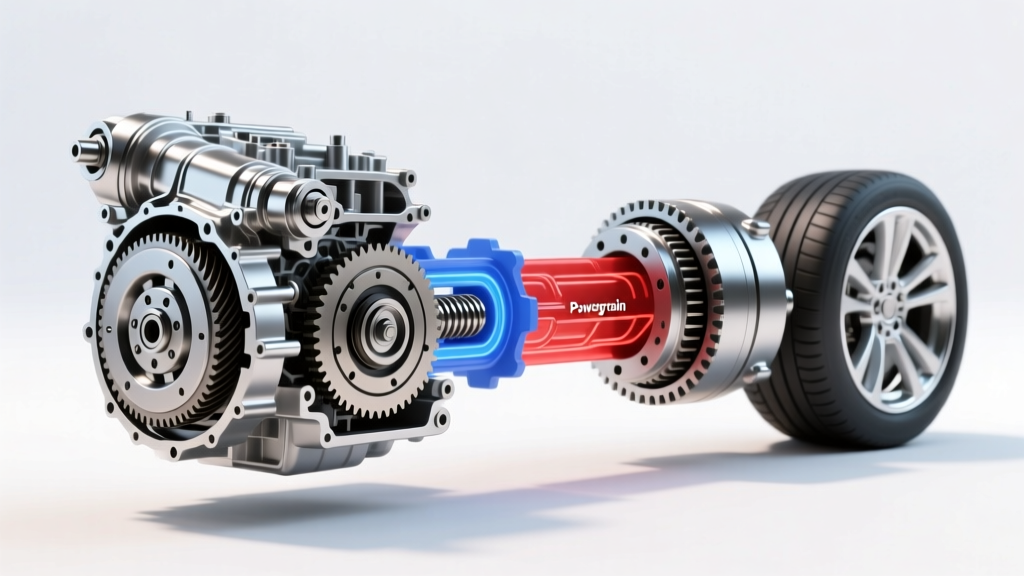
Once the powertrain has generated torque and selected the appropriate gear ratio, the drivetrain system takes over. The drivetrain's sole responsibility is to transfer that rotational force from the back of the transmission to the drive wheels, accommodating for suspension articulation, steering angles, and variations in wheel speed.
Core Drivetrain System Components
- Output Shafts and Slip Yokes: The very first point of contact after the transmission seal.
- Driveshafts (Propeller Shafts): The aluminum or carbon-steel tubes connecting the front and rear of the vehicle, balanced to within fractions of an ounce to prevent high-speed NVH (Noise, Vibration, and Harshness).
- Universal Joints (U-Joints) and CV Joints: Spicer 1310 or 1350 series U-joints allow for angular deflection in rear-wheel-drive setups, while Constant Velocity (CV) joints handle the extreme steering angles of front-wheel or independent front suspension (IFS) axles.
- Transfer Cases: In 4WD and AWD applications (like the BorgWarner 4406 found in older F-150s or modern active torque-vectoring units), the transfer case splits power front-to-rear.
- Differentials and Axle Assemblies: The ring and pinion gears, limited-slip clutch packs, spider gears, and the axle shafts that ultimately turn the wheel hubs.
Mapping the Exact Mechanical Boundary
Where does the powertrain end and the drivetrain system begin? According to SAE International standards and general automotive engineering consensus, the dividing line is the transmission output shaft seal and the mating flange/yoke.
| Component | System Classification | Primary Function | Common Failure Mode |
|---|---|---|---|
| ZF 8HP Mechatronic Unit | Powertrain | Controls hydraulic pressure and gear shifts | Solenoid failure, valve body wear |
| Transmission Output Shaft Seal | Boundary / Drivetrain | Prevents fluid loss where yoke enters trans | Rubber lip degradation, leaking ATF |
| Front/Driveshaft U-Joint | Drivetrain System | Allows angular movement of the driveshaft | Cap bearing failure, rust seizure |
| Differential Ring & Pinion | Drivetrain System | Transfers power 90-degrees to the axles | Improper backlash setup, gear whine |
| CV Axle Half-Shaft | Drivetrain System | Delivers torque to the wheel hub | Torn CV boot, joint clicking on turns |
Why the Distinction Matters: Warranties and Repair Costs
The distinction between these two systems becomes painfully obvious when a warranty claim is denied. The Federal Trade Commission (FTC) notes that manufacturers define their warranty coverage based on strict component lists. A standard 'Powertrain Warranty' (often 5-year/60,000-mile or 10-year/100,000-mile) typically covers the engine block, cylinder heads, internal engine parts, and the transmission case and internals.
Expert Warning: Many consumers mistakenly believe a 'Powertrain Warranty' covers the entire vehicle from engine to wheels. If your rear differential pinion bearing fails or your front CV axle snaps on a vehicle with 75,000 miles, a standard powertrain warranty will likely deny the claim, classifying the differential and axles as 'wear items' or excluded drivetrain components.
Real-World Cost Comparison (2026 Estimates)
- Powertrain Failure (e.g., GM 6L80 Torque Converter Shudder & Clutch Burnout): Requires transmission removal, teardown, and rebuild. Parts and labor typically range from $2,800 to $4,500.
- Drivetrain System Failure (e.g., Dana 44 Ring and Pinion Replacement): Requires dropping the axle, pressing bearings, and setting gear backlash. Parts (master rebuild kit, gears) and labor range from $1,200 to $2,200.
- Drivetrain System Failure (e.g., Driveshaft U-Joint Replacement): A simple Spicer 1310 U-joint swap on a lift takes under an hour. Parts cost $25 to $60, making it a highly affordable, albeit critical, maintenance item.
The 2026 EV Paradigm: Blurring the Lines
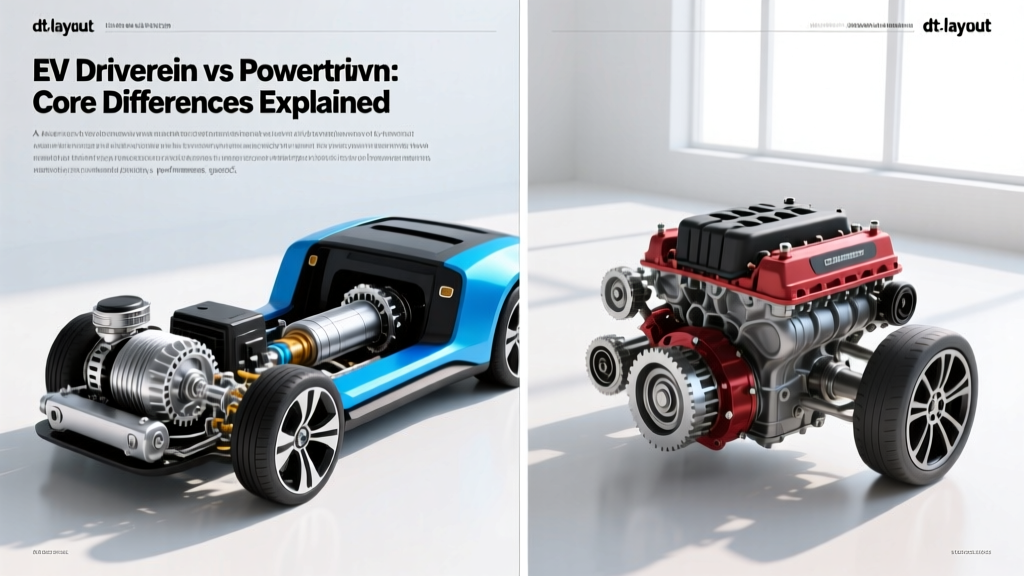
As we navigate the automotive landscape in 2026, the proliferation of Electric Vehicles (EVs) like the Tesla Model Y, Ford F-150 Lightning, and Rivian R1T has forced a re-evaluation of these terms. In an EV, the 'engine' is replaced by an electric motor and inverter, while the 'transmission' is often reduced to a single-speed reduction gear housed in a shared drive unit casing.
In modern EV architecture, the powertrain encompasses the high-voltage battery, the inverter, the stator/rotor assembly, and the reduction gear. The drivetrain system begins at the output flange of the reduction gear, consisting of the half-shafts, CV joints, and the mechanical disconnect units (like the eAxle disconnects found in the GMC Hummer EV) that allow the vehicle to coast freely to save energy. Maintaining the drivetrain system in an EV is actually more critical than in ICE vehicles, as the instantaneous, massive torque output of electric motors places extreme shearing forces on CV joints and half-shaft splines.
Hands-On Maintenance: Fluids and Torque Specifications
Because the drivetrain system operates outside the engine bay, it is often neglected during routine oil changes. Proper maintenance requires specific fluids and adherence to precise torque specifications to prevent catastrophic mechanical failure. According to Spicer Parts Technical Notes, improper U-joint installation is a leading cause of driveshaft separation.
Critical Drivetrain System Torque Specifications
When servicing your drivetrain, always use a calibrated torque wrench. Guesswork leads to sheared bolts or loose yokes.
- Spicer 1310/1350 U-Joint Strap Bolts: 15 to 20 lb-ft. (Warning: Over-torquing these will distort the U-joint caps, binding the needle bearings and causing immediate failure.)
- Ford 8.8 Rear Differential Cover Bolts: 28 to 38 lb-ft. (Use a star pattern to ensure even gasket sealing.)
- Dana 44 Ring Gear Bolts: 70 to 85 lb-ft. (Must be paired with Red Loctite 271 to prevent backing out under high-torque loads.)
- Front CV Axle Spindle Nut (Typical FWD/AWD): 140 to 250 lb-ft. (Varies heavily by manufacturer; e.g., Subaru WRX front axle nuts require roughly 140 lb-ft, while heavy-duty trucks can exceed 250 lb-ft. Always use a new staked nut.)
Fluid Selection for the Drivetrain
While your powertrain relies on engine oil (e.g., 0W-20 or 5W-30) and specific ATF (like Dexron ULV or ZF Lifeguard 8), the drivetrain system requires high-pressure, extreme-temperature gear lubricants.
- Differentials: Use a high-quality 75W-90 or 75W-140 GL-5 synthetic gear oil (e.g., Amsoil Severe Gear or Mobil 1 Synthetic Gear Lube). If your differential features a clutch-type Limited Slip Differential (LSD), you must add the manufacturer-specific friction modifier additive to prevent chatter during low-speed cornering.
- Transfer Cases: Do not assume GL-5 gear oil goes in the transfer case. Many modern transfer cases (like the BW 4485 in GM trucks) require specific ATF (such as AutoTrak II or standard Dexron VI) to properly lubricate the internal chain and planetary gears without causing clutch pack degradation.
- Manual Transmission / Drivetrain Linkage: If your drivetrain includes a manual transfer case shifter or linkage, regular application of a molybdenum-based grease to the pivot points prevents the dreaded 'stuck in 4-Low' scenario.
Summary: Know Your Vehicle's Anatomy
The debate of drivetrain system vs powertrain ultimately comes down to generation versus delivery. The powertrain is the powerhouse, creating the torque and managing the gear ratios. The drivetrain system is the unsung hero, battling suspension geometry, road debris, and extreme torque loads to ensure that power actually reaches the asphalt. By understanding where the transmission output shaft ends and the slip yoke begins, you can make informed decisions about extended warranties, accurately diagnose NVH issues, and apply the correct torque specs and fluids to keep your vehicle on the road for decades to come.