The Anatomy of a 'Drivetrain Malfunction' Warning
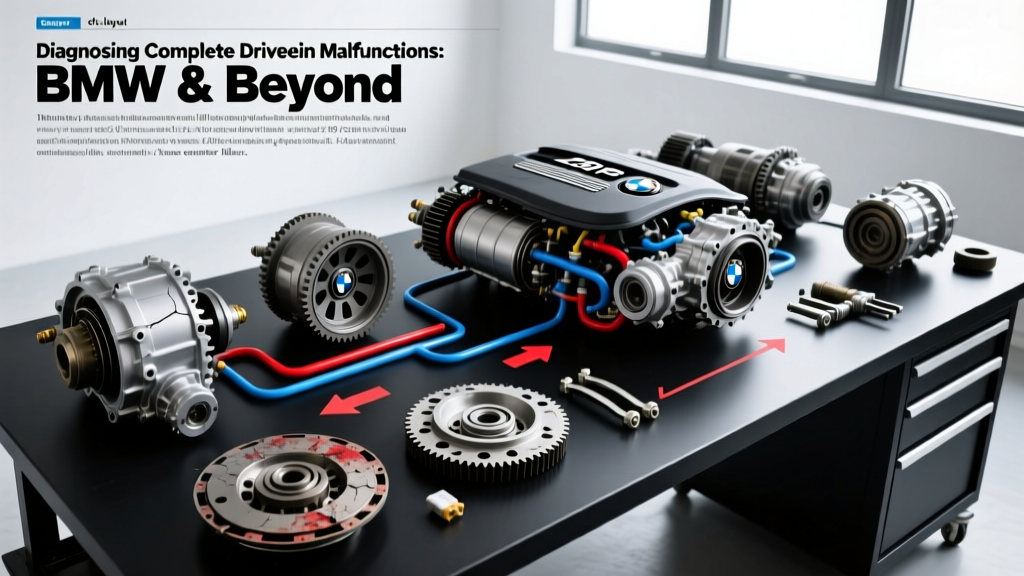
For automotive enthusiasts and professional tuners, the dreaded 'Drivetrain Malfunction' (DTM) warning on the iDrive or instrument cluster is an all-too-familiar roadblock. While often perceived as a vague catch-all error, this warning is actually a highly specific limp-mode protocol triggered when the Engine Control Unit (ECU) and Transmission Control Unit (TCU) detect a parameter deviation outside the factory calibrated safety margins. When you begin modifying a vehicle, you are no longer just tuning an engine; you are altering the behavior of the complete drivetrain.
As of 2026, modern performance platforms—particularly BMW’s G-series (B58/S58) and F-series (N55/S55) mated to the ubiquitous ZF 8HP automatic transmissions—rely on complex torque-request models. If the actual wheel torque or transmission slip RPM deviates from the TCU’s expected map, the system defaults to a reduced-torque state to protect the hardware. Diagnosing these faults requires moving beyond generic OBD2 engine scanners and diving deep into TCU-specific telemetry, mechanical wear patterns, and fluid dynamics.
BMW ZF 8HP & xDrive: Diagnosing the Usual Suspects
The ZF 8HP (spanning the 8HP45, 8HP50, 8HP70, and 8HP75 variants) is widely regarded as one of the greatest performance automatic transmissions ever engineered. However, when pushed beyond 500-600 wheel-horsepower, or when subjected to aggressive launch control on high-grip surfaces, specific mechanical and electronic weak points emerge.
The Mechatronic Adapter Sleeve Leak
One of the most common non-performance-related triggers for a DTM code is a leaking mechatronic adapter sleeve. The sealing sleeve (BMW Part # 28117571899 / ZF Part # 0501 216 243) houses the electrical pass-through pins connecting the chassis wiring harness to the TCU inside the transmission pan. Over time, the plastic and rubber composite hardens, allowing ZF LifeguardFluid 8 to wick up into the TCU connector pins. This causes intermittent CAN-bus communication faults, often throwing codes like 480A08 (Gear ratio monitoring) or 48111B (Clutch monitoring).
The Fix: Replace the sleeve (part cost: ~$45-$75). This requires dropping the integrated plastic transmission pan (which houses the filter), cleaning the TCU pins with electrical contact cleaner, and reinstalling with a new pan and fluid. Total fluid capacity for a service fill is typically 5.5 to 6.5 liters, requiring a precise temperature-dependent leveling procedure at 30°C - 50°C.
xDrive Transfer Case (ATC) Binding
On xDrive models, the transfer case (such as the ATC35L or ATC45L) uses an internal electric actuator motor to engage a clutch pack that sends torque to the front axle. A notorious failure point is the internal plastic actuator gear stripping. When this happens, the transfer case cannot properly modulate front/rear torque split. The TCU detects a speed mismatch between the front and rear driveshafts, assumes massive clutch slip, and triggers a complete drivetrain malfunction warning.
Performance Context: Even with a healthy actuator, xDrive systems are hyper-sensitive to tire circumference. BMW officially mandates that the rolling circumference difference between the front and rear axles must not exceed 1.5%. If you install an aggressive square or staggered aftermarket wheel/tire setup without verifying the exact rollout measurements via a tire revs-per-mile calculator, the xDrive clutch pack will constantly micro-slip, overheating the transfer case fluid and triggering a DTM limp mode.
Common DTM Codes and Performance Solutions
| TCU Fault Code | Description | Root Cause in Tuned Vehicles | Performance Upgrade / Fix |
|---|---|---|---|
| 480A08 | Gear Ratio Monitoring | Clutch pack slip during high-boost WOT shifts. | Upgrade to ZF 8HP70+ clutches or install a Pure Drivetrain Solutions Stage 2 valve body. |
| 4823E4 | Transfer Case Internal Fault | Stripped actuator gear or mismatched tire rollout. | Install an aluminum ATC actuator gear upgrade and perform xDrive calibration via ISTA+. |
| 48111B | Clutch Monitoring (Slip) | Exceeding the torque capacity of the A or E clutch. | TCU torque limit removal (via MHD/BM3) and upgraded friction plates. |
| 480652 | Turbine Speed Sensor | Mechatronic sleeve fluid contamination. | Replace ZF mechatronic sleeve (0501 216 243) and flush TCU connector. |
Beyond BMW: Ford 10R80 and GM 10L90 Drivetrain Faults
While BMW dominates the European tuning scene, domestic platforms have their own unique complete drivetrain malfunction signatures when pushed to the limit.
Ford 10R80 (Mustang GT / F-150)
The 10R80 is notorious for CDF (Clutch D and F) drum snap-ring failures when subjected to high-torque drag radials and aggressive roll-racing transbrake tuning. When the snap ring blows, the transmission loses 4th, 6th, 8th, and 10th gears. The PCM detects the sudden loss of gear ratio and triggers a 'Drivetrain Malfunction' or wrench light. Upgrading to a billet CDF drum and upgraded snap rings is mandatory for any 10R80 pushing over 600 lb-ft of torque at the wheels.
GM 10L90 (Camaro ZL1 / Corvette C8)
The GM 10L90 often suffers from torque converter shudder and solenoid body wear. In high-performance applications, the factory GM ACDelco Dexron ULV fluid can shear under extreme thermal loads. Tuners utilizing HP Tuners must adjust the TCC (Torque Converter Clutch) apply rates and line pressure tables to prevent the converter from slipping during 1-2 and 2-3 shifts, which the TCU interprets as a catastrophic drivetrain failure.
Step-by-Step Diagnostic Protocol for Tuned Platforms
When a customer rolls into the shop with a DTM code, guessing is not an option. Follow this strict diagnostic hierarchy:
- Read TCU-Specific Codes: Generic OBD2 scanners will only show 'P0700 - Transmission Control System Malfunction'. You must use manufacturer-level software (like BMW ISTA+, Ford FORScan, or GM GDS2) or advanced enthusiast tools to read the actual hex codes from the TCU.
- Verify Tire Rollout: Measure the physical circumference of all four tires. If the variance is >1.5% on an AWD/xDrive vehicle, no amount of software tuning will fix the drivetrain malfunction.
- Log Transmission Slip RPM: Using a logging tool, monitor the 'Turbine Speed' vs. 'Output Shaft Speed' during WOT pulls. If slip RPM exceeds 150-200 RPM during a shift, your clutch packs are failing mechanically, or your TCU line pressure is inadequate.
- Check Fluid Condition: Drop the pan. If you find metallic glitter on the magnets, the transmission requires a tear-down. If the fluid smells burnt and is dark brown, the friction materials have glazed or delaminated.
Expert Tuner Insight: 'Many enthusiasts immediately blame the transmission when a DTM code pops up on a Stage 2+ BMW. However, I cannot stress enough how often a simple misfire under load (due to bad spark plugs or an inadequate ignition coil) causes a sudden drop in crankshaft speed. The TCU reads this sudden RPM drop as transmission slip, triggering a drivetrain malfunction. Always log ignition timing corrections and misfire counters before tearing into the ZF 8HP.' — Lead Calibrator at a premier Euro-tuning shop.
Cost Breakdown: OEM Replacement vs. Performance Built Drivetrains
When the mechanical limits of the factory hardware are breached, you face a critical decision. Here is a realistic look at the pricing landscape for ZF 8HP platforms in the current market.
| Service / Upgrade Path | Estimated Cost (Parts & Labor) | Torque Capacity (Wheel) | Best Application |
|---|---|---|---|
| OEM ZF 8HP Remanufactured | $3,800 - $5,200 | ~450 - 550 lb-ft | Stock or Stage 1 daily drivers. |
| Stage 1 Valve Body & Clutch Upgrade | $2,500 - $3,500 | ~650 - 750 lb-ft | E85 flex-fuel tunes, FBO single turbo. |
| Full Built ZF 8HP (e.g., Pure Drivetrain) | $5,500 - $8,500+ | 850 - 1,000+ lb-ft | Big turbo builds, drag racing, roll racing. |
| xDrive Transfer Case Rebuild | $1,200 - $1,800 | N/A (Traction limited) | AWD launches, fixing stripped actuator gears. |
Critical Torque Specs and Assembly Notes
If you are servicing the complete drivetrain in your own garage, adhering to factory torque specifications is non-negotiable. Improper torque on driveline fasteners leads to catastrophic harmonic vibrations or severed components under load.
- Driveshaft to Transmission Flex Disc (Guibo) - M12 Bolts: 100 Nm (74 lb-ft) + 90 degrees of rotation. (Always replace TTY bolts).
- Driveshaft Center Support Bearing - M8 Bolts: 21 Nm (15 lb-ft).
- ZF 8HP Mechatronic Unit to Case - M6 Bolts: 8 Nm (71 lb-in). Warning: Overtightening these will crack the mechatronic plastic housing, ruining a $2,500+ unit.
- ZF 8HP Oil Pan to Case - M6 Bolts: 10 Nm (89 lb-in), following the exact ZF spiral tightening sequence.
- xDrive Transfer Case Fill/Drain Plugs: 30 Nm (22 lb-ft).
Final Thoughts on Drivetrain Reliability
Achieving true reliability in a modified vehicle requires a holistic approach. You cannot simply bolt on a larger turbocharger and expect the factory hardware to compensate indefinitely. By understanding the intricate relationship between the ECU, TCU, and the mechanical realities of the ZF 8HP or domestic 10-speed automatics, you can preemptively diagnose and resolve complete drivetrain malfunctions. For further technical documentation on transmission calibrations and aftermarket valve body specifications, refer to resources provided by the ZF Group aftermarket division or engage with specialized calibration communities on Bimmerpost. Treat your drivetrain as a complete, integrated ecosystem, and it will reward you with uninterrupted, record-setting performance.