The Anatomy of Motorcycle Transmission Oil Level Checks
In the evolving landscape of 2026 motorcycle engineering, diagnosing drivetrain issues often begins with a single, misunderstood component: the dipstick. Unlike passenger vehicles where the transmission is a sealed, remote unit, motorcycle architectures vary wildly. While most modern Japanese inline-fours and European parallel-twins utilize a shared sump (where engine and transmission share the same oil bath checked via a crankcase sight glass), heavy cruisers and touring motorcycles—most notably Harley-Davidson Big Twins—feature a dedicated, separate transmission case with its own specific motorcycle transmission oil dipstick.
Misinterpreting this dipstick reading is one of the most common catalysts for catastrophic shifting failures, clutch drag, and blown transmission seals. When a rider experiences clunky gear engagements or false neutrals, the immediate instinct is often to add more fluid. However, as we will explore, a 'low' reading on a motorcycle transmission dipstick is frequently a phantom symptom caused by thermal dynamics, bike posture, or aeration rather than an actual fluid deficit.
Why Your Motorcycle Transmission Oil Dipstick Reading is Lying to You
Diagnosing transmission fluid levels requires an understanding of fluid dynamics inside a compact, high-vibration casing. If your dipstick reading does not align with the physical symptoms of the motorcycle, consider the following troubleshooting scenarios.
Scenario 1: The 'Phantom Low' Reading (Thermal Expansion & Posture)
The most frequent diagnostic error occurs when checking the transmission oil cold or while the motorcycle is resting on its side stand. A motorcycle leaning at a mere 3-to-5-degree angle on a kickstand can trap 150ml to 250ml of heavy gear oil in the upper recesses of the transmission casing, away from the dipstick tube. Furthermore, dedicated motorcycle transmission fluids (like 75W-90 or 85W-140 synthetic gear oils) possess high coefficients of thermal expansion. A reading taken at ambient 60°F (15°C) will show significantly lower on the dipstick than one taken at the manufacturer-specified operating temperature of 180°F to 200°F (82°C to 93°C). Never trust a cold, leaned-over dipstick reading.
Scenario 2: Aeration, Windage, and the 'Frothy High'
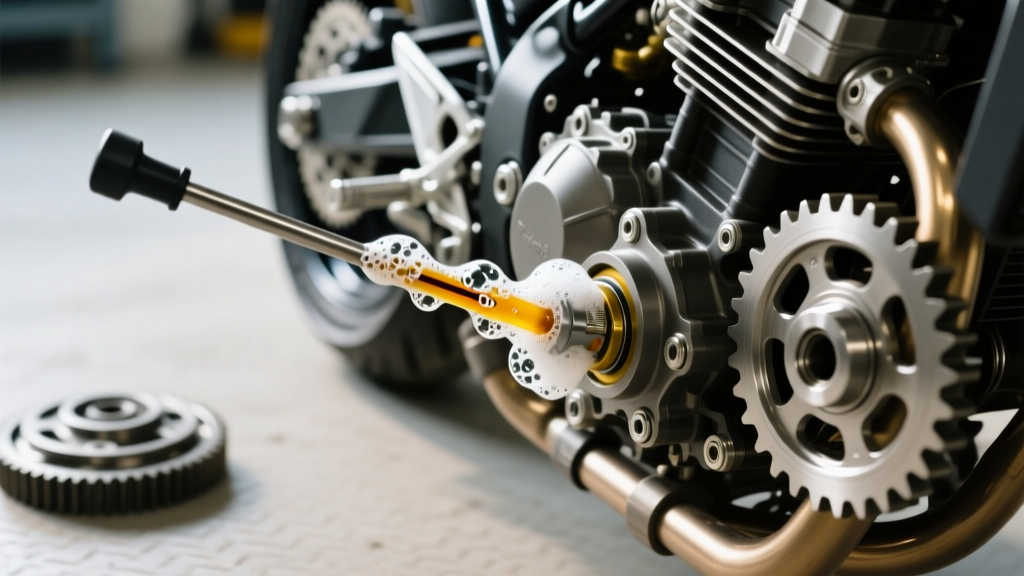
Conversely, an overfilled transmission will read 'full' or even 'overfull' on the dipstick, but the fluid will appear as a thick, bubbly froth. When the fluid level exceeds the safe operating threshold, the rotating transmission mainshaft and counterbalance gears whip the oil into an aerated foam. This aeration is disastrous because air bubbles cannot transmit hydraulic pressure or lubricate gear dogs effectively. The dipstick reads high, but the actual liquid volume protecting the shift forks is critically compromised, leading to missed shifts and accelerated gear wear.
Scenario 3: Contaminant Diagnosis on the Dipstick Rod
The dipstick itself is a vital forensic tool. Wipe the rod with a white lint-free shop towel and analyze the residue under a bright LED light:
- Milky or Emulsified Residue: Indicates water ingestion. This usually occurs when the transmission breather hose is submerged during deep water crossings, or when high-pressure water is directed at the breather valve during washing. Water destroys the extreme pressure (EP) additives in GL-4/GL-5 gear oils.
- Brass/Golden Flakes: While a tiny amount of 'glitter' is normal break-in material, distinct brass flakes point to clutch basket wear (on shared-sump bikes) or specific bronze thrust washer degradation inside the transmission.
- Steel Splinters or Dark Sludge: Indicates severe gear dog rounding, shift fork galling, or bearing cage failure. Immediate teardown is required.
Step-by-Step Diagnostic Protocol for Accurate Readings
To eliminate variables and achieve a true baseline reading for your motorcycle transmission oil dipstick, follow this exact diagnostic protocol:
- Level the Chassis: Place the motorcycle on a center stand, a hydraulic lift, or a rear paddock stand. The bike must be perfectly vertical (0-degree lean).
- Thermal Cycling: Ride the motorcycle for at least 15–20 minutes to bring the transmission oil up to full operating temperature (approx. 180°F+). This ensures all fluid has drained from the upper galleries and thermal expansion is accounted for.
- Extract and Clean: With the bike upright and the engine off for exactly 60 seconds (allowing splash-down), remove the transmission dipstick/filler cap. Wipe it completely clean with a lint-free cloth.
- The 'Resting' Insertion: Reinsert the dipstick into the filler hole without threading it in. Let it rest on the threads or the sealing lip. Pull it out and read the level. Threading the cap down can push the dipstick deeper than the factory calibration mark, resulting in a false high reading.
Expert Torque Warning: When reinstalling the transmission dipstick/filler cap on Harley-Davidson Milwaukee-Eight or Twin Cam models, the torque specification is typically 84 to 108 in-lbs (inch-pounds), NOT foot-pounds. Applying 80 ft-lbs will instantly crack the aluminum transmission end-cover, resulting in a $400+ case replacement and total fluid loss.
Fluid Specifications & Capacity Reference Table
Referencing the correct capacity and fluid type is critical for accurate dipstick interpretation. Using a shared-sump JASO MA2 motor oil in a dedicated transmission requiring API GL-4 gear oil will lead to rapid gear dog degradation.
| Motorcycle Architecture | Transmission Type | Fluid Spec / Viscosity | Capacity | Filler Cap Torque Spec |
|---|---|---|---|---|
| Harley-Davidson Softail (M8) | Separate (Dedicated) | API GL-4 / 75W-90 Synthetic | 32 oz (0.95 L) | 84-108 in-lbs |
| Indian Challenger (PowerPlus) | Separate (Dedicated) | API GL-4 / 75W-110 | 32 oz (0.95 L) | 14-18 ft-lbs |
| Honda Gold Wing GL1800 | Shared (Engine/Trans) | JASO MA2 / 10W-40 | 4.4 L (Total System) | 12 Nm (Final Drive: 22 Nm) |
| BMW R1250GS (ShiftCam) | Shared / Shaft Final | JASO MA2 (Engine) / SAE 75W-90 (Final) | 4.0 L (Engine) / 200ml (Final) | 10 Nm (Final Drive Plug) |
Troubleshooting Shifting Symptoms Linked to Fluid Levels
Use this diagnostic matrix to correlate your motorcycle transmission oil dipstick reading with the physical behavior of the gearbox.
- Symptom: Clunky engagement into 1st gear from a stop; difficulty finding neutral.
Dipstick Reading: Low (Below the 'Add' mark).
Root Cause: Fluid starvation at the shift drum and hydraulic clutch actuator (if internal).
Fix: Top off with the exact OEM-specified gear oil. Do not mix viscosities. - Symptom: Harsh downshifts, gear whine, and fluid weeping from the transmission breather hose.
Dipstick Reading: High (Above 'Full' mark) or Frothy.
Root Cause: Overfilling causes gear windage, pushing pressurized foam out the breather.
Fix: Use a fluid extraction syringe to pull out 2-4 oz of fluid until the level rests exactly at the 'Full' mark on a hot, upright bike. - Symptom: Slipping clutch or rear tire spin-up under hard acceleration.
Dipstick Reading: Normal (but fluid smells burnt).
Root Cause: In shared-sump bikes, severe overheating breaks down the friction modifiers in JASO MA2 oil, ruining the wet clutch friction plates.
Fix: Complete drain and fill; inspect clutch basket for grooving.
Authoritative Sources & Further Reading
For deeper dives into motorcycle drivetrain maintenance and fluid chemistry, consult these industry-standard resources:
1. RevZilla Common Tread: How to Check Your Motorcycle Oil - Comprehensive guide on sight glass vs. dipstick reading protocols and thermal expansion variables.
2. Cycle World: How to Change Motorcycle Oil - Detailed breakdowns of shared-sump versus dedicated transmission architectures and torque specifications.
Mastering the nuances of your motorcycle transmission oil dipstick reading separates casual riders from true mechanical diagnosticians. By controlling for temperature, chassis posture, and aeration, you ensure your gearbox receives the precise hydrodynamic protection required for thousands of miles of seamless shifting.