Diagnosing Chevy Towing Overheat Symptoms
When you hook up a 7,000-pound travel trailer to your Silverado or Sierra, the last thing you want to see on your dash is the dreaded "Trans Over Temp" warning. General Motors' modern automatic transmissions—specifically the 6L80, 8L90, and the ubiquitous 10-speed 10L80—are engineering marvels, but they generate immense parasitic heat under high Gross Combined Weight Rating (GCWR) loads. If you are experiencing limp mode, torque converter clutch (TCC) slip codes like P0741, or a distinct burnt smell from your dipstick tube, your factory cooling system is failing to manage the thermal load.
Before throwing parts at the truck, proper symptom diagnosis is critical. Grab an infrared thermometer and measure the transmission cooler feed and return lines at the radiator. Under normal highway driving, you should see a temperature delta (drop) of at least 20°F to 30°F across the cooling circuit. If your feed line reads 210°F and your return line reads 205°F, your OEM heat exchanger is completely saturated or bypassed.
The Thermal Bypass Valve and TMM Failures
On 6L80 and 6L90 applications, GM installed a thermal bypass valve designed to restrict cooler flow during cold starts to help the transmission reach operating temperature faster. Unfortunately, these valves are notorious for sticking in the closed or partially closed position, starving the cooler of fluid when you need it most. On newer 10L80 and 10L90 platforms, this mechanical valve has been replaced by an electronic Thermal Management Module (TMM). If your scan tool shows a massive discrepancy between commanded TMM position and actual fluid temps while towing up a grade, the OEM routing is your bottleneck.
Expert Insight: Never delete the thermal bypass valve without installing a proper inline thermostat or auxiliary cooler with an integrated bypass. Running raw, unheated fluid to the transmission in sub-40°F weather causes severe torque converter shudder and delayed shift times due to high fluid viscosity.
Why the OEM Chevy Transmission Cooler Fails Under Load
Most half-ton and three-quarter-ton Chevy trucks route the transmission fluid to a small plate-and-fin cooler integrated into the bottom tank of the engine radiator. While this is cost-effective for the manufacturer and adequate for commuting, it creates a thermal ceiling. When towing heavy loads in ambient temperatures above 85°F, the engine coolant itself can exceed 215°F. You are essentially trying to cool your 230°F transmission fluid with 215°F engine coolant. The heat transfer rate drops to near zero, and the fluid rapidly degrades, losing its friction modifiers and sheer stability.
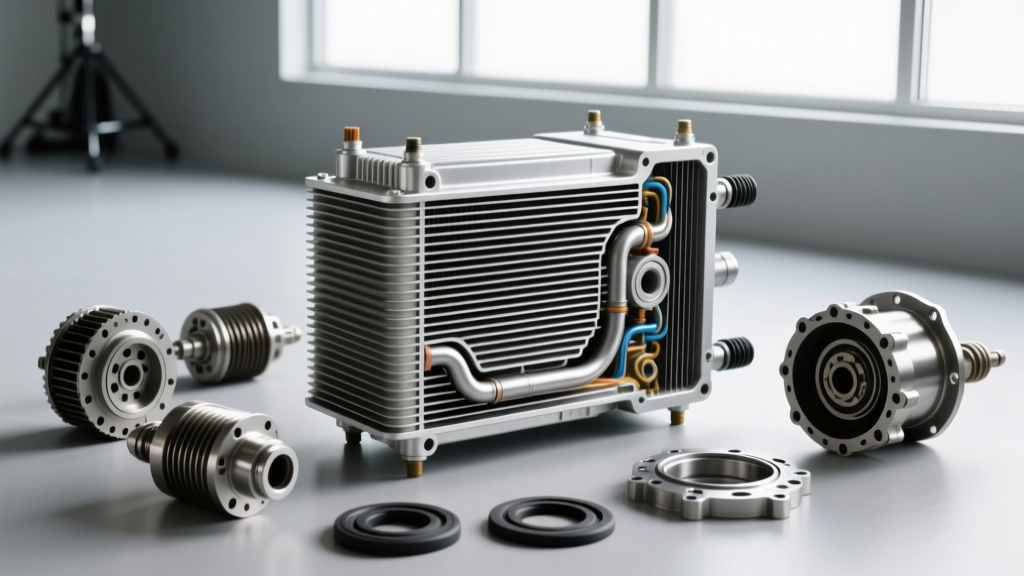
To protect your drivetrain, upgrading to an auxiliary stacked-plate Chevy transmission cooler is mandatory for anyone regularly towing near their max payload. Stacked-plate designs offer up to 30% more surface area and superior turbulent flow characteristics compared to outdated tube-and-fin designs, ensuring maximum heat rejection without restricting line pressure.
Sizing and Selecting the Best Chevy Transmission Cooler for Towing
Choosing the right cooler depends on your truck's GVWR and your typical towing environment. Below is a comparison of the top-tier stacked-plate coolers that dominate the 2026 heavy-duty towing market.
| Brand & Model | Type | GVWR Rating | Core Dimensions | Est. Price (2026) |
|---|---|---|---|---|
| Derale 15850 (Hyper-Cool) | Stacked-Plate | Up to 40,000 lbs | 13" x 9.5" x 2" | $160 - $190 |
| Mishimoto MMTC-F2D | Stacked-Plate | Up to 30,000 lbs | 12.6" x 9.4" x 1.5" | $185 - $220 |
| Hayden 678 (Swift-Cool) | Plate-and-Fin | Up to 24,000 lbs | 11" x 9.5" x 1.25" | $75 - $95 |
For Silverado 2500HD and 3500HD owners pulling fifth wheels or heavy equipment trailers, the Derale 15850 is the undisputed heavyweight champion. Its 19-row stacked-plate core provides massive thermal capacity. For half-ton 1500 owners where grille clearance is tighter, the Mishimoto MMTC series offers an excellent balance of flow rate and compact packaging.
Step-by-Step Troubleshooting & Auxiliary Cooler Installation
Installing an auxiliary cooler requires precision to avoid introducing air into the hydraulic circuit or crushing the soft aluminum fittings on your transmission case.
Line Pressure Testing and Flushing
Before cutting into your lines, verify your base line pressure. A healthy 6L80 should produce 50-75 PSI at idle in Drive, spiking to 150+ PSI under heavy throttle. If pressure is low, adding a restrictive cooler will exacerbate TCC slip. Once verified, flush the OEM cooler lines using a dedicated pneumatic flush tool and a solvent-based flush fluid to remove any clutch material or varnish left behind by previous overheating events.
Routing, Fittings, and Torque Specifications
The golden rule of auxiliary cooler routing is: Transmission -> Radiator -> Auxiliary Cooler -> Transmission Return. The radiator acts as a pre-cooler (and a fluid warmer in winter), while the auxiliary cooler gets the final say on the fluid temperature before it re-enters the transmission pan.
- Fittings: GM uses specific quick-connect fittings on the radiator and transmission case. You will need a quick-connect to 3/8" barb or AN-6 adapter (e.g., Derale 13035 or equivalent GM part #15118448).
- Torque Specs: When threading adapter fittings into the transmission case or radiator tank, the torque specification is strictly 15 to 18 lb-ft. Overtightening will crack the aluminum casting or distort the radiator end-tank, leading to catastrophic fluid leaks.
- Hose Clamps: Use high-pressure fuel injection style clamps (not standard worm-gear clamps) on the 3/8" transmission cooler hose. Transmission line pressure can spike over 200 PSI during hard 1-2 shifts while towing.
Post-Install Verification and Fluid Requirements
After installing your new Chevy transmission cooler, you must refill the system with the correct fluid. Mixing fluids will destroy the clutch packs. For 6L80 and 8L90 transmissions, use only Dexron VI. For the 10L80 and 10L90, you must use Dexron ULV (Ultra Low Viscosity). The 10-speed relies on this specific fluid to navigate its complex hydraulic labyrinth; using Dexron VI in a 10L80 will cause immediate shift flare and overheating.
Fill the transmission to the correct level on the dipstick or via the overflow plug (on 10-speed models, the fluid must be between 180°F and 200°F when checking the level plug). Take the truck for a 20-mile test drive without the trailer, then hook up your load and monitor the temperatures via an OBD2 scanner. With a properly sized stacked-plate cooler and correct routing, your transmission temperatures should stabilize between 175°F and 195°F, even on 6% grades in the middle of summer. By addressing the root thermal bottlenecks and upgrading your hardware, you ensure your Chevy drivetrain survives the brutal demands of modern towing.