The Peterbilt 379 Cooling Challenge in 2026
Even in 2026, the Peterbilt 379 remains an undisputed icon of the American highway. While production of this legendary Class 8 heavy-duty truck ended years ago, owner-operators and specialized heavy-haul fleets continue to maintain, restore, and repower them. When repowering a 379 or upgrading its drivetrain for modern heavy-haul demands, thermal management becomes a critical focal point. The Peterbilt 379 transmission cooler setup must be meticulously matched to the transmission's flow requirements, the truck's Gross Combined Weight Rating (GCWR), and the specific operating environment.
A failing or undersized transmission cooler will rapidly degrade automatic transmission fluid (ATF), leading to clutch pack glazing, torque converter shudder, and ultimately, catastrophic transmission failure. This model-specific repair and selection guide provides the exact engineering data, part selection frameworks, and torque specifications required to service or upgrade the transmission cooling system on a Peterbilt 379.
Identifying Your 379 Drivetrain and Cooling Requirements
Before selecting a cooler, it is vital to identify the exact transmission model housed in your 379, as cooling requirements vary drastically across Class 8 drivetrains.
Eaton Fuller Manual vs. Automated Transmissions
If your Peterbilt 379 is equipped with a traditional manual transmission, such as the ubiquitous Eaton Fuller RTLO-18918B, it relies on splash lubrication and does not utilize an external ATF cooler. However, if the truck has been retrofitted or originally spec'd with an Eaton UltraShift PLUS automated manual transmission (AMT), the system utilizes a hydraulic clutch actuation and cooling circuit that requires dedicated thermal management, often integrated with the engine oil cooling loop or a standalone hydraulic cooler.
Allison Heavy-Duty Automatics (4000 Series)
Many vocational and heavy-haul 379s are spec'd with Allison automatic transmissions, most notably the Allison 4500 RDS or the older HD 4060. These transmissions generate immense heat, particularly during torque converter multiplication on steep grades. According to Allison Transmission Support, the 4000 series requires a continuous cooler flow rate of 15 to 25 Gallons Per Minute (GPM) with a maximum allowable pressure drop of 15 to 20 PSI across the cooler circuit. Undersizing the cooler for an Allison 4500 RDS will trigger the transmission's thermal protection limp mode at approximately 270°F (132°C).
Transmission Cooler Types for Class 8 Applications
When sourcing a replacement or auxiliary cooler for a Peterbilt 379, you will encounter three primary heat exchanger architectures. For heavy-duty applications, selecting the correct core type is non-negotiable.
| Cooler Type | Thermal Efficiency | Flow Restriction | Class 8 Suitability | Estimated Cost (2026) |
|---|---|---|---|---|
| Tube-and-Fin | Low (40-50%) | High | Poor. Prone to clogging and inadequate for high-GCWR hauling. | $150 - $300 |
| Plate-and-Fin | Medium (60-70%) | Medium | Fair. Acceptable for light vocational, but struggles in heavy-haul. | $300 - $550 |
| Stacked-Plate (Brazed) | High (85-95%) | Low | Excellent. The mandatory choice for Allison 4000 series and heavy-haul. | $650 - $1,400+ |
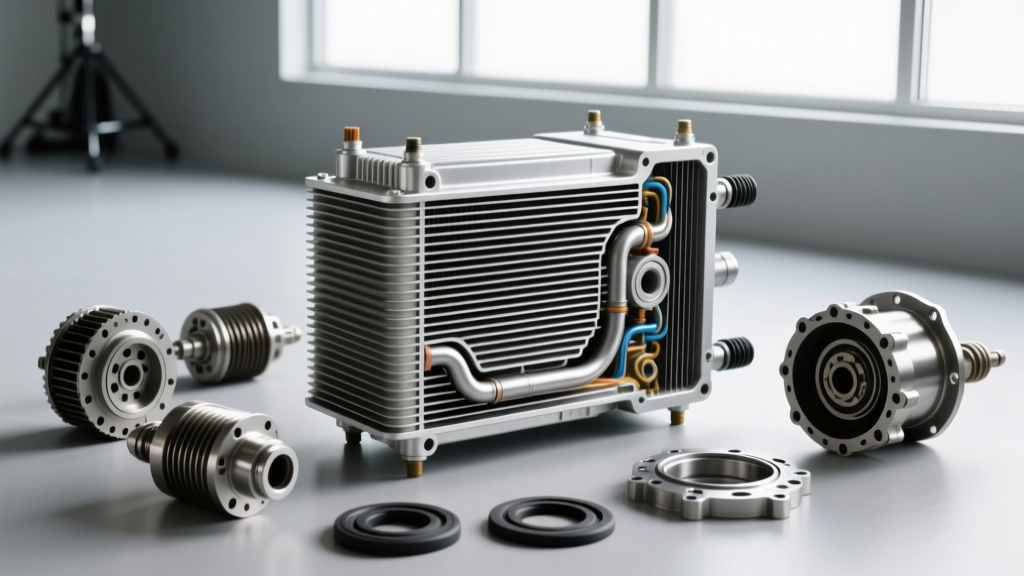
Expert Recommendation: For any Peterbilt 379 pulling over 80,000 lbs GCWR, exclusively use Copper-Brass or Aluminum Brazed Stacked-Plate coolers from heavy-duty manufacturers like Modine Manufacturing or Long Manufacturing (LNG). Stacked-plate designs force the ATF through a series of turbulated plates, maximizing surface area contact while maintaining the high flow rates required by Allison and Eaton hydraulic systems.
Sizing and Selection Framework
Selecting the correct physical size and BTU rejection rating requires analyzing the truck's operational profile. The Peterbilt 379's expansive front fascia and set-back axle configuration allow for significant airflow, but the cooler must be positioned to avoid dead zones behind the bumper or chassis crossmembers.
- GCWR up to 80,000 lbs (Highway): A standard heavy-duty stacked-plate cooler with a core size of approximately 18' x 24' x 3' is typically sufficient for an Allison 4500 RDS.
- GCWR 80,000 - 120,000 lbs (Heavy Haul/Lowboy): Requires an oversized core (e.g., 24' x 30' x 4') or a dual-cooler setup routed in parallel to maintain the 15+ GPM flow rate without exceeding the 20 PSI pressure drop threshold.
- Airflow Considerations: If the 379 is equipped with a high-horsepower Cummins ISX15 or Caterpillar C15 requiring a massive radiator, the transmission cooler must be mounted in a dedicated airstream, often utilizing a remote hydraulic fan driven by a dedicated PTO or electric pump setup if chassis space is restricted.
Installation, Line Routing, and Torque Specifications
The most common point of failure in a Peterbilt 379 transmission cooler repair is improper line routing and incorrect fitting torque. Class 8 trucks utilize high-pressure hydraulic lines that vibrate intensely under load.
JIC 37-Degree Flared Fittings
Modern heavy-duty transmission cooler lines utilize SAE J514 JIC 37-degree flared fittings. Never use NPT (pipe thread) fittings on high-flow transmission circuits, as they restrict flow and are prone to cracking under vibration. Most Allison 4000 series applications on a 379 use -16 AN/JIC (1-inch OD tube) or -20 AN/JIC (1-1/4-inch OD tube) steel or stainless steel braided lines.
SAE J514 Torque Specifications
Over-torquing JIC fittings will gall the threads and crush the flare, causing immediate leaks. Under-torquing will result in weeping under high thermal expansion. Use a calibrated torque wrench and adhere to the following specifications for steel JIC fittings:
- -12 JIC (3/4' Tube): 65 - 80 lb-ft
- -16 JIC (1' Tube): 130 - 150 lb-ft
- -20 JIC (1-1/4' Tube): 185 - 215 lb-ft
- -24 JIC (1-1/2' Tube): 260 - 300 lb-ft
Pro-Tip: Always apply a light coating of anti-seize or clean ATF to the male threads before torquing to prevent galling on stainless steel lines. For exact chassis-specific routing diagrams, consult Peterbilt Parts & Service archives for your specific VIN.
The Critical Role of the Thermal Bypass Valve
When replacing the transmission cooler on a 379, technicians often overlook the thermal bypass valve. This valve, usually located at the transmission output or integrated into the cooler head, routes cold, highly viscous ATF back to the transmission sump during cold starts, preventing cooler core blowout and starvation of the transmission clutches.
If your 379 operates in cold climates, ensure your replacement cooler assembly includes a wax-element thermostatic bypass calibrated to open at 160°F to 180°F. If the bypass is stuck open, the transmission will never reach optimal operating temperature, leading to sluggish shift times and increased fuel consumption. If stuck closed, cold fluid will be forced through the stacked plates, potentially rupturing the brazed joints due to extreme cold-flow pressure spikes exceeding 150 PSI.
Flushing and Fluid Selection
Before installing the new stacked-plate cooler, the existing chassis lines must be flushed. Stacked-plate coolers have narrow, turbulated internal passages that are easily clogged by metallic debris from a failing torque converter. Use a dedicated inline magnetic flush filter (10-micron rating) during the initial 500-mile break-in period.
For Allison-equipped 379s, ensure you are filling the system with the correct fluid. While older models utilized Dexron-III or TES 295, the 2026 standard for heavy-duty Allison vocational transmissions is Allison Approved TES 668 synthetic fluid, which offers superior shear stability and oxidation resistance at sustained temperatures of 220°F. The total system capacity for an Allison 4500 RDS with a large remote cooler and long chassis lines can exceed 32 quarts; always verify via the transmission dipstick or digital fluid level sensor (FLS) readout.
Summary
Upgrading or repairing the Peterbilt 379 transmission cooler requires moving beyond light-duty automotive practices. By selecting a high-flow brazed stacked-plate cooler, utilizing correctly torqued JIC 37-degree fittings, and verifying thermal bypass operation, you ensure that your Class 8 drivetrain survives the punishing demands of modern heavy-hauling. Proper thermal management is the single most effective way to extend the service life of your Allison or Eaton transmission well past the 500,000-mile mark.