The Anatomy of Failure: Reading the Automotive Clutch Diagram
The Tremec T56 6-speed manual transmission remains a hallmark of GM performance engineering, famously powering the C5 Corvette, 1997-2002 Camaro/Firebird, and early CTS-V models. However, as these vehicles age and are modified with aftermarket drivetrain components, throw-out bearing (TOB) noise and premature failure have become pervasive issues. When technicians and DIY enthusiasts attempt to diagnose these NVH (Noise, Vibration, and Harshness) complaints without referencing an accurate automotive clutch diagram, they frequently misdiagnose input shaft bearing failure or clutch fork binding. Understanding the precise mechanical leverage, hydraulic actuation, and stack-up tolerances mapped out in the factory diagram is the only way to accurately isolate throw-out bearing failure.
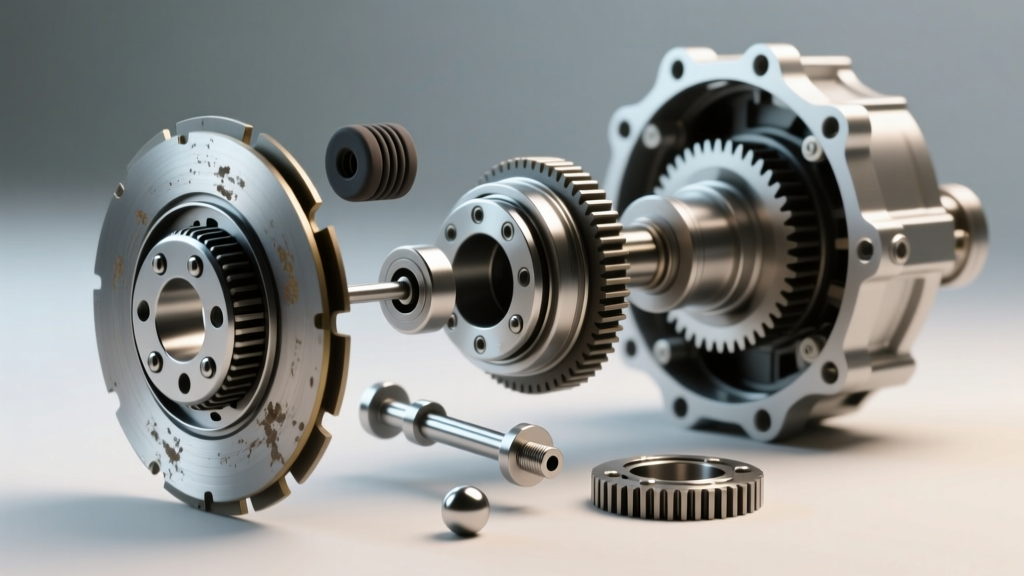
In the T56 architecture, the clutch release system relies on a hydraulic master-slave cylinder setup pushing a stamped steel fork on a spherical pivot ball. The throw-out bearing rides on the transmission input shaft retainer collar and is pressed against the diaphragm spring fingers of the pressure plate. If the geometry defined in the automotive clutch diagram is altered—often by installing an aftermarket clutch with a different stack-up height or thicker pressure plate fingers—the bearing is forced into a state of constant rotational preload, leading to catastrophic thermal failure.
Auditory Diagnostics: Identifying T56 Throw-Out Bearing Noise
Throw-out bearing noise is highly dependent on pedal position and engine load. To properly diagnose the T56 system, perform the 'Pedal Sweep Test' in a quiet environment with the transmission in neutral and the parking brake engaged.
- Idle Squeal (Pedal Released): If a high-pitched squealing or grinding noise is present with your foot completely off the pedal, the bearing is likely making constant contact with the pressure plate fingers due to incorrect clutch stack-up height or a missing return spring tension. According to Tremec's official service guidelines, the TOB should have a slight air gap (typically 0.050' to 0.100') when the clutch is fully engaged.
- Chirping on Light Pedal Pressure: A distinct 'chirp-chirp' sound that occurs exactly as you take the slack out of the pedal (the first 1/2 inch of travel) usually indicates a dry or worn pivot ball, or a binding fork pivot. The bearing itself may be fine, but the friction at the fulcrum point is causing the noise.
- Growling Under Heavy Pedal Load: If a low-frequency growl or rumble occurs when the pedal is fully depressed, the throw-out bearing's internal needle or ball bearings are starved of lubrication and suffering from spalling. This requires immediate transmission removal.
- Input Shaft Bearing Differentiation: Input shaft bearing noise will change in pitch directly with engine RPM regardless of pedal position, whereas TOB noise is strictly tied to the hydraulic actuation and physical pressure against the diaphragm spring.
Why T56 Throw-Out Bearings Fail Prematurely
Beyond normal wear and tear, specific model-year quirks and aftermarket modifications drive the high failure rate of T56 throw-out bearings. Data compiled via SAE International tribology studies on manual transmission release systems shows that misalignment and thermal degradation are the primary culprits.
Bellhousing Runout and Concentricity
The T56 is highly sensitive to bellhousing-to-crankshaft runout. If the engine block and bellhousing are not perfectly concentric, the input shaft rides at an angle. This forces the throw-out bearing to ride off-center on the pressure plate fingers, causing localized overheating and bearing cage failure. Maximum allowable Total Indicator Reading (TIR) for the T56 bellhousing bore is 0.005 inches. Anything exceeding this requires the installation of offset dowel pins.
Aftermarket Clutch Stack-Up Height
The factory GM clutch setup was engineered with a specific stack-up height to ensure the TOB retracts properly. When owners install aggressive aftermarket clutches (such as twin-disc setups or heavy-duty single discs from McLeod or Centerforce) without adjusting the pivot ball height or using the correct spacer, the bearing remains preloaded against the spinning fingers. This constant friction generates immense heat, melting the bearing's internal grease and seizing the cage.
Tremec T56 Clutch System Specifications & Torque Data
Adhering to exact specifications is critical during reassembly. The following table outlines the mandatory tolerances for the T56 release system, frequently referenced by master technicians on CorvetteForum's technical archives during C5 and F-Body restorations.
| Component / Parameter | Specification / Torque | OEM Part Number / Notes |
|---|---|---|
| Throw-Out Bearing | N/A (Replace if noisy) | Sachs 3151 275 001 / GM 12583596 |
| Pivot Ball Stud Torque | 20 lb-ft (27 Nm) | GM 14062481 (Inspect for >0.015' groove wear) |
| Bellhousing to Block Torque | 37 lb-ft (50 Nm) | Use OEM shoulder bolts |
| Bellhousing Bore Runout (Max) | 0.005' TIR | Correct with offset dowels (0.007', 0.014', 0.021') |
| Hydraulic Fluid | DOT 3 or DOT 4 | GM PN 88958860 or Castrol SRF |
Step-by-Step Model-Specific Repair Protocol
Replacing the throw-out bearing on a C5 Corvette or 4th-Gen F-Body requires dropping the rear differential (on the Corvette) or the exhaust and crossmember (on the Camaro) to remove the Tremec T56. Follow this rigorous protocol to ensure the new bearing does not fail prematurely.
1. Removal and Forensic Inspection
Once the transmission is on the bench, slide the worn throw-out bearing off the input shaft retainer. Inspect the retainer collar for scoring. If the collar is grooved, the new bearing will bind; the retainer must be replaced or carefully polished with 600-grit emery cloth. Next, unbolt the clutch fork pivot ball. Measure the spherical surface with a micrometer. If there is a wear groove deeper than 0.015 inches, the pivot ball must be replaced. A worn pivot ball alters the leverage ratio, causing the new TOB to bind against the pressure plate at an improper angle.
2. Bellhousing Alignment Verification
Before reinstalling the transmission, mount a dial indicator to the engine block or crankshaft flange and measure the inside bore of the bellhousing. Rotate the crankshaft 360 degrees. If the runout exceeds 0.005 inches, install aftermarket offset dowel pins to re-center the bellhousing. Skipping this step is the number one reason why rebuilt T56 transmissions experience recurring throw-out bearing noise within 10,000 miles.
3. Clutch Stack-Up and Fork Preload Adjustment
If you are installing an aftermarket clutch, you must verify the stack-up height. Bolt the clutch and pressure plate to the flywheel. Using a straight edge across the bellhousing mating surface, measure the distance to the pressure plate fingers. Compare this to the factory specification. If the fingers sit too far forward, you must use an adjustable pivot ball or add a shim behind the pivot ball stud to maintain the correct air gap between the TOB and the fingers when the slave cylinder is fully retracted.
4. Reassembly and Lubrication
Apply a thin layer of high-temperature molybdenum disulfide (moly) grease to the pivot ball, the fork contact pads, and the input shaft retainer collar. Do not over-grease the retainer collar, as excess grease will sling onto the clutch friction disc during high-RPM operation, causing catastrophic clutch slippage. Install the new Sachs throw-out bearing, seat the fork, and torque the pivot ball stud to exactly 20 lb-ft.
2026 Cost Analysis: Bearing vs. Labor Reality
One of the most frustrating aspects of throw-out bearing failure is the severe disproportion between the part cost and the labor required to access it. As of early 2026, a high-quality OEM-equivalent Sachs throw-out bearing (PN 3151 275 001) retails for approximately $65 to $85. An upgraded billet pivot ball and heavy-duty clutch fork kit will add another $120 to $180 to the parts list.
However, the labor is where the financial impact hits. Because the T56 is a rear-wheel-drive longitudinal application, the entire exhaust system, driveshaft, shifter linkage, and hydraulic lines must be disconnected. Dealership flat-rate labor for a C5 Corvette transmission R&R averages $145 to $175 per hour in 2026, resulting in a labor bill ranging from $1,100 to $1,600. Independent drivetrain specialists typically quote between $850 and $1,200 for the same job. Consequently, it is universally recommended to replace the clutch disc, pressure plate, flywheel, and hydraulic slave cylinder while the transmission is out, as the marginal parts cost is negligible compared to the $1,000+ labor savings of doing it all at once.
By thoroughly understanding the mechanical relationships shown in the automotive clutch diagram and strictly adhering to runout and stack-up tolerances, you can eliminate T56 throw-out bearing noise and ensure a silent, reliable drivetrain for the next 100,000 miles.