The Physics of Transmission Cooling: GVWR vs. Flow Restrictions
As we move through 2026, modern heavy-duty towing packages and complex 8- and 10-speed automatic transmissions generate unprecedented thermal loads. However, many enthusiasts and fleet mechanics make a critical error when upgrading their cooling systems: they focus entirely on the cooler's Gross Vehicle Weight Rating (GVWR) while completely ignoring the fluid dynamics of the plumbing. A massive 40,000 GVWR stacked-plate cooler is entirely useless if your transmission cooler fittings and line diameters choke the flow rate, starving the torque converter clutch (TCC) and causing catastrophic slip.
This step-by-step guide will walk you through calculating your transmission's exact flow requirements, selecting the appropriate core dimensions, and matching the correct hose barbs and AN adapters to maintain optimal line pressure. According to Sonnax Technical Resources, maintaining proper cooler flow is just as critical as maintaining mainline pressure for TCC apply and overall transmission longevity.
Step 1: Determine Your Transmission’s Flow Rate (GPM)
Before looking at cooler catalogs, you must understand your transmission's baseline fluid flow, measured in Gallons Per Minute (GPM). Flow rates dictate how quickly heat is transferred from the torque converter to the cooler core.
- GM 4L60E / 4L80E: These legacy workhorses typically flow between 1.5 and 2.0 GPM. They are highly forgiving and perform well with standard 3/8-inch ID rubber hoses and basic barb fittings.
- GM 6L80 / 6L90: Designed for heavier towing, these units push 2.5 to 3.0 GPM. Restricting this flow with undersized fittings will lead to delayed shifts and TCC overheating under load.
- ZF 8HP45 / 8HP70 (and newer 8HP75): These highly efficient transmissions flow between 2.0 and 2.8 GPM but are incredibly sensitive to pressure drop. They require precise thermal management and specific thermostatic bypass routing to reach their optimal 80°C (176°F) operating temperature quickly.
- GM 10L90 (2026 HD Applications): Flow rates can exceed 3.0 GPM under heavy towing conditions, demanding 1/2-inch lines and high-flow AN8 adapters to prevent cooler circuit cavitation.
Step 2: Select the Correct Core Size and GVWR
GVWR is a standardized rating used by manufacturers like Hayden and Derale to indicate the maximum vehicle weight a cooler can effectively handle. However, physical dimensions and fin density matter just as much as the GVWR number. For daily drivers and light towing, a standard tube-and-fin or plate-and-fin cooler is sufficient. For heavy towing (over 8,000 lbs) or track use, a stacked-plate design offers the highest thermal transfer per square inch.
| Transmission Model | Stock Flow Rate | Min. GVWR Rating | Recommended Core Size | Required Line / Fitting Size |
|---|---|---|---|---|
| GM 4L60E | 1.5 - 2.0 GPM | 20,000 lbs | 8.5' x 13' (Tube/Fin) | 3/8' Hose / AN6 |
| GM 6L80 / 6L90 | 2.5 - 3.0 GPM | 28,000 lbs | 10' x 15.5' (Stacked) | 1/2' Hose / AN8 |
| ZF 8HP45 / 8HP70 | 2.0 - 2.8 GPM | 24,000 lbs | 9.5' x 13' (Plate/Fin) | 3/8' Hose / AN6 (w/ Bypass) |
| GM 10L90 (HD Towing) | 3.0+ GPM | 32,000 lbs | 11' x 16' (Stacked) | 1/2' Hose / AN8 |
For a 6L80 towing a 9,000 lb trailer, the Derale 13316 Hyper-Cool (28,000 GVWR) or the Hayden 678 Ultra-Cool (24,000 GVWR) are excellent baseline choices, provided you pair them with the correct hardware.
Step 3: Sizing Transmission Cooler Fittings (The Hidden Bottleneck)
This is where most installations fail. When selecting transmission cooler fittings, the internal diameter (ID) of the barb or AN adapter is just as critical as the thread pitch. Many cheap, cast-aluminum adapters found on budget marketplaces feature a 3/8-inch exterior barb but a restrictive 5/16-inch or even 1/4-inch internal bore. This creates a massive pressure drop right at the cooler inlet.
AN Flare vs. NPT vs. Hose Barbs
For high-flow applications (6L80, 10L90), abandon standard hose clamps and barbed fittings in favor of AN (Army-Navy) JIC 37-degree flare fittings. AN fittings provide superior sealing under thermal cycling and vibration without the risk of slicing the hose barb.
- AN6 (9/16-18 UNF Thread): Designed for 3/8-inch ID hose. Ideal for 4L60E and ZF 8HP applications. Ensure the adapter bore is at least 0.375 inches. A quality part like the Earl's Performance AT991906ERL (AN6 to 3/8' hose barb) maintains full flow.
- AN8 (3/4-16 UNF Thread): Designed for 1/2-inch ID hose. Mandatory for 6L80/6L90 and 10L90 transmissions. The Fragola 491108-BL provides a full 0.500-inch internal bore, eliminating the bottleneck.
- NPT (National Pipe Taper): Most aftermarket coolers feature 1/8' or 1/4' NPT female ports. You must use high-quality brass or billet aluminum NPT-to-AN adapters. Always use a PTFE thread sealant (like Permatex 56521) rather than Teflon tape, which can shred and block the transmission filter.
For universal applications, the Mishimoto MMTC-F2 transmission cooler fitting kit provides reliable NPT-to-barb transitions, but always verify the internal bore diameter with digital calipers before installation.
Step 4: Installation, Routing, and Torque Specifications
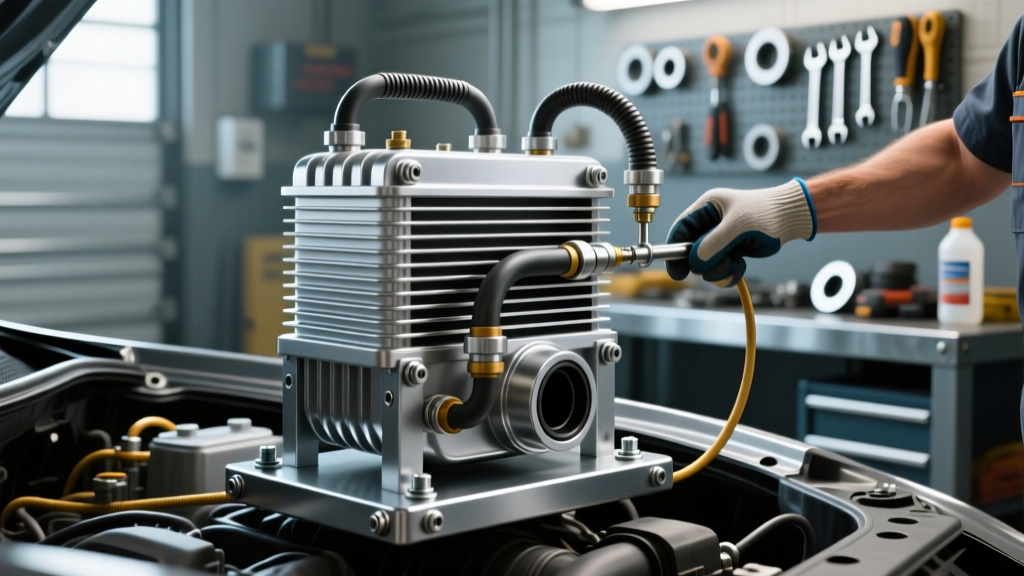
Proper torque on your transmission cooler fittings prevents both leaks and cracked cooler headers. Aluminum cooler plates are relatively soft; overtightening an NPT fitting will split the header, ruining a $200 cooler instantly. For comprehensive thread pitch data, refer to the Summit Racing AN Fitting Guide.
Exact Torque Specifications
- AN6 Aluminum to Aluminum: 12 - 15 ft-lbs (Use a drop of assembly lube on the threads).
- AN8 Aluminum to Aluminum: 20 - 25 ft-lbs.
- 1/8' NPT Brass into Aluminum Header: 10 - 12 ft-lbs (Use PTFE paste).
- 1/4' NPT Brass into Aluminum Header: 15 - 18 ft-lbs.
- Hose Clamps (if using barbs): 15 - 20 in-lbs (Do not overtighten, or you will cut the synthetic rubber hose).
Routing Pro-Tip: Always route the cooler lines away from exhaust manifolds and moving suspension components. Use abrasion-resistant nylon braided sleeving (TechFlex) over your AN hoses where they pass through the radiator support or frame crossmembers. Transmission fluid operates at 40-80 PSI in the cooler circuit, and a pinhole leak spraying ATF onto a hot exhaust will result in an immediate vehicle fire.
Step 5: Pressure Drop Testing and Thermostatic Bypasses
Once the cooler and fittings are installed, you must verify the system's pressure drop. Install a 0-100 PSI liquid-filled gauge on the transmission's cooler return line. Compare the return line pressure to the transmission's mainline pressure (via a scan tool or dedicated port). A healthy cooler circuit with properly sized transmission cooler fittings should show a pressure drop of no more than 15-25 PSI at operating temperature. If the drop exceeds 35 PSI, your fittings are too restrictive, or the cooler core tubes are clogged.
The ZF 8HP Thermostatic Bypass Requirement
If you are upgrading a ZF 8HP transmission (found in modern Rams, BMWs, and Jaguars), you must retain or install a thermostatic bypass valve, such as the Hayden 107 or an OEM-style integrated bypass. ZF transmissions utilize highly specific low-viscosity fluids (ZF Lifeguard 8). If the fluid is overcooled and remains below 70°C, the hydraulic viscosity remains too high, causing harsh 2-3 and 3-4 shifts, and accelerating clutch pack wear. The bypass ensures fluid only routes through the cooler core once it exceeds the thermostat's opening temperature (typically 160°F - 180°F).
For more information on maintaining optimal fluid temperatures and understanding thermal cycling, review the Hayden Auto Technical Information database. By correctly matching your cooler's GVWR to your transmission's GPM, and ensuring your transmission cooler fittings offer zero flow restriction, you will guarantee decades of reliable, heat-free operation whether you are towing a fifth-wheel across the country or navigating stop-and-go traffic.