The Symbiosis of Cooler Size and Mounting Real Estate
When upgrading your vehicle's thermal management, transmission cooler size selection is rarely just about picking the highest Gross Vehicle Weight (GVW) rating you can find. As of 2026, with modern 8-speed and 10-speed automatics generating immense localized heat during torque converter clutch (TCC) slip and rapid downshifts, the physical dimensions of the cooler are strictly dictated by your available transmission cooler mounting position. A 40,000 GVW stacked-plate cooler is useless if it blocks your AC condenser or cannot be routed without kinking the lines. This step-by-step guide walks you through evaluating your chassis constraints, calculating thermal loads, and selecting the exact core geometry required for your specific application.
Step 1: Map Your Available Transmission Cooler Mounting Position
Before browsing catalogs, you must physically map the spatial constraints of your vehicle's front end or frame rails. Grab a tape measure and document the maximum width, height, and depth available in your chosen zone.
Zone A: In Front of the Radiator/Condenser (The Gold Standard)
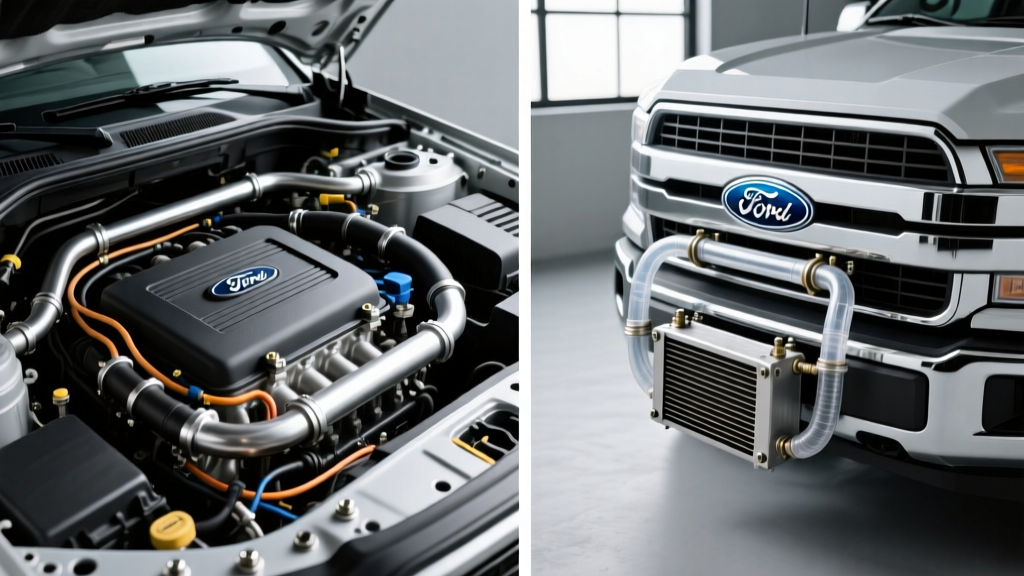
Mounting directly in front of the AC condenser and radiator provides the highest volume of ambient airflow. However, depth is your primary enemy here. Most modern unibody SUVs and trucks only allow for 3/4-inch to 1-inch of clearance between the condenser fins and the core support. If you select a tube-and-fin cooler with a 2-inch depth, you will either crush the condenser lines or be forced to mount it behind the bumper, severely choking airflow.
Zone B: Behind the Bumper or Grille (The Compromise)
If front-of-radiator space is compromised by intercoolers or active aero shutters, the bumper inlet is your secondary transmission cooler mounting position. This area often allows for thicker cores (up to 2 inches) but requires careful ducting. Without a sealed airbox or foam shrouding, air will take the path of least resistance and bypass the cooler fins entirely.
Zone C: Remote Mounting (The Heavy-Duty Solution)
For dedicated tow rigs or vehicles with zero front-end real estate, remote mounting in the bed or behind the rear axle is an option. This requires an auxiliary fluid pump (such as the Derale 40000 series) and a thermostat bypass, adding roughly $150-$200 to the build cost, but allows for massive 30,000+ GVW coolers without affecting radiator airflow.
Step 2: Calculate Required GVW and Fluid Volume
Once your physical dimensions are established, you must match the cooler's thermal capacity to your transmission's fluid volume and operational stress. GVW ratings are standardized industry metrics indicating the maximum vehicle weight the cooler can safely support under standard towing conditions.
| Transmission Model | Fluid Capacity | Minimum Target GVW | Thermal Characteristics |
|---|---|---|---|
| GM 4L60E | 11.2 qts | 16,000 GVW | Moderate heat; prone to 3-4 clutch burn if under-cooled. |
| GM 6L80E / 6L90 | 11.8 qts | 24,000 GVW | High TCC slip heat; requires high-flow stacked plates. |
| GM 10L80E | 11.6 qts | 28,000 GVW | Fast shift thermal spikes; benefits from high fin-density. |
| ZF 8HP70 / 8HP90 | 9.5 qts | 20,000 GVW | ITM bypass considerations; sensitive to pressure drops. |
| Allison 1000 (6/10-spd) | 12.7 qts | 32,000+ GVW | Massive volume; demands 1/2-inch lines and AN-8 fittings. |
For a comprehensive breakdown on transmission-specific thermal thresholds, refer to the engineering data provided by Sonnax Technical Resources, which details how clutch apply rates directly correlate to fluid temperature spikes.
Step 3: Match Core Technology to Spatial Constraints
Your transmission cooler mounting position dictates which core architecture you can physically install. Here is how the three main designs compare regarding spatial efficiency and cooling power.
1. Stacked-Plate (Best for Tight, Shallow Mounts)
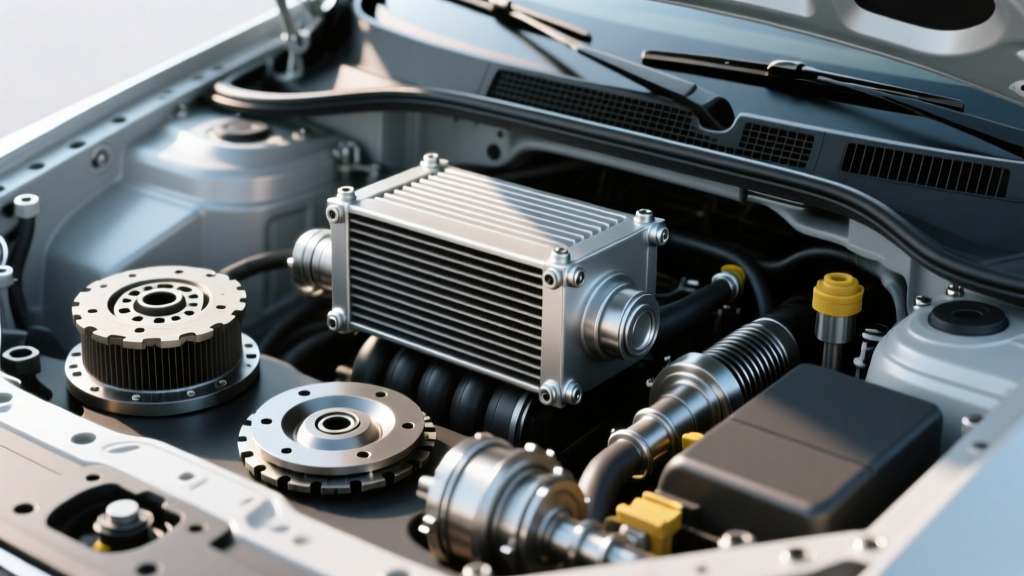
Stacked-plate coolers offer the highest efficiency-to-size ratio. They are typically 3/4-inch thick, making them the undisputed choice for Zone A (in front of the condenser) installations.
- Top Pick: Derale Series 8000 Plate-Fin (Part #13503)
- Dimensions: 3/4" x 11" x 11-3/8"
- GVW Rating: 24,000
- Price Range: $65 - $80
- Application: Perfect for GM 6L80E trucks with tight core supports.
2. Plate-and-Fin (The Balanced Approach)
Slightly thicker than stacked plates (usually 1 to 1.5 inches), these offer excellent durability and are less prone to clogging from road debris.
- Top Pick: Hayden Rapid-Cool (Part #678)
- Dimensions: 3/4" x 10" x 13" (Note: verify specific sub-model depth, some reach 1.25")
- GVW Rating: 24,000
- Price Range: $75 - $95
3. Tube-and-Fin (Budget / Deep Space Applications)
These are the thickest (often 2+ inches) and least efficient per square inch. They are only recommended if your transmission cooler mounting position is in a deep cavity like behind a wide truck bumper where thickness is not an issue. For modern 2026 towing standards, tube-and-fin is largely obsolete for heavy-duty use.
Expert Tip: When measuring for a Hayden Automotive or Derale cooler, always subtract 1.5 inches from your measured width to account for the mounting brackets and zip-tie or bolt head clearances.
Step 4: Plumbing, Line Sizing, and Fitting Torque
Selecting the right size cooler is only half the battle; plumbing it correctly ensures you do not starve the transmission lube circuit. The internal volume of the cooler and the length of your lines will dictate your required hose diameter.
Line Sizing Rules
- 3/8-inch (AN-6) Lines: Standard for most passenger vehicles, half-ton trucks (4L60E, ZF 8HP), and coolers up to 24,000 GVW.
- 1/2-inch (AN-8) Lines: Mandatory for 3/4-ton and 1-ton trucks (Allison 1000, 6L90E) running 28,000+ GVW coolers, especially if the transmission cooler mounting position is more than 4 feet away from the transmission output.
Crucial Torque Specifications
Over-tightening AN fittings on aluminum cooler tanks will strip the threads or crack the header plate, leading to catastrophic fluid loss on the highway. Always use a calibrated torque wrench.
- AN-6 (3/8") Aluminum to Aluminum: 12 - 15 ft-lbs
- AN-6 (3/8") Steel to Aluminum: 10 - 12 ft-lbs
- AN-8 (1/2") Aluminum to Aluminum: 18 - 22 ft-lbs
- AN-8 (1/2") Steel to Aluminum: 15 - 18 ft-lbs
Note: Always apply a single drop of clean ATF to the O-ring or flare seat before torquing to prevent binding and ensure a proper seal.
Common Sizing and Mounting Mistakes to Avoid
Even seasoned mechanics make critical errors when evaluating the transmission cooler mounting position. Avoid these common pitfalls:
- Blocking the AC Condenser Core: If your cooler covers more than 30% of the AC condenser surface area, your cabin cooling and high-side AC pressures will suffer in stop-and-go traffic. Always choose a wider, shorter cooler rather than a tall, narrow one to preserve lower condenser airflow.
- Ignoring the OEM Thermal Bypass Valve: Many modern transmissions (like the ZF 8HP and GM 10L80E) utilize a thermal bypass valve in the adapter plate that prevents fluid from reaching the cooler until it hits 180°F. If you mount an oversized cooler in a high-airflow position without deleting or bypassing this valve, the transmission may never reach optimal operating temperature, leading to harsh shifts and increased wear.
- Using Push-Lock Fittings on High-Pressure Circuits: While push-lock (barb and clamp) fittings are fine for the low-pressure return side, the pressure side exiting the transmission can see spikes over 150 PSI during heavy towing. Always use crimped hydraulic hoses or AN flare fittings on the pressure side.
Final Verification Checklist
Before finalizing your purchase and routing your lines, run through this quick checklist:
- Did I measure the depth clearance to the AC condenser fan shroud?
- Does the selected cooler's GVW rating exceed my truck's loaded towing weight?
- Are my line sizes matched to the cooler's internal flow capacity and run length?
- Have I accounted for the OEM thermostat bypass if my target operating temp is above 190°F?
By rigorously matching your transmission cooler size selection to the physical realities of your transmission cooler mounting position, you ensure optimal fluid temperatures, extended clutch pack life, and reliable performance whether you are navigating mountain passes or sitting in summer gridlock.