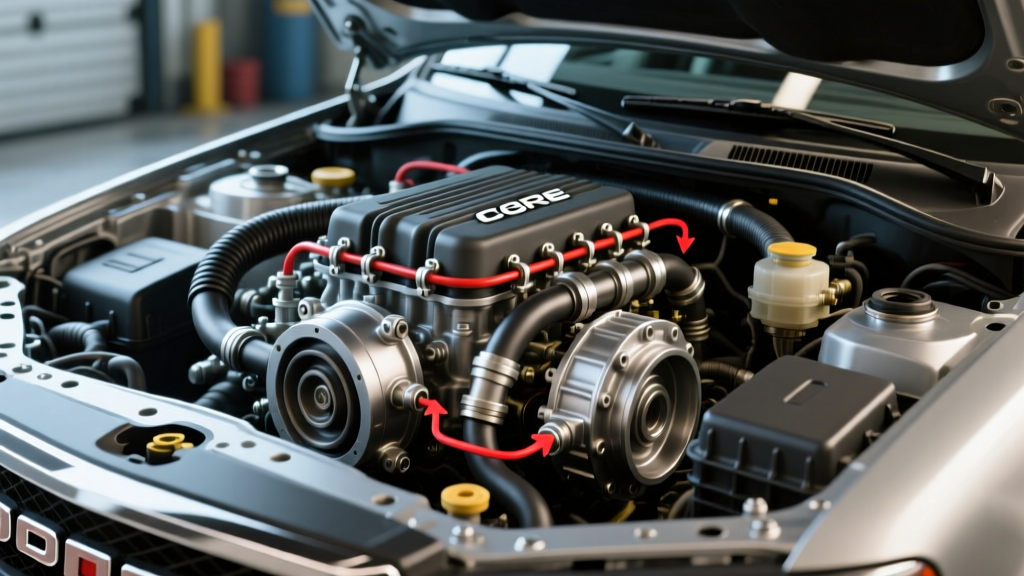
The Thermodynamics of Cold ATF and the Bypass Necessity
When installing an auxiliary transmission cooler, the most overlooked component in the plumbing circuit is the thermostatic bypass valve. Many enthusiasts and fleet mechanics mistakenly route 100% of the transmission fluid through the external cooler at all times. While this maximizes heat rejection under heavy towing in July, it creates catastrophic flow restrictions in January.
Automatic transmission fluid (ATF) is highly temperature-dependent. For instance, General Motors' Dexron VI and Ford's Mercon LV exhibit a kinematic viscosity of approximately 5.5 to 6.0 centistokes (cSt) at their optimal operating temperature of 180°F (82°C). However, at 32°F (0°C), that same fluid's viscosity spikes to over 150 cSt. If you force 150 cSt fluid through a high-efficiency 31-row stacked-plate auxiliary transmission cooler, the pressure drop across the cooler core can exceed 40 PSI. This massive restriction starves the transmission's internal lube circuits, delays shift solenoid response, and can cause the internal gerotor pump to cavitate, leading to premature clutch pack burnout.
A thermostatic bypass valve solves this by keeping the fluid in a closed-loop 'short circuit' (bypassing the auxiliary cooler) until the ATF reaches a specific temperature threshold. Once the internal wax pellet expands, the valve gradually opens, blending cooler flow proportionally to maintain the ideal 175°F to 195°F operating window.
2026 Buyer's Matrix: Inline Thermostatic Bypass Valves
Below is a comparison of the top inline bypass valves available for custom auxiliary transmission cooler plumbing. Pricing reflects early 2026 market averages.
| Brand / Model | Part Number | Opening Temp | Fitting / Thread | Max Flow | Price Range | Ideal Application |
|---|---|---|---|---|---|---|
| Hayden Automotive 459 | 459 | 180°F (82°C) | 1/2'-20 Inverted Flare | 5.5 GPM | $65 - $75 | GM 6L80/6L90, Ford 6R80 |
| B&M Racing SuperCooler | 70264 | 165°F (74°C) | 3/8'-24 Inverted Flare | 4.0 GPM | $80 - $95 | Older 4L60E, 4R70W, Light Duty |
| Mishimoto MMTC-U | MMTC-U | 185°F (85°C) | AN-8 O-Ring Boss | 6.5 GPM | $110 - $130 | ZF 8HP, Allison 1000, Custom AN Lines |
Platform-Specific Valve Selection: Why Temperature Matters
Not all transmissions tolerate cold fluid equally. Selecting the correct bypass valve opening temperature is critical to the longevity of your specific drivetrain.
GM 6L80 / 6L90: High-Flow Demands
The GM 6L80 and 6L90 transmissions utilize a high-volume pump to feed both the torque converter and the clutch apply circuits. These units are notorious for running hot (often seeing 210°F+ in stock SUV configurations). When adding an auxiliary transmission cooler, you must use a high-flow valve like the Hayden 459 or Mishimoto MMTC-U. The 6L80 requires a minimum of 1.5 to 2.0 GPM of cooler flow to maintain thermal equilibrium under load. A restrictive valve will trigger the 'Transmission Over Temp' limp mode, locking the torque converter and limiting you to 2nd gear.
ZF 8HP: Friction Material Sensitivity
The ZF 8HP (found in the Ram 1500, BMW, Jaguar, and Dodge Charger) is an engineering marvel but highly sensitive to fluid viscosity. It uses ZF Lifeguard 8 fluid, which is specifically formulated for ultra-fast shift times and precise torque converter clutch (TCC) slip modulation. According to ZF Friedrichshafen AG service documentation, the transmission sump must reach a minimum of 80°C (176°F) for the friction materials to engage correctly without shudder. If you install a 165°F bypass valve (like the B&M 70264), the fluid will route to the cooler too early. The sump will stagnate at 165°F, causing severe TCC shudder and premature wear to the 'A' and 'B' clutch packs. For the ZF 8HP, the 185°F Mishimoto valve is mandatory.
Heavy Duty Diesel (Allison 1000 / 68RFE): Pressure Spikes
Diesel trucks towing 15,000+ lbs generate immense converter heat. The OEM Allison 1000 thermal bypass tube is made of plastic and is a known failure point; it routinely melts or collapses under sustained 250°F+ converter-out temperatures. Deleting the OEM bypass and installing an external inline auxiliary transmission cooler with a heavy-duty brass/steel bypass valve (like the Mishimoto AN-8 setup) prevents catastrophic line blowouts on the highway.
Product Breakdown: The Big Three
Hayden Automotive 459
The Hayden 459 is the industry standard for factory-style replacements and moderate-duty towing setups. It features a brass wax-element housing that responds predictably to Dexron VI and Mercon LV. Its 1/2'-20 inverted flare ports mate directly to the hard lines found on most domestic V8 trucks. Hayden Automotive designs these with a large internal bypass orifice, ensuring that when the valve is closed (cold fluid), the fluid bypasses the cooler with less than a 3 PSI pressure drop.
B&M Racing 70264
B&M's 165°F valve is best suited for older, less thermally sensitive transmissions like the 4L60E or 4R70W, or for vehicles operating in extremely cold climates (sub-zero Alaska/Canada) where reaching 180°F takes too long. However, its 3/8' ports and slightly smaller internal bypass channel make it a poor choice for modern 8-speed or 10-speed transmissions that demand high cooler circuit flow rates.
Mishimoto MMTC-U
For custom fabricators and high-horsepower builds, the Mishimoto MMTC-U is the premium choice. It utilizes AN-8 O-ring boss fittings, allowing you to plumb the entire auxiliary transmission cooler circuit using braided stainless steel or PTFE-lined AN hoses. This eliminates the need for hose clamps and rubber hose entirely, virtually guaranteeing zero leaks under the 100+ PSI line pressures seen in modern 10-speed automatics.
Plumbing, Fittings, and Torque Specifications
Improper plumbing is the number one cause of auxiliary cooler failure. Follow these strict guidelines when integrating your bypass valve:
- Hose Selection: Never use standard fuel line or generic oil hose. Modern synthetic ATFs will dissolve the inner lining of cheap hoses, sending rubber debris directly into the transmission valve body. Use SAE J1532-rated transmission hose (such as Gates 3539), which is rated for continuous 250°F+ operation and high pressure.
- Clamp Style: If using rubber hose and barbed fittings, use constant-tension (spring) clamps or high-quality T-bolt clamps. Standard worm-gear clamps can cut into the rubber over time due to thermal expansion and contraction cycles.
- Torque Specs: For 3/8'-24 inverted flare fittings, torque to 15-18 lb-ft. For 1/2'-20 inverted flare fittings, torque to 22-25 lb-ft. Use a crowfoot wrench on an inch-pound torque wrench for precision.
- Sealants: NEVER use PTFE (Teflon) tape on inverted flare or AN O-ring boss fittings. The tape does not seal the flare; it only shreds and clogs the delicate shift solenoids inside the transmission pan. The seal is made entirely by the metal-to-metal flare contact.
Diagnostics: Verifying Bypass Operation
After installation, you must verify the valve is functioning correctly to ensure your auxiliary transmission cooler is active when needed.
Pro-Tip: Use a digital IR thermometer (like the Fluke 62 MAX+) to measure the hard line temperatures. Start the truck cold (after sitting overnight). The line entering the auxiliary cooler should remain near ambient temperature while the line returning to the transmission heats up. Once the pan temperature hits the valve's threshold (e.g., 180°F), the cooler inlet line temperature should rapidly spike, confirming the wax pellet has opened the circuit.
If the cooler lines remain hot immediately upon a cold startup, your bypass valve is either stuck open, installed backward (check the flow direction arrow cast into the housing), or the internal spring has failed. Catching this during the initial test drive prevents months of suboptimal shift quality and unnecessary drivetrain wear.