The Drivetrain Hierarchy: Where Power Goes
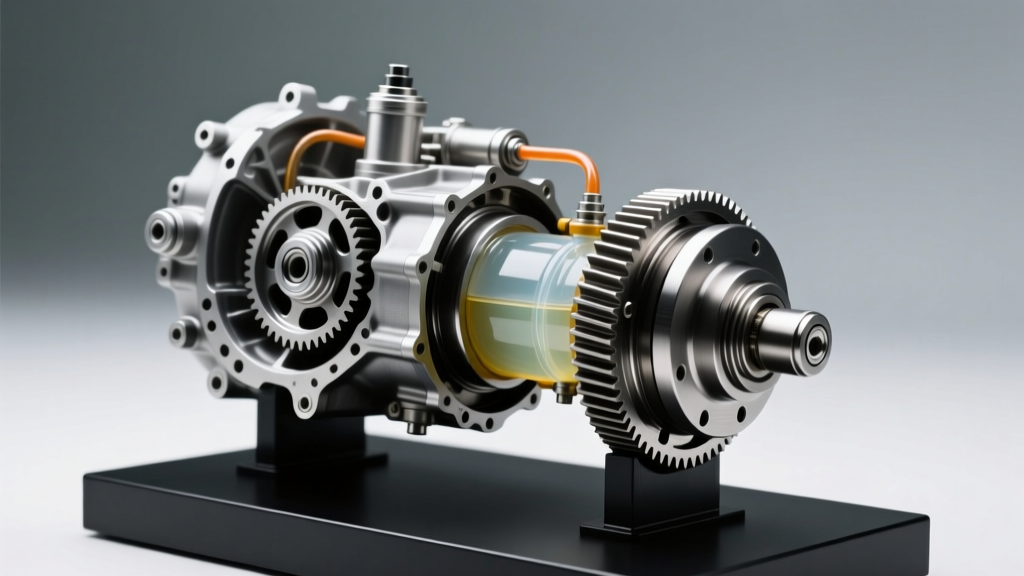
For beginners diving into the world of four-wheel drive (4WD) and all-wheel drive (AWD) vehicles, the underside of a truck or SUV can look like a tangled metal maze. At the heart of this mechanical labyrinth are two critical components that often get confused: the transfer case and the differential. While they both deal with distributing power, they operate on entirely different axes and serve distinct purposes. Understanding the transfer case and differential relationship is the first step toward mastering off-road traction and performing proper drivetrain maintenance.
Think of your vehicle’s drivetrain as a logistics network. The transmission (whether it’s a classic 4L60E, a modern ZF 8HP, or a heavy-duty 10-speed like the Ford 10R80) is the main highway, taking raw engine torque and converting it into usable rotational force. From there, the power flows into the transfer case. The transfer case acts as the regional sorting facility, deciding whether to send power down the rear driveshaft only (2WD) or to split it between the front and rear driveshafts (4WD). Finally, the power reaches the differentials (front and rear axles), which act as the local delivery routes, splitting the power left and right to the individual wheels while allowing them to rotate at different speeds around corners.
The Symbiotic Relationship: Longitudinal vs. Lateral Power
To truly grasp how these systems interact, you have to look at the geometry of traction. The transfer case manages the longitudinal (front-to-back) power split. If your rear wheels are buried in mud and spinning, engaging the transfer case’s 4-High or 4-Low range forces the front driveshaft to turn, effectively pushing the vehicle forward using the front axle.
However, the transfer case is completely blind to what is happening side-to-side. That is where the differential steps in, managing the lateral (left-to-right) power split. An open differential will always send power to the wheel with the least resistance. If you lock your transfer case in 4WD but leave your rear differential open, and one rear wheel is on ice while the other is on dry pavement, the open diff will send all the rear power to the spinning wheel on the ice. The transfer case did its job by sending power to the rear axle, but the differential defeated the system by routing it to the path of least resistance.
Drivetrain Binding and Axle Wind-Up
The relationship between these two components also dictates how the vehicle behaves on different surfaces. When you lock a part-time transfer case (like the legendary NP241 or NP261) into 4WD, the front and rear driveshafts are locked together, spinning at the exact same speed. Because the front and rear axles travel different distances during a turn, this creates a phenomenon known as "drivetrain wind-up" or binding. The differentials are forced to absorb this binding stress laterally. If you drive a locked part-time 4WD system on dry pavement, the stress will eventually shatter U-joints, snap axle shafts, or strip the internal chain and planetary gears inside the transfer case. This is why understanding their relationship is vital for both driving safety and mechanical longevity.
The Maintenance Connection: Fluids and Seals
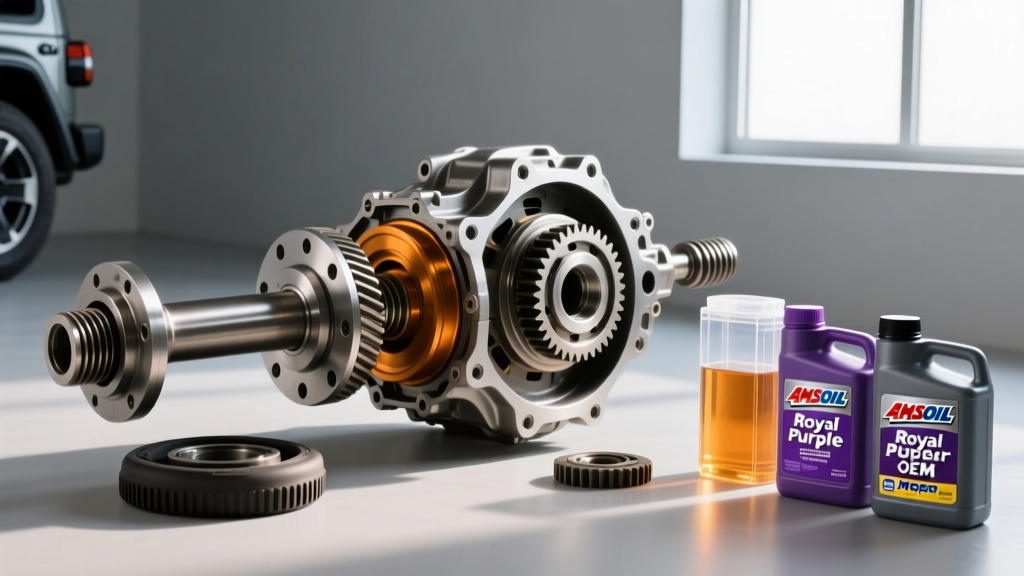
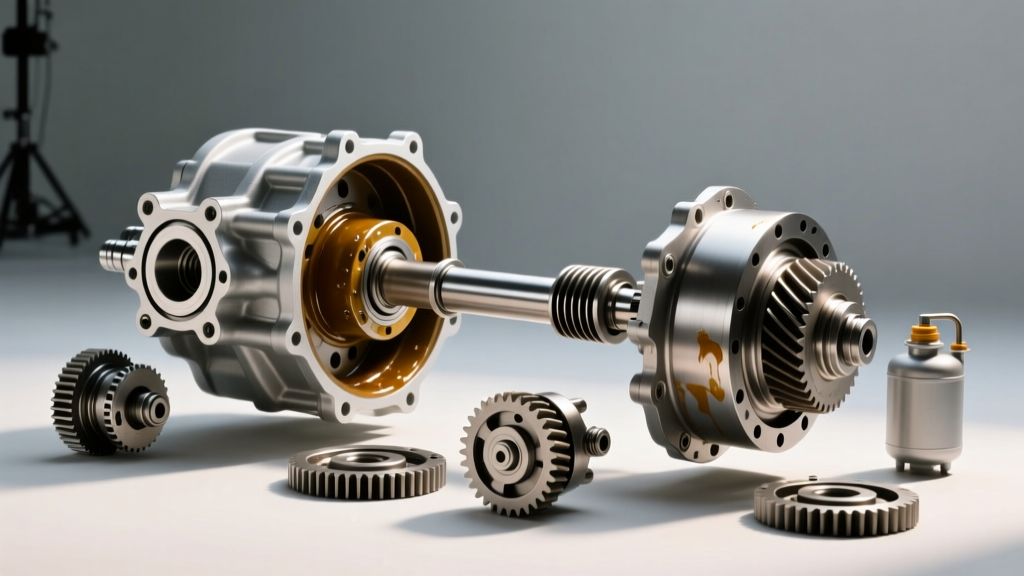
Because the transfer case and differententials work in tandem to multiply and route torque, they both endure immense thermal and mechanical stress. Servicing them is often grouped together as a "drivetrain fluid flush." However, beginners must note that they rarely share the same fluid chemistry.
- Transfer Cases: Most modern transfer cases (such as the BorgWarner 4406 found in Ford F-150s or the GM NVG246) rely on Automatic Transmission Fluid (ATF) like Dexron VI or ATF+4. This is because they contain internal clutches, chains, and planetary gearsets that require the specific friction modifiers and detergents found in ATF.
- Differentials: Axle housings rely on heavy-duty gear oils, typically 75W-90 or 75W-140 synthetic. These fluids are designed to handle the extreme shearing forces and sliding friction of hypoid ring and pinion gears. Furthermore, if your axle features a Limited Slip Differential (LSD) like an Eaton Posi or Ford Trac-Lok, you must add a specific friction modifier (usually 4 oz) to prevent clutch pack chatter during tight turns.
When performing this combined service, understanding the transfer case and differential relationship is only half the battle. When it comes time to drain, clean, and reseal the axle housings, knowing your exact differential cover torque specs is what separates a successful weekend wrenching session from a leaking driveway nightmare.
Essential Differential Cover Torque Specs
Over-torquing differential cover bolts is one of the most common beginner mistakes. The axle housings and the stamped steel or cast aluminum covers are relatively soft. Applying 60 ft-lbs of force with a massive breaker bar will easily strip the threads out of the axle housing, warp the cover, or crush the gasket, leading to immediate gear oil leaks. According to drivetrain engineering guidelines from Spicer Parts (Dana) and Ring & Pinion, precision is paramount. Always use a calibrated 3/8-inch drive torque wrench for these fasteners.
| Axle Model | Common Applications | Cover Bolt Size | Torque Spec (ft-lbs) | Torque Spec (Nm) |
|---|---|---|---|---|
| Dana 30 (Front) | Jeep Wrangler (JK/TJ), Ford F-150 (IFS) | 3/8" - 16 or 10mm | 25 - 30 ft-lbs | 34 - 41 Nm |
| Dana 44 (Front/Rear) | Jeep Wrangler Rubicon, Ram 2500 | 3/8" - 16 or 13mm | 30 - 35 ft-lbs | 41 - 47 Nm |
| Ford 8.8 (Rear) | Ford F-150, Mustang, Ranger | 3/8" - 16 | 28 - 38 ft-lbs | 38 - 52 Nm |
| GM 8.6 / 10-Bolt | Chevy Silverado, GMC Sierra, Tahoe | M10 x 1.5 | 22 ft-lbs | 30 Nm |
| Chrysler 8.25 | Jeep Cherokee (XJ), Dodge Dakota | 3/8" - 16 | 30 ft-lbs | 41 Nm |
The Star Pattern Sequence
Just like torquing a cylinder head or a wheel lug nut, you must never tighten differential cover bolts in a circle. Doing so will pinch the gasket on one side and leave a gap on the other. You must use a crisscross or star pattern. Start by threading all 10 or 12 bolts in by hand to prevent cross-threading. Then, snug them down to about 10 ft-lbs in a star pattern. Finally, make your second pass in the same star pattern, bringing them up to the final specified torque. This ensures the cover seats evenly against the mating surface, distributing the clamping load uniformly across the gasket.
RTV Silicone vs. Pre-Cut Gaskets
The drivetrain community is perpetually divided on whether to use Room Temperature Vulcanizing (RTV) silicone or pre-cut gaskets when resealing a differential cover. Both methods are valid, but they require different preparation techniques.
If you opt for a pre-cut gasket (such as the highly regarded Fel-Pro RDS 55024 for Ford 8.8 axles or Lube Locker reusable elastomer gaskets), you generally do not need RTV. The key here is ensuring both the axle housing mating surface and the cover flange are completely free of old oil. Use aerosol brake parts cleaner and a green Scotch-Brite pad to scour the metal. Any residual gear oil will cause a dry gasket to slip and weep.
If you prefer RTV, Permatex Ultra Black or The Right Stuff are the industry standards for high-torque, oil-resistant environments. Apply a continuous 1/8-inch bead around the cover, ensuring you circle every bolt hole. The most critical mistake beginners make with RTV is filling the differential with gear oil immediately. Standard RTV requires atmospheric moisture to cure. If you fill the axle and drive the vehicle within 30 minutes, the internal fluid pressure and heat will blow out the uncured silicone. Always wait a minimum of 12 to 24 hours before adding 75W-140 gear oil.
Common Beginner Pitfalls to Avoid
As you service the transfer case and differentials, keep these expert-level warnings in mind:
- Ignoring the Fill Plug: ALWAYS remove the top fill plug before you remove the bottom drain plug or the cover. If you drain the axle and then discover your fill plug is seized or stripped, your vehicle is permanently grounded until the plug is extracted.
- Mixing Up Transfer Case and Diff Fluid: Never put 75W-140 gear oil into a transfer case. The heavy viscosity will cause the internal clutch packs to drag, overheat, and fail. Conversely, never put ATF into a differential; it lacks the extreme pressure (EP) additives required to protect hypoid gear teeth from shearing.
- Forgetting the LSD Additive: If your truck has a factory limited-slip differential and you skip the $8 bottle of friction modifier, your axle will shudder and "chatter" violently every time you make a slow turn out of a driveway. This chatter physically degrades the clutch packs over time.
- Reusing Stretched Bolts: While most differential cover bolts can be reused, if you notice the threads look "necked" or stretched, or if they easily torque past 40 ft-lbs without clicking, throw them away. Replace them with Grade 8 or Class 10.9 hardware store equivalents of the exact same thread pitch.
Final Thoughts on Drivetrain Synergy
The transfer case and the differential are two halves of the same traction equation. One pushes power forward and backward, while the other distributes it left and right. By respecting their mechanical relationship on the trail, and adhering strictly to manufacturer differential cover torque specs and fluid chemistries in the garage, you will ensure your 4WD system remains reliable, quiet, and leak-free for hundreds of thousands of miles.