The Ultimate Guide to Jeep Wrangler JL Differential Fluid Types and Specifications
Executing a proper Jeep Wrangler JL differential fluid change is one of the most critical maintenance tasks for preserving the longevity of your rig's drivetrain. Whether you are daily driving a Sahara on the highway or crawling boulders in a Rubicon, the hypoid gear sets inside your axles generate immense shear forces and localized heat. Using the wrong viscosity or skipping the API GL-5 specification can lead to premature ring and pinion wear, bearing failure, and catastrophic differential lockup.
As we navigate the 2026 off-road season, the aftermarket and OEM landscape for gear oils has evolved. Synthetic base stocks are now more shear-stable than ever, and additive packages are specifically tuned for the unique metallurgy of modern Jeep axles. In this comprehensive buyer’s guide and comparison, we will break down the exact factory specifications, compare the top-tier differential fluids on the market, and provide the precise torque specs and capacities you need to service your JL Wrangler with absolute confidence.
OEM Specifications: What Does Your JL Wrangler Actually Need?
Stellantis (formerly FCA) engineered the JL platform with specific axle configurations that dictate fluid viscosity. The most common mistake DIYers make is assuming all JL axles take the same gear oil. The standard Sport and Sahara models utilize lighter-duty axles compared to the Rubicon, Mojave, and 392 variants, which feature heavy-duty Dana 44-based housings.
All JL differentials require an API GL-5 rated gear oil. GL-5 fluids contain high levels of sulfur and phosphorus extreme pressure (EP) additives designed to protect the sliding friction of hypoid gears. Never use a GL-4 fluid in a JL differential, as it lacks the necessary EP protection for the ring and pinion contact patch.
Factory Fill Viscosity and Capacity Chart
| Model / Trim | Axle Type (Front / Rear) | OEM Viscosity Spec | Approx. Capacity | Friction Modifier? |
|---|---|---|---|---|
| Sport / Sahara (Standard) | M186 Front / M220 Rear | 75W-85 GL-5 | 1.3 qt (F) / 2.0 qt (R) | Only if equipped with Trac-Lok LSD |
| Rubicon / Mojave | M210 Front / M220 HD Rear | 75W-85 (F) / 75W-140 (R) | 1.5 qt (F) / 2.4 qt (R) | No (Electronic Lockers do not require it) |
| Wrangler 392 / Recon | M210 Front / M220 HD Rear | 75W-85 (F) / 75W-140 (R) | 1.5 qt (F) / 2.4 qt (R) | No |
Note: Capacities are approximate. Always fill until the fluid is level with the bottom of the fill plug threads.
The 2026 Buyer’s Guide: Top Differential Fluids Compared
When selecting a fluid for your Jeep Wrangler JL differential fluid change, you must balance cold-weather flow, high-temperature shear stability, and budget. Below, we compare the most trusted fluids utilized by Jeep technicians and hardcore off-roaders.
1. Mopar OEM 75W-85 & 75W-140 (The Factory Baseline)
If you want to replicate the exact factory fill, Mopar’s branded synthetic gear oils are the safest bet. The Mopar 75W-85 (Part # 68218655AA) and 75W-140 (Part # 68218657AA) are manufactured by Pennzoil/Shell to Stellantis' strict MS-12313 and MS-12314 specifications.
- Pros: 100% guaranteed compatibility; maintains factory warranty compliance; readily available at dealerships and via Mopar Online Parts.
- Cons: Higher price per quart (~$18-$22) compared to aftermarket equivalents; lacks the advanced ester-based additive packages found in boutique synthetics.
- Best For: Warranty-conscious owners and daily drivers who stick to the 40,000-mile severe service interval.
2. AMSOIL Severe Gear 75W-90 & 75W-110 (The Synthetic Heavyweight)
AMSOIL is widely regarded in the tribology community for its robust synthetic base stocks. For the JL Wrangler, AMSOIL recommends their Severe Gear 75W-90 for standard axles and 75W-110 for Rubicon rear axles (as a slightly lighter, more flowable alternative to 75W-140 that still maintains high-temp film strength).
- Pros: Exceptional thermal stability; resists foaming during high-RPM highway driving or deep water crossings; extended drain interval capabilities.
- Cons: Premium pricing (~$22-$26 per quart); requires purchasing a separate friction modifier if you have a Trac-Lok LSD.
- Best For: Overlanders and heavy towers who subject their M220 rear axles to sustained high-load, high-heat conditions.
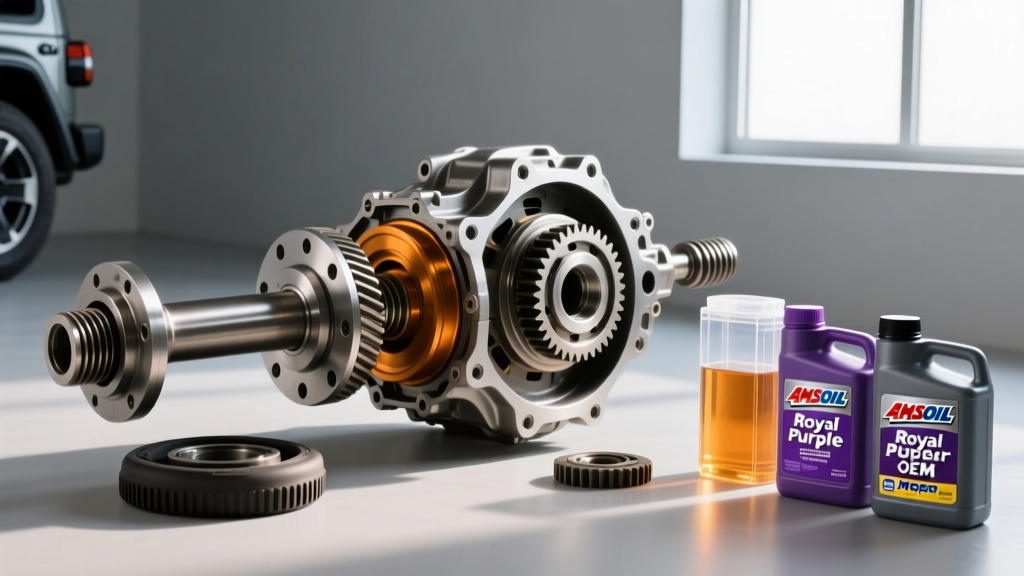
3. Royal Purple Max Gear 75W-90 & 75W-140 (The All-in-One Solution)
Royal Purple’s Max Gear line is famous for its proprietary Synerlec additive technology, which creates a micro-thin sacrificial film on gear teeth. A massive advantage of Max Gear is that it already contains the necessary friction modifier for limited-slip differentials, eliminating the need to buy and mix a separate additive.
- Pros: Built-in friction modifier saves time and money; distinct purple dye makes leak detection easy; excellent shock-load protection for rock crawling.
- Cons: The high sulfur/phosphorus content can have a strong odor during the first few heat cycles; slightly lower oxidation resistance compared to ester-heavy competitors like Red Line.
- Best For: Trail runners and weekend warriors who want a pour-and-go solution without worrying about chatter in their Trac-Lok axles.
4. Red Line 75W-90 & 75W-140 (The Track & Trail Premium)
Red Line utilizes a Group V PAO/Ester synthetic base stock. Esters are naturally polar, meaning they cling to metal surfaces even when the differential is sitting idle or tilted at extreme angles on a boulder. According to data from lubrication analysts at Bob Is The Oil Guy, Red Line consistently posts some of the highest shear-stability numbers in independent used oil analysis (UOA) testing.
- Pros: Unmatched film strength; contains friction modifiers for LSDs; highly resistant to water contamination.
- Cons: Expensive (~$28-$32 per quart); can be difficult to find locally, often requiring online ordering.
- Best For: Dedicated rock crawlers and competition vehicles where extreme axle articulation starves gears of oil splash lubrication.
The Friction Modifier Debate: Trac-Lok vs. Electronic Lockers
One of the most confusing aspects of a Jeep Wrangler JL differential fluid change is determining whether a friction modifier is required. The answer depends entirely on your differential type.
If your JL is equipped with the Trac-Lok limited-slip differential (LSD)—common on Sport S and Sahara models with the Tow Package—you must add a friction modifier (such as Mopar Part # 4318060AD). Without it, the clutch packs inside the Trac-Lok will bind during low-speed turns, causing a violent shuddering or "chatter" that will eventually destroy the clutches and score the side gears.
Conversely, if you drive a Rubicon, Mojave, or Willys with an electronic locking differential, you do not need a friction modifier. Electronic lockers use a mechanical dog-clutch mechanism to lock the axles together; there are no friction clutches to modulate. Adding a friction modifier to a Rubicon locker won't necessarily harm it, but it is an unnecessary expense and can slightly reduce the mechanical bite of the locker engagement.
Step-by-Step: Essential Torque Specs & Service Data
Proper execution of the fluid change requires adherence to factory torque specifications. Over-torquing the fill and drain plugs can crack the cast aluminum or stamped steel differential covers, leading to expensive replacements and trail-side leaks.
Critical Torque Specifications
- Differential Fill / Drain Plugs: 25 - 30 lb-ft (Typically a 3/8" or 1/2" square drive, or 13mm/15mm hex depending on the aftermarket cover).
- M220 / Dana 44 Cover Bolts (If Removing): 30 lb-ft. Always tighten in a crisscross star pattern to ensure even gasket compression.
- M186 / Dana 30 Cover Bolts: 25 lb-ft.
Pro-Tips for the JL Platform
- Fill First, Then Drain: Always remove the fill plug before you remove the drain plug or drop the cover. If your fill plug is seized or stripped, you do not want to be left with an empty differential and no way to refill it.
- Fluid Temperature Matters: Gear oil is highly viscous. If you are servicing the axles in cold weather, drive the Jeep for 15-20 minutes to warm the fluid. This allows metallic particulate and sludge to suspend in the oil and drain out completely.
- Use a Pump: The JL's differential fill ports are positioned awkwardly, especially on the front M186/M210 axles with the sway bar disconnect and steering stabilizer in the way. Invest in a high-quality $15 manual fluid transfer pump from your local auto parts store to make the job painless.
- Check the Breather Tubes: While under the Jeep, inspect the axle breather tubes. Ensure they are routed high into the engine bay or frame rails and that the one-way check valves are not clogged with mud. A clogged breather will cause pressure buildup during operation, forcing gear oil past the axle seals and pinion seal.
Final Verdict: Which Fluid Should You Choose?
For the vast majority of JL Wrangler owners, Royal Purple Max Gear 75W-90 / 75W-140 offers the best balance of extreme pressure protection, built-in LSD compatibility, and ease of use. However, if you are strictly adhering to factory warranty requirements or prefer the peace of mind of OEM engineering, the Mopar 75W-85 and 75W-140 fluids available via Quadratec or your local dealer remain the gold standard.
By selecting the correct API GL-5 fluid, respecting the torque specs, and understanding the nuances of your specific axle package, your Jeep Wrangler JL differential fluid change will ensure your rig's drivetrain survives everything from daily commutes to the harshest trails of 2026 and beyond.