Understanding the 4WD Drivetrain: A Beginner's Guide
When you shift your truck into four-wheel drive to tackle a muddy job site or a snow-covered driveway, a complex mechanical symphony occurs beneath your feet. For beginners, the drivetrain can seem like a confusing web of gears and shafts. However, understanding the relationship between the transfer case and the 2016 F150 rear differential is crucial for proper maintenance, troubleshooting, and maximizing the lifespan of your truck. As these half-ton pickups age in 2026, many are crossing the 120,000-mile threshold, making drivetrain fluid maintenance more critical than ever.
This beginner-friendly explainer will demystify how power travels from your engine to the pavement, the distinct roles of the transfer case and the rear axle, and the specific fluid requirements that keep the 2016 F-150's drivetrain operating smoothly.
The Chain of Command: From Engine to Axles
To understand how the transfer case and differential interact, we must first look at the drivetrain's chain of command. The engine generates rotational power, which the transmission (such as the 6R80 6-speed automatic found in many 2016 F-150s) multiplies and manages via gear ratios. From the transmission's output shaft, power enters the transfer case.
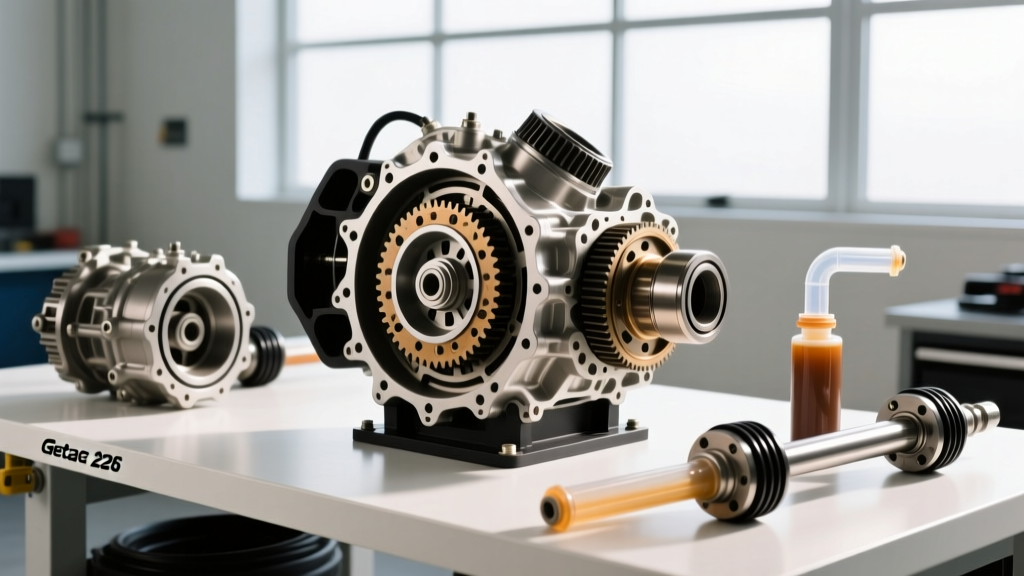
The transfer case acts as a secondary gearbox and a power splitter. In a part-time 4WD system like the BorgWarner 4417 found in many 2016 F-150s, the transfer case can lock the front and rear driveshafts together, forcing them to spin at the exact same speed. From the transfer case, power is routed down the driveshafts to the differentials—the 2016 F150 rear differential and the front differential (if equipped with 4WD).
Transfer Case vs. Differential: What is the Difference?
Beginners often confuse these two components because both house heavy-duty gears and require specialized lubricants. Here is a clear breakdown of their distinct roles:
| Feature | Transfer Case | 2016 F150 Rear Differential |
|---|---|---|
| Primary Function | Splits power between front and rear axles; provides low-range gearing. | Splits power between left and right rear wheels; allows wheels to spin at different speeds during turns. |
| Location | Bolted directly to the back of the transmission. | Located in the center of the rear axle housing. |
| Internal Gearing | Chain-driven or gear-driven planetary sets. | Ring and pinion gear set (hypoid gears) and spider gears. |
| Lubricant Type | Automatic Transmission Fluid (ATF). | Heavy-duty Synthetic Gear Oil. |
How Power Reaches the 2016 F150 Rear Differential
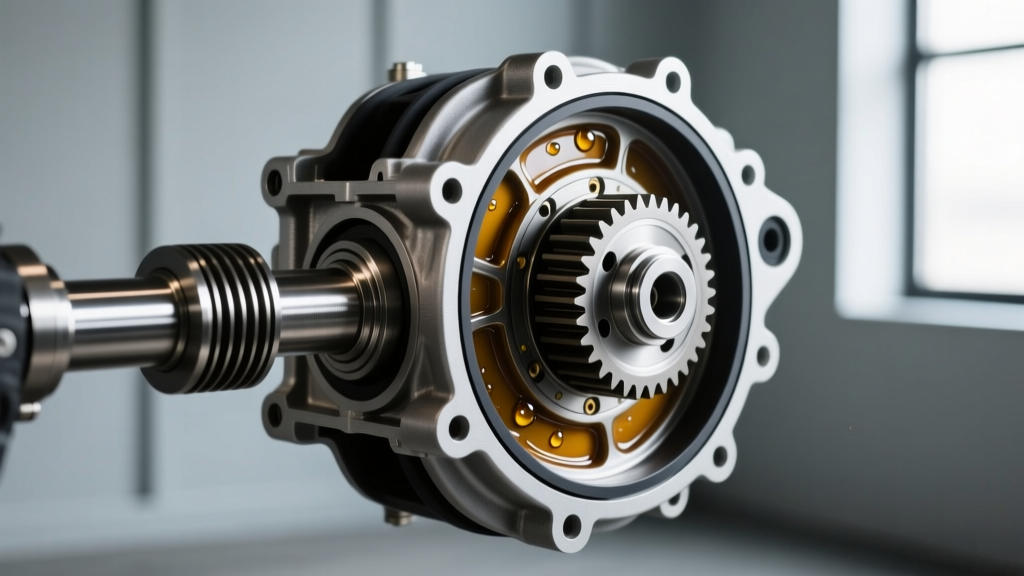
Once the transfer case sends power down the rear driveshaft, it arrives at the pinion flange of the 2016 F150 rear differential. The driveshaft spins the pinion gear, which meshes with the massive ring gear. This ring and pinion setup serves two purposes: it turns the rotational force 90 degrees to spin the axles, and it provides the final gear reduction (the axle ratio, such as 3.31, 3.55, or 3.73) to multiply torque at the wheels.
The 2016 F-150 was offered with three primary rear axle sizes depending on the engine and payload package:
- 8.8-Inch Axle: Common on base V6 and lighter-duty V8 models. Lightweight and efficient for daily driving.
- 9.75-Inch Axle: Found on 5.0L V8 and 3.5L EcoBoost trucks equipped with the Max Trailer Tow Package. Features larger ring and pinion gears for heavy towing.
- 10.5-Inch Axle: Reserved for Heavy-Duty Payload Package (HDPP) trucks. This is a massive, full-floating or semi-floating setup designed for maximum commercial payload.
Inside the differential housing, a set of spider gears allows the left and right wheels to rotate at different speeds when you turn a corner. Without this differential action, the tires would chirp, hop, and scrub across the pavement, causing severe binding between the rear axle and the transfer case.
Fluid Dynamics: Why the Transfer Case and Diff Need Different Oils
A common beginner mistake is assuming all drivetrain fluids are interchangeable. They are not. The internal mechanics of a transfer case and a differential operate under vastly different pressures and shear forces.
The 2016 F150 rear differential utilizes hypoid gears. The teeth of these gears slide against one another under extreme pressure, requiring a high-viscosity, sulfur-phosphorus fortified gear oil to prevent metal-on-metal wear. Conversely, the transfer case relies on a chain and clutch packs (in Torque-on-Demand models like the BorgWarner 4419) that require the friction-modified, lower-viscosity environment of an Automatic Transmission Fluid (ATF).
According to the Ford Owner's Manual archive, using gear oil in a transfer case will destroy the clutch packs and chain, while using ATF in a rear differential will lead to catastrophic ring and pinion failure within a few hundred miles.
2016 F-150 Drivetrain Fluid Specifications & Torque Data
When performing maintenance, precision is key. Below are the exact factory specifications, capacities, and torque requirements for the 2016 F-150 drivetrain. (Note: Capacities can vary slightly based on the exact axle ratio and housing).
| Component | Factory Fluid Specification | Approx. Capacity | Fill/Drain Plug Torque |
|---|---|---|---|
| Rear Differential (8.8") | Motorcraft SAE 75W-85 Premium Synthetic (WSS-M2C942-A) | 3.3 Pints (1.56 L) | 33 lb-ft (45 Nm) |
| Rear Differential (9.75") | Motorcraft SAE 75W-85 or 75W-140 (for severe towing) | 4.25 Pints (2.0 L) | 33 lb-ft (45 Nm) |
| Transfer Case (4417 Part-Time) | Motorcraft MERCON LV ATF (WSS-M2C938-A) | 1.8 Quarts (1.7 L) | 20 lb-ft (27 Nm) |
| Transfer Case (4419 TOD) | Motorcraft MERCON LV ATF | 2.0 Quarts (1.9 L) | 20 lb-ft (27 Nm) |
Pro Tip: If your 2016 F-150 is equipped with an Electronic Locking Rear Differential (E-Locker), you must NOT add aftermarket friction modifier additives to the gear oil, as this can cause the locking mechanism to slip or fail to engage.
Drivetrain Wind-Up: When the Transfer Case and Differential Fight
Understanding the relationship between these components is vital for diagnosing a phenomenon known as 'drivetrain wind-up' or 'binding.' Because a part-time transfer case locks the front and rear driveshafts together, it forces the front and rear axles to spin at the same RPM. However, on dry, high-traction pavement, the front and rear tires naturally travel slightly different distances due to steering angles, tire wear, and weight transfer.
When this happens, the tires cannot slip to relieve the tension. Instead, the tension is absorbed by the drivetrain. The transfer case and the 2016 F150 rear differential fight against one another, twisting the driveshafts like giant metal springs. If you attempt to shift out of 4WD while the drivetrain is bound up, the transfer case shift fork can bend, or the internal gears can chip.
How to relieve wind-up: If you accidentally leave your truck in 4WD on dry pavement and the shifter feels 'stuck,' do not force it. Put the truck in reverse and back up a few feet, or drive onto a loose surface like gravel or grass to allow the tires to slip and release the stored kinetic energy.
Maintenance Costs and DIY Viability
As we evaluate truck ownership costs in 2026, DIY maintenance remains a massive money-saver. A dealership or independent shop will typically charge between $120 and $180 to drain and fill the rear differential, and another $150 to $200 for the transfer case. This includes shop labor rates and markup on OEM fluids.
For a beginner, the 2016 F150 rear differential service is an excellent introductory DIY project. The fill and drain plugs are easily accessible on the differential housing (or via the rear cover on older designs, though the 2016 models utilize a drain plug on the bottom and a fill plug on the front/side of the housing). You will need a 3/8-inch drive ratchet or a specific Torx/hex bit depending on the exact axle assembly, a fluid pump, and roughly $40 worth of high-quality synthetic 75W-85 gear oil from brands like AMSOIL, Mobil 1, or Motorcraft. Always remember the golden rule of drivetrain fluid changes: open the fill plug before you open the drain plug. If the fill plug is seized and you have already drained the fluid, you will be stranded until a mechanic can extract the plug.
By understanding how the transfer case and the rear differential cooperate to put power to the ground, you can make informed decisions about your truck's maintenance, ensuring your F-150 remains capable and reliable for hundreds of thousands of miles.