Mastering Leaking Transmission Cooler Lines Repair and Performance Upgrades
When automatic transmission fluid (ATF) starts pooling near your crossmember or bellhousing, you are facing a critical thermal management failure. A standard leaking transmission cooler lines repair usually involves swapping out degraded OEM rubber hoses or brittle plastic quick-connects. However, as of 2026, simply replacing failed OEM components with identical factory parts is a missed opportunity. For enthusiasts, towers, and heavy-duty users, a cooler line failure is the perfect catalyst for a comprehensive performance upgrade.
Modern transmissions like the GM 6L80/6L90, Ford 10R80, and the ubiquitous ZF 8HP operate under immense thermal stress. The OEM cooling circuits are often bottlenecked by restrictive quick-connect fittings, thermal bypass valves, and rubber line sections that degrade under high underhood temperatures. This guide transcends basic leak repair, providing a masterclass in upgrading your transmission cooling lines with braided stainless steel, AN fittings, and bypass deletes to ensure maximum hydraulic stability and longevity.
The Anatomy of OEM Cooler Line Failures
Before executing a repair, it is vital to understand why the factory engineered these weak points. According to diagnostic data and engineering bulletins from Sonnax, the majority of cooler line leaks are not caused by the metal tubing itself, but by the transition points and auxiliary components integrated into the lines.
GM 6L80 / 6L90: The Quick-Connect and Bypass Plague
The 6L80 and 6L90 transmissions utilize plastic snap-in quick-connect fittings at both the transmission case and the radiator. Over time, heat cycles cause the nylon collars to become brittle, leading to catastrophic blowouts under high line pressure (which can exceed 120 PSI in performance tuning scenarios). Furthermore, GM integrated a thermal bypass valve into the pressure (out) line. This valve blocks fluid from reaching the cooler until the ATF hits approximately 185°F. While designed for emissions and rapid warm-up, it is disastrous for towing or track use, causing severe fluid degradation before the cooler even engages.
Ford 10R80: Exhaust Proximity and ULV Swelling
The Ford 10-speed automatic relies on Mercon ULV (Ultra Low Viscosity) fluid. The OEM cooler lines are often routed in close proximity to exhaust manifolds and catalytic converters. The factory rubber hose sections, while adequate for standard commuting, dry-rot and swell when subjected to prolonged radiant heat and the aggressive synthetic detergents in ULV fluid. Leaks here often manifest as a fine mist of ATF coating the undercarriage rather than a distinct puddle.
ZF 8HP: Plastic Fittings and O-Ring Extrusion
Found in everything from Dodge Chargers to BMW M cars, the ZF 8HP uses external plastic snap-in fittings secured by wire retaining clips. The O-rings inside these fittings are prone to extrusion and flattening. When the transmission experiences high-torque converter slip, the resulting spike in cooler line pressure forces the degraded O-ring past its tolerance, resulting in a slow, persistent weep.
Diagnostic Matrix: Identifying Your Leak Profile
Accurate diagnosis dictates the upgrade path. Use the matrix below to identify your specific failure mode before ordering parts.
| Leak Type | Common Location | Root Cause | Performance Upgrade Solution |
|---|---|---|---|
| High-Pressure Blowout | Radiator or Trans Case | Brittle plastic quick-connect collars | CNC Aluminum AN Adapters & Braided Lines |
| Thermal Weep | Mid-line Rubber Section | Radiant exhaust heat baking NBR rubber | PTFE-lined Stainless Braided Hoses |
| Thermal Bypass Leak | Pressure Line (Out) | Bypass valve O-ring failure / housing crack | Thermal Bypass Valve Delete Kit |
| Chafing Puncture | Crossmember / Frame Rail | Missing OEM retaining clips / vibration | Fire-sleeve wrapped AN lines with adel clamps |
The Performance Upgrade Path: Ditching OEM for AN Fittings
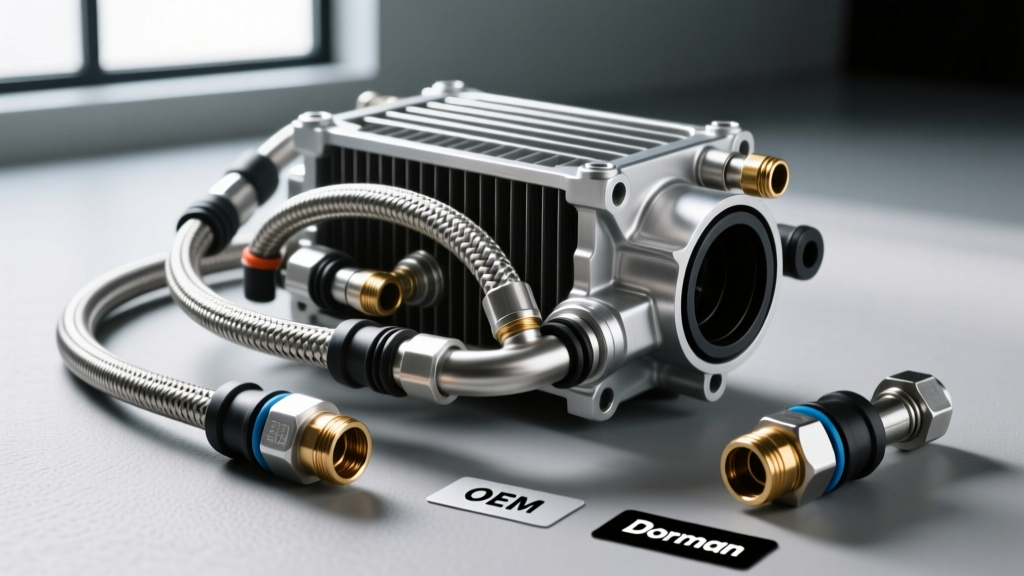
When performing a leaking transmission cooler lines repair on a performance vehicle, the industry standard upgrade is transitioning from OEM push-lock quick-connects to military-spec AN (Army-Navy) fittings. Specifically, utilizing JIC 37-degree flared fittings paired with braided stainless steel or PTFE-lined hoses.
AN-6 vs. AN-8: Sizing for Flow and Pressure
Transmission cooler lines operate under high pressure (up to 150+ PSI on the pressure side) but require high volume on the return side.
- AN-6 (3/8-inch ID): Requires a 9/16-inch wrench. This is the standard for most passenger vehicles and light-duty trucks. It provides ample flow for 6L80 and ZF 8HP applications while maintaining high structural integrity.
- AN-8 (1/2-inch ID): Requires a 3/4-inch wrench. Mandatory for heavy-duty towing applications, high-horsepower drag racing builds (like the Dodge TF-8 or upgraded 4L80E setups), and auxiliary cooler integration where minimizing pressure drop across long routing distances is critical.
The 6L80 Thermal Bypass Delete
If you are upgrading a GM 6L80/6L90, a bypass delete is non-negotiable. By removing the OEM thermal valve and replacing it with a straight-through aluminum AN adapter tube, you ensure 100% of the ATF flows to the cooler at all times. This simple modification can drop peak transmission temperatures by 20°F to 35°F during sustained highway towing or track sessions, drastically extending the life of the clutch packs and the fluid itself.
Step-by-Step Execution: Repair and Upgrade Protocol
Executing this upgrade requires precision. Cross-threading an aluminum adapter into a cast-aluminum transmission case will result in a ruined case and a totaled vehicle. Follow these exact specifications.
Step 1: Safe Depressurization and Draining
ATF expands when hot. Never crack a cooler line on a hot transmission. Allow the vehicle to cool, then place a catch pan beneath the lines. Use a specialized quick-connect release tool (like the Lisle 39960 set) to safely detach the OEM lines without damaging the case threads.
Step 2: Installing Aluminum AN Adapters
The transmission case and radiator ports typically use metric or NPT threads that must be adapted to AN.
- Thread Prep: Clean the case threads with a dedicated thread chaser (not a standard tap, which cuts new metal). Blow out debris with compressed air.
- Sealing: Use a high-temperature anaerobic thread sealant (like Loctite 545) for NPT-to-AN adapters. Never use Teflon tape, as shredded tape will enter the transmission and clog the valve body solenoids.
- Torque Specs: Aluminum AN adapters into an aluminum trans case should be torqued to 15-18 lb-ft. Steel adapters into aluminum require extreme caution; limit torque to 12-15 lb-ft to prevent stripping.
Step 3: Routing and Securing Braided Lines
PTFE-lined braided hoses resist the aggressive synthetic detergents found in modern fluids like Dexron VI, Mercon ULV, and ZF 8-Speed fluid. When routing, maintain a minimum 3-inch clearance from all exhaust components. Use aerospace-grade Adel clamps (cushioned metal loops) bolted to existing frame holes to secure the lines every 12 to 18 inches. This prevents harmonic vibration from fatiguing the AN hose ends.
Step 4: Flare Torque and Final Assembly
Connect the AN hose ends to the adapters. For aluminum AN-6 fittings, torque to 10-12 lb-ft. For AN-8, torque to 18-20 lb-ft. Always use a crowfoot wrench on a calibrated torque wrench to ensure accurate clamping load without rounding the anodized aluminum nuts.
Cost & Sourcing Breakdown: OEM vs. Performance
While an OEM repair is cheaper upfront, the performance upgrade offers vastly superior longevity and thermal management. Below is a realistic 2026 pricing breakdown for a full line replacement.
| Component / Service | OEM Replacement Route | Performance AN Upgrade Route |
|---|---|---|
| Hard Lines & Rubber Hoses | $80 - $140 (Dealer) | $160 - $220 (PTFE Braided Kit) |
| Adapters & Fittings | $15 (Plastic Clips) | $65 - $95 (Billet Aluminum AN) |
| Bypass Delete (GM 6L80) | N/A (Retains OEM Valve) | $35 - $50 (Straight Delete Tube) |
| ATF Fluid Top-Off (2-3 Qts) | $25 - $45 | $25 - $45 |
| Estimated DIY Total | $120 - $200 | $285 - $410 |
For sourcing high-quality PTFE lines and billet adapters, reputable performance brands featured on platforms like Mishimoto or specialized drivetrain shops offer application-specific kits that eliminate the guesswork of measuring hose lengths and crimping fittings.
Post-Repair Verification and Thermal Mapping
Once the new lines are installed and the system is filled to the correct level (checking at the specified temperature, usually 86°F to 122°F depending on the manufacturer's dipstick or level-plug procedure), the verification process begins.
Run the vehicle through all gear ranges while stationary to cycle the valve body and purge air from the cooler circuit. Then, perform a 15-mile test drive. Use an OBD-II scanner capable of reading the Transmission Fluid Temperature (TFT) PID. Monitor the line pressure and TFT simultaneously. If you installed a bypass delete, you should see the TFT stabilize much faster and remain 15°F to 20°F lower under load compared to stock. Inspect all AN fittings with a UV flashlight and ATF dye if you suspect a micro-weep, though properly torqued 37-degree JIC flares are virtually leak-proof under transmission pressures.
Final Thoughts on Drivetrain Reliability
Treating a leaking transmission cooler lines repair as a mere maintenance chore is a disservice to your drivetrain. By upgrading to braided stainless lines, eliminating restrictive plastic quick-connects, and deleting thermal bypass valves, you transform a weak point into a robust, high-flow cooling circuit. Whether you are pushing 800 wheel horsepower in a ZF 8HP-equipped Charger or towing 10,000 lbs with a 6L80 Silverado, precision AN upgrades ensure your transmission stays cool, pressurized, and ready to perform.