The Acoustic Illusion: TR-6060 Bellhousing vs. FEAD Noise
One of the most frequent misdiagnoses in modern manual transmission repair involves the GM Tremec TR-6060, commonly found in the 2010–2015 Camaro SS and various Corvette applications. Owners and novice technicians often report a high-pitched metallic squeal, chirp, or grind emanating from the rear of the engine block. The immediate assumption is a failing hydraulic concentric slave cylinder (CSC) or throw-out bearing (TOB). However, the aluminum TR-6060 bellhousing acts as a massive acoustic amplifier. Front-End Accessory Drive (FEAD) noise—specifically a failing AC compressor clutch bearing or pulley bearing—can travel through the serpentine belt tensioner, into the engine block, and resonate inside the bellhousing, perfectly mimicking a failing throw-out bearing.
Before committing to a 6.5-hour transmission removal job, it is critical to isolate the noise source. Many technicians mistakenly drop the transmission before learning how to take off AC compressor clutch assemblies to rule out front-end accessory drive noise. In 2026, with the rising cost of OEM dual-mass flywheels and hydraulic CSC assemblies, accurate diagnostics are more financially critical than ever.
Diagnostic Flowchart: Isolating the Squeal
Use this decision matrix to determine if your TR-6060 throw-out bearing is actually the culprit, or if the issue lies at the front of your LS3/L99 engine.
- Noise present at idle, clutch pedal fully released (engaged): Likely pilot bearing, input shaft bearing, or FEAD accessory (AC clutch pulley bearing).
- Noise appears only when taking up pedal free-play (clutch disengagement begins): Classic throw-out bearing / CSC bearing failure.
- Noise changes pitch when AC is turned ON/OFF: High probability of AC compressor clutch coil gap issue or compressor internal failure.
- Noise disappears completely when serpentine belt is removed: 100% FEAD issue. The TR-6060 clutch system is mechanically sound.
Step-by-Step: How to Take Off AC Compressor Clutch (LS3/L99)
If removing the serpentine belt stops the noise, but you need to verify the AC compressor clutch assembly without fully replacing the compressor, follow this procedure. This requires basic hand tools and a specialized clutch puller.
Tools Required
- 10mm socket and ratchet
- Snap ring pliers (internal/external)
- Feeler gauge set
- AC Clutch Puller/Installer tool (e.g., Lisle HVAC & Clutch Tools or OEMTOOLS equivalent)
- Thread locker (Blue)
Removal Procedure
- Disconnect the Battery: Always isolate the negative terminal to prevent the AC clutch from engaging unexpectedly or shorting the coil.
- Remove the Center Bolt: The clutch plate is held by a single center bolt (usually 10mm). Remove this bolt and the flat washer.
- Pull the Clutch Plate: Thread the appropriate puller tool into the center hub of the clutch plate. Tighten the puller screw against the compressor shaft until the plate pops free. Do not pry with a screwdriver, as you will warp the friction surface.
- Inspect the Shims: Behind the clutch plate, you will find thin metal shims on the compressor shaft. Remove and store them carefully; these dictate the critical air gap.
- Remove the Pulley Snap Ring: Use snap ring pliers to remove the large retaining ring holding the pulley and bearing assembly to the compressor snout.
- Extract the Pulley: Use a standard gear puller or the specific AC pulley puller attachment to slide the pulley and bearing off the compressor.
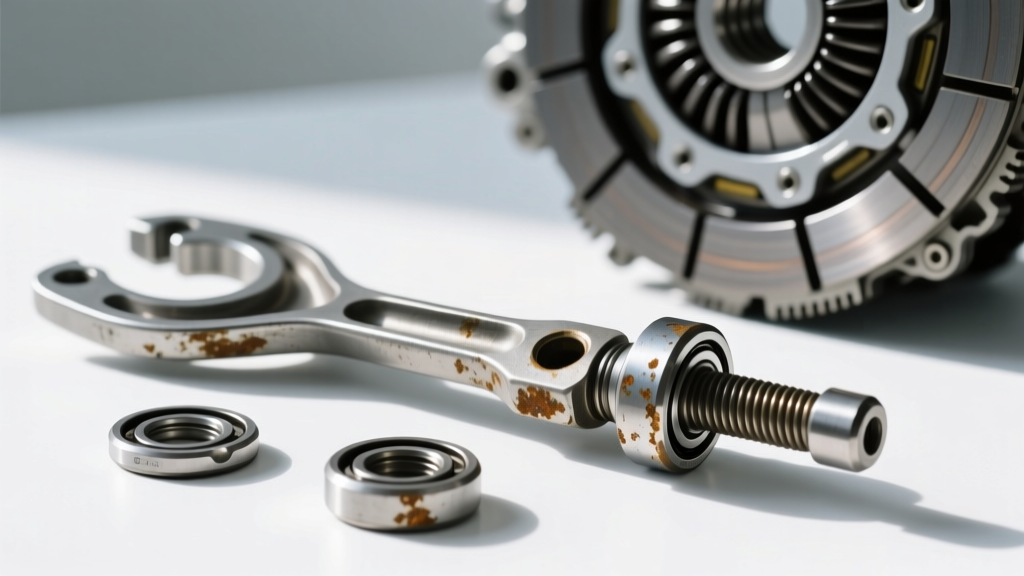
Once removed, spin the pulley bearing by hand. It should be buttery smooth with zero lateral play or gritty resistance. If the bearing is dry, pitted, or grabs, you have found the source of your "throw-out bearing" noise. Reassembly requires checking the air gap with a feeler gauge (spec is typically 0.020" to 0.030" for GM/Delphi HT6 compressors). If the gap is too wide, the clutch will slip and chatter; if too tight, it will drag and burn out.
Evaluating the TR-6060 Throw-Out Bearing
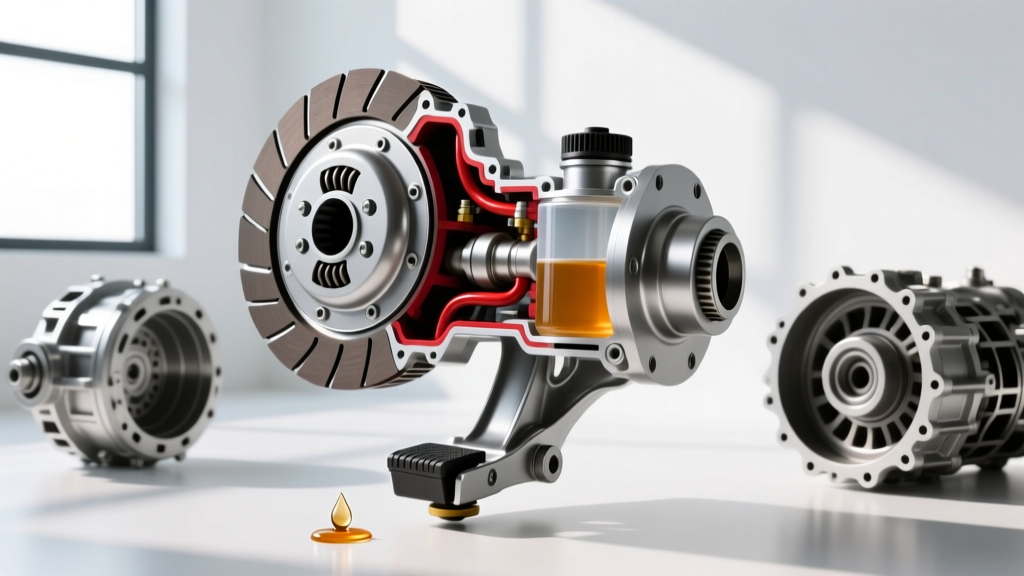
If the serpentine belt is removed and the noise persists when depressing the clutch pedal, the fault lies inside the TR-6060 bellhousing. The TR-6060 utilizes a hydraulic Concentric Slave Cylinder (CSC) where the throw-out bearing is integrated directly into the hydraulic piston assembly. Unlike older mechanical fork setups, you cannot simply replace the bearing; the entire CSC must be replaced.
Common CSC & TOB Failure Modes
According to FTE Automotive Concentric Slave Cylinders technical documentation, the primary failure modes for hydraulic CSCs include:
- Seal Weeping: Brake fluid bypasses the internal seals and coats the clutch friction disc, leading to severe clutch slip and chatter alongside the bearing noise.
- Cage Disintegration: The roller bearing cage fractures due to excessive heat from riding the clutch, causing a harsh grinding sensation felt directly through the pedal.
- Piston Scoring: The internal bore becomes scored, leading to slow clutch disengagement and difficulty shifting into reverse or first gear while idling.
The Infamous TR-6060 Hydraulic Bleed
If you replace the CSC (GM Part # 92226522 or aftermarket LuK equivalent), be prepared for the notorious TR-6060 hydraulic bleed procedure. The slave cylinder sits at the lowest point of the hydraulic circuit, making gravity bleeding entirely ineffective. Air becomes trapped in the upward loop of the hard line. You must use a pressure bleeder set to 15-20 PSI, or employ the "zip-tie method" (depressing the pedal to the floor and zip-tying it overnight) to allow the CSC piston to fully extend and push micro-bubbles up to the master cylinder reservoir. Furthermore, the hydraulic line connects to the CSC via a specialized quick-connect fitting inside the bellhousing, requiring a 5/16" fuel line disconnect tool or GM tool J-44321 for removal.
TR-6060 Bellhousing & Clutch Torque Specifications
When reassembling the TR-6060 and LS clutch system, precise torque is mandatory to prevent harmonic vibrations that can be mistaken for bearing noise. Always reference Tremec TR-6060 Manual Transmission service guidelines.
| Component | Fastener Size / Spec | Torque Specification |
|---|---|---|
| Flywheel to Crankshaft (LS3) | M11 x 2.0 (ARP or OEM) | 74 lb-ft + 90 degrees |
| Pressure Plate to Flywheel | M8 x 1.25 | 22 lb-ft (Star Pattern) |
| Bellhousing to Engine Block | M10 / M12 | 37 lb-ft |
| Transmission Crossmember | M12 | 52 lb-ft |
| Driveshaft to Pinion Flange | 12mm 12-point | 22 lb-ft |
| CSC Hydraulic Line Fitting | Quick-Connect | N/A (Seat until click, verify retention) |
2026 Repair Cost Comparison: TOB vs. AC Clutch
Understanding the financial stakes of misdiagnosis is crucial for shop owners and DIYers alike. Here is a realistic breakdown of 2026 market pricing for these two vastly different repairs.
| Repair Scenario | Parts Cost (OEM/Premium) | Estimated Labor Time | Total Cost Estimate |
|---|---|---|---|
| AC Compressor Clutch Bearing/Pulley | $65 - $140 | 0.8 Hours | $185 - $280 |
| AC Compressor Complete Assembly | $280 - $450 | 1.5 Hours + Refrigerant | $550 - $850 |
| TR-6060 CSC / Throw-Out Bearing Only | $160 - $220 | 6.5 Hours | $850 - $1,100 |
| Full TR-6060 Clutch Job (CSC, DMF, Disc, PP) | $850 - $1,400 | 7.5 Hours | $1,600 - $2,400+ |
Expert Tips for Preventing Premature TR-6060 TOB Failure
The hydraulic CSC in the TR-6060 is designed to maintain constant, light contact with the pressure plate fingers. Unlike older cable-driven setups that required free-play, the TR-6060 CSC operates with zero free-play. However, this means the bearing is always spinning under load. To maximize the lifespan of your throw-out bearing:
- Never Rest Your Foot: Even a few pounds of pressure on the clutch pedal will push the CSC piston further into the pressure plate fingers, generating immense friction and heat that will destroy the bearing seal in a matter of weeks.
- Monitor Fluid Color: Check the clutch master cylinder reservoir (shared with the brake system on some GM platforms, or standalone on others). If the fluid is dark or contains suspended black particles, the CSC bearing cage or internal seals are already degrading.
- Inspect the DMF: If your Camaro SS is equipped with a Dual-Mass Flywheel, check for excessive rotational free-play. A failing DMF spring pack will create a clattering noise at idle that disappears when the clutch is depressed, often confusing owners into thinking the TOB is the issue when the pedal is engaged.
By methodically eliminating front-end accessory noise and understanding the unique hydraulic architecture of the Tremec TR-6060, you can confidently diagnose throw-out bearing failures without wasting hours on unnecessary transmission removals.