The Evolution of Toyota Tacoma Differential Specifications
When maintaining the drivetrain of Toyota's most popular midsize truck, selecting the correct Toyota Tacoma differential fluid type is a topic of intense debate among owners and off-road enthusiasts. Whether you are servicing a battle-tested 3rd-generation (2016–2023) model or breaking in a brand-new 2026 4th-generation hybrid trail rig, the differential gears and bearings rely entirely on a thin film of gear oil to survive extreme loads.
Historically, Toyota recommended 80W-90 API GL-5 gear oil for older Tacomas. However, as Corporate Average Fuel Economy (CAFE) standards tightened, Toyota shifted its OEM factory fill and service recommendation to a lower-viscosity 75W-85 API GL-5 synthetic blend. This change reduced parasitic drag and improved fuel economy by a marginal but measurable percentage. But is the OEM 75W-85 fluid the best choice for your specific build in 2026? Let's break down the chemistry, compare the top aftermarket alternatives, and provide the exact service specifications you need.
Viscosity Showdown: 75W-85 vs. 75W-90
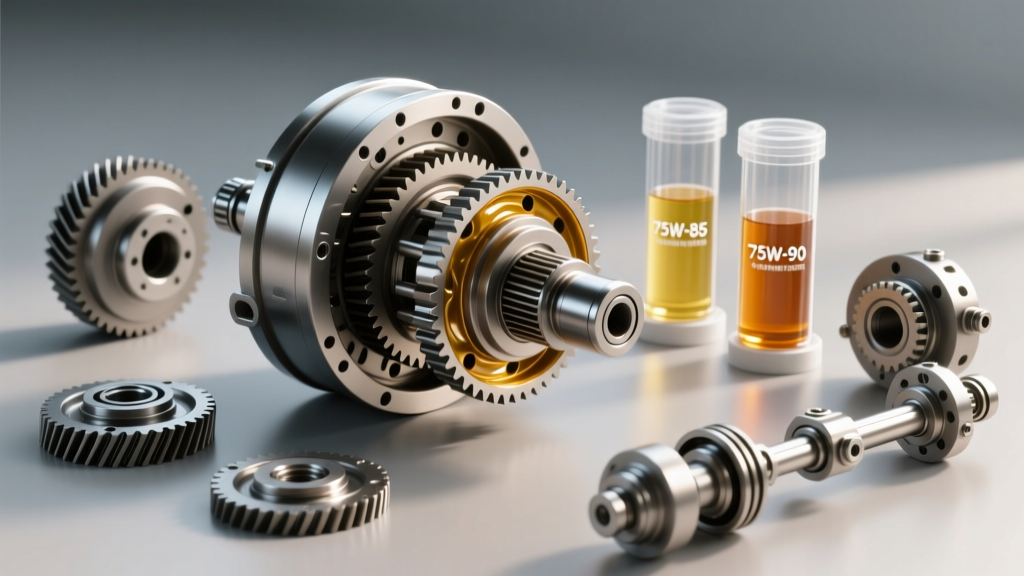
Understanding the difference between 75W-85 and 75W-90 is critical before you buy your next case of gear oil. The first number (75W) represents the oil's flow characteristics at cold temperatures (Winter). Both fluids will flow similarly during cold starts, ensuring rapid lubrication to the ring and pinion gears. The second number (85 vs. 90) represents the oil's kinematic viscosity at operating temperature (100°C / 212°F).
When to Stick with OEM 75W-85
- Daily Drivers & Commuters: If your Tacoma is a street-driven daily driver or light-duty hauler, the OEM 75W-85 provides the exact fuel economy and wear protection Toyota engineers designed for.
- Warranty Compliance: For 2024–2026 4th-generation Tacomas still under the 60,000-mile powertrain warranty, using the exact OEM viscosity ensures no dealership can deny a drivetrain claim.
When to Upgrade to 75W-90
- Heavy Towing & Payloads: If you frequently tow trailers over 4,000 lbs, differential temperatures can easily exceed 220°F. A 75W-90 synthetic maintains a thicker hydrodynamic film under extreme thermal stress.
- Low-Speed Rock Crawling: Slow-speed, high-torque off-roading generates immense shearing forces on the gear teeth. The slightly thicker 90-weight film resists being squeezed out from between the ring and pinion contact patches.
2026 Gear Oil Comparison Chart
Below is a comprehensive comparison of the top gear oils suitable for the Toyota Tacoma differential fluid type requirements, balancing OEM compliance, extreme-duty protection, and pricing.
| Brand & Product | Viscosity | Part Number | Est. Price/Qt | Best Application |
|---|---|---|---|---|
| Toyota Genuine Gear Oil LT | 75W-85 GL-5 | 08885-81016 | $12.50 | OEM Warranty & Daily Driving |
| AMSOIL Severe Gear | 75W-90 GL-5 | SVGQT | $22.95 | Heavy Towing & Extreme Off-Road |
| Red Line ShockProof Heavy | 75W-90 (Unique) | 50204 | $24.00 | Rock Crawling & Shock Loads |
| Mobil 1 Synthetic Gear Lube | 75W-90 GL-5 | 104361 | $11.50 | Budget-Friendly Synthetic Upgrade |
| Valvoline SynPower Full Syn | 75W-85 GL-5 | VV985 | $10.00 | Direct OEM Replacement |
Product Deep-Dive: Top Picks for 2026
AMSOIL Severe Gear 75W-90 (SVGQT)
AMSOIL's Severe Gear is widely considered the gold standard for aftermarket differential fluids. According to AMSOIL's official technical data, this fluid contains an extra dose of extreme-pressure (EP) additives. For Tacomas equipped with the 8.75-inch rear ring gear (found on TRD Off-Road and TRD Pro models), Severe Gear provides exceptional protection against gear pitting when running 33-inch or larger aftermarket tires without re-gearing.
Red Line ShockProof Heavy Gear Oil
Red Line takes a completely different chemical approach. Instead of traditional sulfur-phosphorus EP additives, ShockProof uses a solid microscopic dispersant that acts like a cushion on the gear teeth. While it is technically a 75W-90 equivalent, its unique formulation makes it ideal for Tacoma owners who subject their axles to sudden shock loads, such as dropping off ledges or high-speed desert whoops. Note that ShockProof is notoriously thick and can be difficult to pump through standard hand-transfer pumps.
Service Specifications: Capacities, Torque, and Hardware
Having the right fluid is only half the battle; improper fill levels or stripped drain plugs are the leading causes of differential failure post-service. Always consult the Toyota Technical Information System (TIS) for your specific VIN, but the following specifications apply to the vast majority of 3rd and 4th-generation Tacomas.
Fluid Capacities
- Front Differential (All 3rd & 4th Gen): 1.27 Liters (1.34 Quarts). Note: 4th-Gen models with the front differential disconnect require precise leveling.
- Rear Differential (8.0-inch Ring Gear): 3.0 Liters (3.17 Quarts).
- Rear Differential (8.75-inch Ring Gear - TRD Off-Road/Pro): 3.8 Liters (4.01 Quarts).
Torque Specifications & Hardware
Toyota uses a standard 18mm drain and fill plug on most Tacoma differentials. You must replace the crush washers every time you service the fluid to prevent slow weeping leaks.
- Crush Washer Part Number: 90430-18008 (18mm ID, aluminum).
- Front Diff Drain/Fill Torque: 29 lb-ft (39 Nm).
- Rear Diff Drain/Fill Torque: 36 lb-ft (49 Nm).
Pro-Tip: Always remove the FILL plug before removing the DRAIN plug. If the fill plug is seized or strips, you do not want to be left with an empty differential and no way to refill it.
The E-Locker and Friction Modifier Myth
One of the most common questions regarding the Toyota Tacoma differential fluid type is whether a limited-slip friction modifier is required. The short answer for modern Tacomas is no.
Older Toyota trucks equipped with clutch-type Limited Slip Differentials (LSDs) required a friction modifier to prevent chatter during tight turns. However, modern TRD Off-Road and TRD Pro Tacomas utilize an electronic locking rear differential (E-Locker). The E-Locker is essentially an open differential that uses an electromagnetic actuator to physically lock the side gears together via a locking collar. Because there are no friction clutches inside the differential housing, adding a friction modifier is completely unnecessary. While adding a modifier won't damage the E-Locker, it is a waste of money and can slightly reduce the fluid's overall load-carrying capacity by diluting the base oil and EP additive package.
4th-Generation (2024–2026) Front Differential Disconnect
If you own a 2024, 2025, or 2026 Tacoma TRD Off-Road or TRD Pro, your front axle features a disconnecting front differential mechanism to allow for independent suspension articulation and improved off-road flex. The internal actuator mechanism and the shifting collar are highly sensitive to fluid viscosity and temperature.
Using an overly thick gear oil (like a straight 85W-140 or a heavy racing grease) can cause the electronic actuator to bind or fail to engage/disengage properly in cold weather. Stick strictly to a high-quality 75W-85 or a premium 75W-90 synthetic to ensure the internal shift collar moves freely. Furthermore, overfilling the front differential on these specific models can cause fluid to be pushed past the axle seals or into the actuator breather tube, leading to catastrophic electronic failure. Fill exactly to the bottom of the fill plug threads and no higher.
Final Verdict: Which Fluid Should You Buy?
Choosing the ultimate Toyota Tacoma differential fluid type comes down to how you use your truck in 2026. If your truck is a warranty-covered daily driver or you simply want to follow the factory service manual to the letter, purchase the Toyota Genuine 75W-85 or Valvoline SynPower 75W-85. Both offer excellent shear stability and fuel economy.
However, if you have bolted on 34-inch tires, added a steel bumper, or regularly tow a camper through mountain passes, the OEM fluid will struggle with heat management. Upgrade to AMSOIL Severe Gear 75W-90. The slight increase in viscosity will not noticeably impact your fuel economy, but the robust synthetic base stocks and extreme-pressure additives will ensure your ring and pinion gears survive the harshest environments you can throw at them.