The BorgWarner 4406: Your F-150's 'Center Differential'
As we navigate the 2026 used truck market, 10-year-old 2016 Ford F-150 models are hitting critical drivetrain mileage milestones. For owners of the Lariat, Platinum, and Limited trims equipped with the AWD selector, understanding the front, rear, and 'center' differentials is paramount to avoiding catastrophic driveline failure. Unlike traditional full-time 4WD systems found in heavy-duty trucks or crossover SUVs that utilize a mechanical planetary center differential, the 2016 F-150 employs the BorgWarner 4406 Torque-On-Demand (TOD) transfer case.
This transfer case acts as an active, electronically controlled center differential. It uses an electromagnetic clutch pack to seamlessly vary the torque split between the front and rear axles based on wheel slip and throttle input. When owners search for 2016 F-150 differential fluid, they are typically looking for 75W-85 or 75W-140 gear oil for the solid axles. However, a catastrophic error occurs when DIYers mistakenly drain the BW4406 transfer case and refill it with heavy gear oil. The TOD clutch packs require the specific frictional properties of MERCON LV Automatic Transmission Fluid (ATF). Gear oil causes immediate clutch glazing, resulting in severe AWD binding and eventual transfer case destruction.
Top 4 Symptoms of Degraded Center Diff & AWD Fluid
Diagnosing driveline shudder requires isolating the source of the friction. Because the F-150's AWD system links the front Super 8.8 IFS differential, the rear 8.8 or 9.75-inch differential, and the BW4406 transfer case, degraded fluid in any of these three nodes can cause binding. Here is how to identify center differential (transfer case) specific fluid failure.
1. Low-Speed Cornering Bind (Tire Chirp)
If your F-150 exhibits tire chirping or a 'hopping' sensation during tight, low-speed turns on dry pavement while in AWD mode, the transfer case clutch pack is failing to modulate slip. The front and rear axles must rotate at different speeds during a turn. A healthy center diff equivalent (the TOD clutch) slips microscopically to allow this. Degraded MERCON LV fluid loses its friction modifiers, causing the clutches to lock up entirely, forcing the driveline to bind.
2. Driveline Shudder Under Load
A pronounced vibration that feels like driving over highway rumble strips during moderate acceleration (usually between 30-50 mph) is a hallmark of a slipping TOD clutch pack. As the fluid shears down and loses its viscosity index, the electromagnetic clutch cannot maintain steady hydraulic pressure, resulting in rapid engage-disengage cycling.
3. 'AWD Off' Dashboard Warning
The F-150's Powertrain Control Module (PCM) and Transfer Case Control Module (TCCM) monitor clutch slip via wheel speed sensors. If the module detects that the front and rear driveshafts are spinning at mismatched speeds that do not correlate with steering angle or slip events, it will trigger the 'AWD Off' message to protect the clutches from melting down.
4. Transfer Case Overheating Smell
Because the BW4406 is mounted directly behind the transmission crossmember, burnt fluid will often manifest as a sharp, acrid odor near the center skid plate. If you pull the fill plug and the fluid smells like burnt toast rather than standard ATF, the clutch friction material has delaminated.
Drivetrain Fluid Specification Matrix
Proper maintenance requires strict adherence to Ford's fluid specifications. Using the wrong weight gear oil in the axles can damage the electronic locking differential (e-Locker) mechanisms, while using gear oil in the TC will destroy the AWD system.
| Component | Fluid Type | Capacity | Fill Plug Torque |
|---|---|---|---|
| BW4406 Transfer Case (Center) | Motorcraft MERCON LV (XT-10-QLVC) | 2.0 qt (1.9L) | 33 lb-ft (45 Nm) |
| Rear Axle (8.8 / 9.75) | 75W-85 Synthetic (XY-75W85-QL) * | 2.3 - 3.4 qt | 33 lb-ft (45 Nm) |
| Front Axle (Super 8.8 IFS) | 80W-90 Premium (XY-80W90-QL) | 1.5 qt (1.4L) | 35 lb-ft (47 Nm) |
*Note: Trucks equipped with the Max Tow Package or those frequently towing over 8,000 lbs should upgrade the rear differential to 75W-140 Synthetic to prevent ring and pinion gear scoring under extreme thermal loads.
Advanced Diagnostic Protocol: Isolating the Shudder
Before tearing into the driveline, use a systematic approach to verify if the issue is mechanical (clutch pack wear) or chemical (fluid degradation).
- Step 1: The 2WD Isolation Test. Switch the rotary dial to 2H (2WD High). Perform the same acceleration and cornering maneuvers. If the shudder and binding completely disappear, the issue is isolated to the AWD engagement system (BW4406 clutches or front axle actuator). If the vibration persists in 2WD, suspect a failing rear limited-slip clutch pack or a worn U-joint.
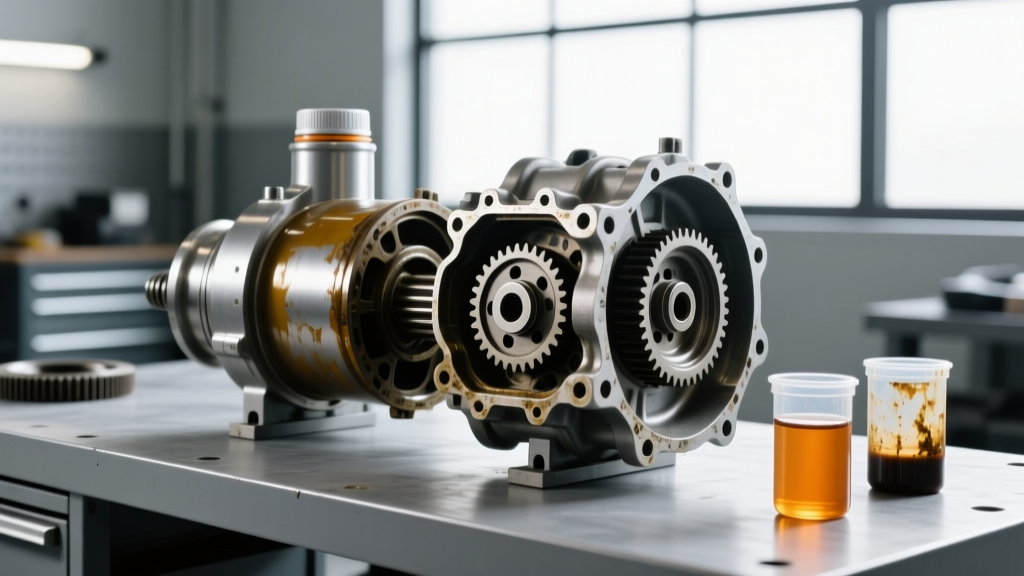
- Step 2: Fluid Sampling. Remove the transfer case fill plug using a 3/8-inch drive ratchet. Insert a clean zip-tie to draw out a sample. Healthy MERCON LV should be translucent red. If it is opaque brown or contains metallic glitter, the planetary gearset or clutch hub is physically machining itself.
- Step 3: FORScan PID Monitoring. Connect an OBDII adapter running FORScan software. Monitor the Transfer Case Clutch Duty Cycle and Clutch Pressure PIDs while driving in AWD. A healthy system will show smooth, progressive duty cycle changes. Erratic spikes indicate a failing TCCM or severely degraded fluid causing hydraulic cavitation.
Friction Modifiers: Do You Need XL-3?
A common point of confusion among Ford truck owners is the use of the XL-3 Friction Modifier Additive. For the 2016 F-150, the BW4406 transfer case does not require XL-3; the MERCON LV specification already contains the necessary friction modifiers for the TOD clutch pack. However, if your rear axle is equipped with a traditional clutch-type Limited Slip Differential (LSD) rather than the electronic locker or Torsen unit, you must add 4 oz of Motorcraft XL-3 to the 75W-85 gear oil to prevent rear-end chatter during tight turns.
Real-World Repair Costs and Preventative Economics
Ignoring center differential symptoms in the TOD transfer case leads to exponential repair costs. Based on 2026 aftermarket and dealer labor rates, here is the financial reality of drivetrain neglect:
- Preventative Fluid Service (All 3 Nodes): $180 - $280 (Includes MERCON LV, 75W-85, and labor).
- BW4406 Clutch Pack Rebuild: $1,200 - $1,800 (Requires transfer case removal, split-case teardown, and new BorgWarner friction/steel plates).
- Remanufactured Transfer Case Assembly: $2,400 - $3,200 (Required if the planetary gear or main shaft scores the magnesium/aluminum housing due to total fluid starvation).
- Front IFS Differential Replacement: $1,500 - $2,200 (Often damaged if the TC locks up and transfers shock loads through the front CV axles and ring gear).
Summary
Troubleshooting the 2016 F-150's AWD system requires treating the transfer case as the highly sensitive center differential that it functionally is. By adhering strictly to MERCON LV for the TOD unit and utilizing the correct synthetic gear oils for the front and rear axles, you can eliminate low-speed binding, protect the driveline electronics, and ensure your truck remains capable for the next decade of service. Always reference the Ford Motorcraft Maintenance Guides and BorgWarner technical documentation for the most accurate, up-to-date torque specifications and fluid volumes.