The Core Question: How Do Torque Converters Work vs. Friction Clutches?
When automotive enthusiasts and drivetrain engineers ask how do torque converters work compared to traditional manual friction clutches, they are essentially comparing hydrodynamic fluid coupling to direct mechanical locking. Both devices serve the exact same primary function: they couple the engine's rotating crankshaft to the transmission's input shaft, allowing the vehicle to come to a stop without stalling the engine and enabling smooth gear transitions. However, the physics governing their operation, their efficiency curves, and their failure modes are vastly different. In this technical deep-dive, we will dissect the fluid dynamics of the torque converter, contrast it with the mechanical grip of a manual clutch, and explore how modern automatic transmissions bridge the gap between the two.
Fluid Dynamics vs. Mechanical Grip: The Engineering Breakdown
Inside the Torque Converter (Impeller, Turbine, Stator)
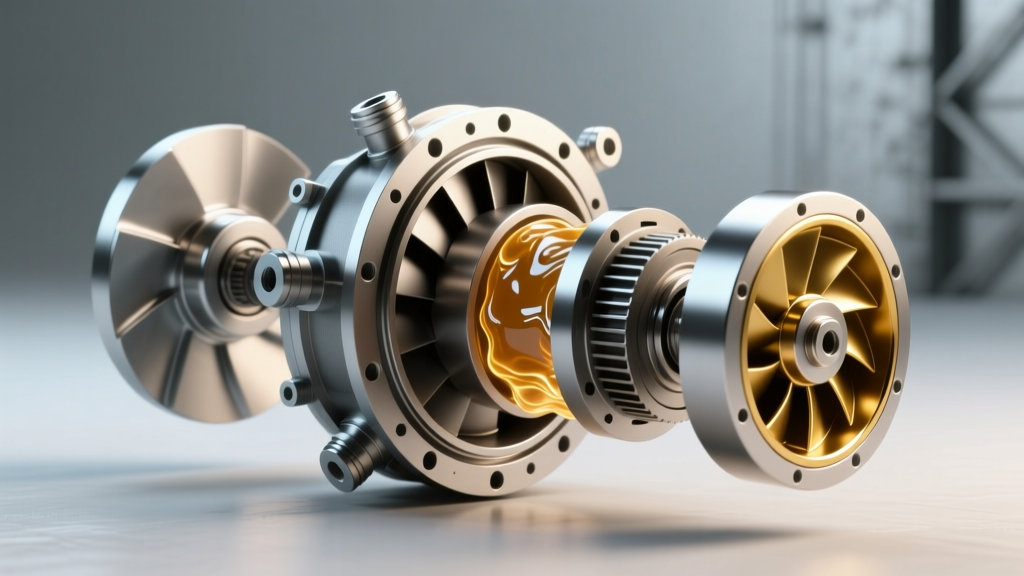
A torque converter is a hydrodynamic fluid coupling filled with automatic transmission fluid (ATF). It operates on the principle of centrifugal force and fluid momentum. The assembly consists of three primary internal components:
- The Impeller (Pump): Bolted directly to the engine's flexplate, the impeller spins at engine RPM. Its curved vanes fling ATF outward via centrifugal force, creating a high-velocity fluid stream.
- The Turbine: Connected to the transmission input shaft, the turbine sits directly opposite the impeller. The high-velocity fluid exiting the impeller strikes the turbine's vanes, transferring kinetic energy and causing the turbine—and consequently the transmission—to spin.
- The Stator: Positioned between the impeller and turbine on a one-way roller clutch, the stator is the secret to torque multiplication. As fluid exits the turbine, it is moving in a direction that would oppose the impeller's rotation. The stator's angled vanes redirect this returning fluid back into the impeller in the direction of rotation, effectively multiplying engine torque by a factor of 1.8x to 2.5x during initial acceleration (before stall speed is reached).
Because there is no physical connection between the impeller and turbine, a torque converter allows for 'slip.' This slip is what allows an automatic vehicle to idle in gear without stalling. However, this inherent slip results in parasitic power loss and heat generation, which is why torque converters are historically less efficient than mechanical clutches during steady-state cruising.
The Manual Clutch Assembly (Flywheel, Friction Disc, Pressure Plate)
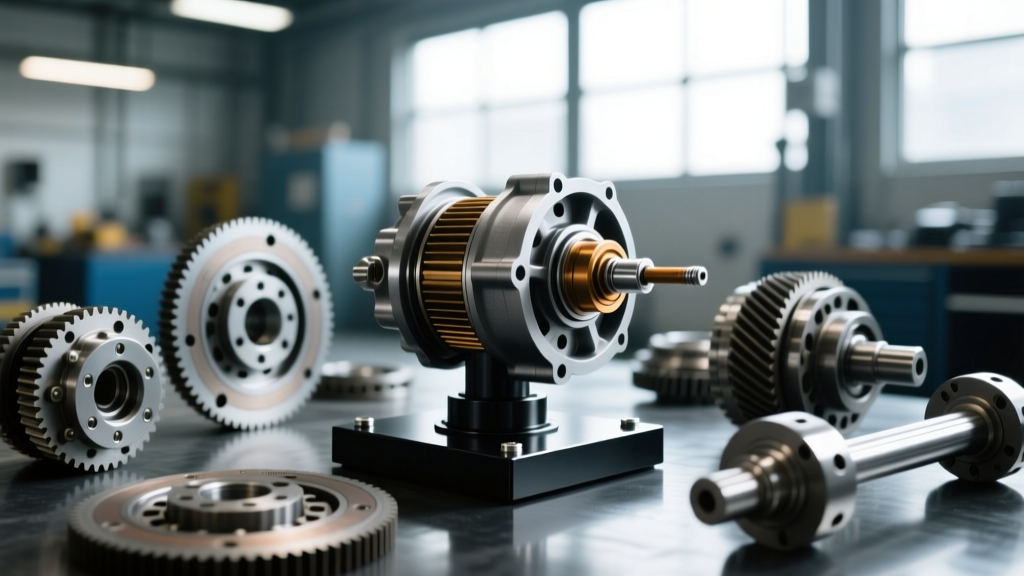
In contrast, a manual clutch relies entirely on mechanical friction and clamping force. The assembly consists of a heavy cast-iron or aluminum flywheel bolted to the crankshaft, a friction disc splined to the transmission input shaft, and a diaphragm-spring pressure plate bolted to the flywheel. When the clutch pedal is released, the pressure plate clamps the friction disc against the spinning flywheel with immense force (often exceeding 2,800 lbs of clamp load in performance applications like the Tremec T56 Magnum).
Unlike the torque converter, a manual clutch offers zero torque multiplication. It is strictly a 1:1 coupling device. When fully engaged, there is zero slip, meaning drivetrain efficiency is near 99%. However, this mechanical lock requires the driver to manually modulate the slip zone (the friction point) during takeoff, and the clutch must be fully disengaged to prevent stalling when coming to a stop.
Comparative Data: Torque Converter vs. Clutch Specifications
| Feature | Torque Converter (e.g., GM 4L60E / 6L80) | Manual Friction Clutch (e.g., Tremec T56) |
|---|---|---|
| Coupling Medium | Hydrodynamic (ATF Fluid) | Mechanical (Friction Material) |
| Torque Multiplication | Yes (Up to 2.5x via Stator) | No (Strictly 1:1 Ratio) |
| Steady-State Efficiency | 85-92% (Unlocked) / 98% (TCC Locked) | 98-99% (Fully Engaged) |
| Heat Generation | High (Requires dedicated ATF cooler) | Low (Only during slip/takeoff) |
| Typical Lifespan | 150,000 - 250,000+ miles | 60,000 - 100,000 miles (Highly variable) |
| Failure Mode | Stator clutch failure, TCC slip, fin fatigue | Friction disc wear, pressure plate fatigue |
The Evolution: Torque Converter Clutches (TCC) and Lockup Mechanisms
To answer how do torque converters work in modern vehicles, we must address the Torque Converter Clutch (TCC). Because hydrodynamic slip destroys fuel economy and generates excessive heat, engineers developed the TCC—a mechanical friction clutch housed inside the torque converter. When the vehicle reaches cruising speed, the transmission control module (TCM) applies hydraulic pressure to lock the turbine directly to the impeller, creating a 1:1 mechanical connection and bypassing the fluid coupling entirely.
In advanced transmissions like the ZF 8HP or GM's 10L90, the TCC is a multi-plate, electronically controlled capacity clutch (ECCC). Instead of a harsh on/off lockup, the TCM uses Pulse Width Modulation (PWM) to allow a highly controlled, microscopic slip of roughly 20 to 40 RPM. This 'slipping lockup' eliminates low-frequency engine vibrations (NVH) from entering the drivetrain, allowing the transmission to lock up as early as 2nd gear without inducing cabin shudder. This effectively gives modern automatics the efficiency of a manual clutch with the smoothness of a fluid coupling.
Diagnosing TCC Shudder and Slipping Symptoms
Because the internal TCC relies on friction material, it is subject to wear and degradation, often mimicking the symptoms of a failing manual clutch. Common TCC failure symptoms include:
- Drivetrain Shudder: A rhythmic vibration felt through the chassis at 40-60 mph under light throttle. This indicates the TCC friction material is degraded or the ATF has lost its friction-modifying additives, causing the clutch to rapidly grab and release.
- TCC Slip Codes (P0741 / P1870): If the TCM commands TCC lockup but the input and output shaft speed sensors detect a slip greater than the programmed threshold (usually >100 RPM), it will set a diagnostic trouble code and inhibit lockup to protect the transmission.
- Overheating ATF: A TCC that fails to lock will force the transmission to rely entirely on fluid coupling at highway speeds, rapidly spiking ATF temperatures past the 220°F danger zone, accelerating fluid breakdown and clutch pack wear.
Real-World Cost and Replacement Considerations
The economics of replacing these components differ significantly due to labor intensity and part complexity. Replacing a torque converter requires dropping the entire transmission, as the TC is sandwiched between the engine flexplate and the transmission bell housing. For a common GM 4L60E, a remanufactured torque converter (stall speed ~1800 RPM) costs between $250 and $450. However, labor to remove the transmission, flush the cooler lines, and reinstall the unit typically runs $800 to $1,200, bringing the total to roughly $1,050 - $1,650. It is mandatory to replace the transmission fluid (approx. 11.2 quarts of Dexron VI) and often the front pump seal during this service.
Conversely, replacing a manual clutch in a vehicle equipped with a Tremec T56 also requires transmission removal. A high-performance twin-disc clutch kit (such as a McLeod RXT rated for 800 lb-ft of torque) will cost between $900 and $1,400. Labor is comparable to the automatic, ranging from $600 to $900. However, manual clutches require periodic replacement of the friction disc, throwout bearing, and sometimes flywheel resurfacing, whereas a torque converter's internal TCC can often last the lifetime of the vehicle if the ATF is maintained properly.
Expert Drivetrain Tip: When diagnosing TCC shudder in modern 6-speed and 8-speed automatics, do not immediately condemn the torque converter. Many shudder issues stem from degraded friction modifiers in the ATF or a failing PWM solenoid in the valve body. Always perform a fluid exchange with the exact OEM-specified fluid (e.g., ZF Lifeguard 8 or GM Dexron ULV) and run a TCC slip data log via an OBD2 scanner before authorizing a transmission teardown.
Summary: Which Drivetrain Coupling Reigns Supreme?
Understanding how do torque converters work compared to manual clutches highlights a fascinating evolution in automotive engineering. The manual friction clutch remains the undisputed king of raw, unfiltered mechanical efficiency and driver engagement, making it the preferred choice for dedicated track cars and heavy-duty towing applications where absolute lockup is required. However, the modern torque converter—armed with a stator for off-the-line torque multiplication and a sophisticated PWM-controlled TCC for highway efficiency—has effectively rendered the traditional manual clutch obsolete for daily driving. By combining the best attributes of fluid dynamics and mechanical friction, today's torque converters deliver seamless power delivery, unparalleled NVH damping, and fuel economy that rivals any manual transmission on the market.
Sources and Further Reading:
Sonnax: Torque Converter Basics and Diagnostics
ZF Group: Automatic Transmission Technology and 8HP Architecture