Introduction: The Intersection of Acoustics and Hydraulics
As an automotive transmission specialist, one of the most critical skills in your diagnostic arsenal is the ability to interpret sound. Torque converter noise diagnosis is rarely about listening to a single isolated clunk or whine; it is about understanding the hydraulic and mechanical forces at play under specific load conditions. When a vehicle enters the shop with drivetrain complaints, technicians frequently perform a stall test. But to truly leverage this test for preventive maintenance, we must answer a fundamental question: what does torque converter stall mean in the context of acoustic diagnostics? By bridging the gap between stall speed physics and noise generation, you can identify failing stator clutches, cavitating impellers, and deteriorating torque converter clutch (TCC) friction materials long before they result in catastrophic transmission failure.
The Core Question: What Does Torque Converter Stall Mean?
Before diagnosing noise, we must define the mechanics of the stall condition. Torque converter stall speed is the maximum engine RPM achieved when the transmission is in a forward gear, the throttle is wide open (WOT), and the output shaft is held completely stationary (usually via the service brakes).
During this state, the impeller (driven by the engine) is spinning at maximum velocity, while the turbine (connected to the transmission input shaft) is held at zero RPM. The stator, situated between them, is locked by its one-way clutch to redirect fluid flow and multiply torque. When technicians ask what does torque converter stall mean for noise diagnosis, they are essentially asking how these components behave when subjected to maximum hydraulic shear and thermal stress. The noises generated during this 3-to-5-second window are direct acoustic signatures of the torque converter's internal health.
Acoustic Profiling: Diagnosing Noises During Operation and Stall
Preventive maintenance relies on catching anomalies early. Below is a structured acoustic profile to help you correlate specific noises with internal torque converter faults.
| Noise Type | RPM Condition | Probable Internal Cause | Preventive Action |
|---|---|---|---|
| High-Pitched Whine | Idle to 1,500 RPM | Fluid cavitation, restricted filter, or low fluid level causing the impeller to draw air. | Check fluid level at operating temp (180°F). Inspect pickup tube O-ring for air ingestion. |
| Heavy Gravel Rumble | During Stall Test | Stator one-way clutch failure; stator is freewheeling in both directions or jammed. | Immediate TC replacement. Flush cooler lines to remove metallic debris. |
| Rhythmic Shudder | 1,200 - 2,000 RPM (TCC Apply) | TCC friction material degradation or loss of fluid friction modifiers. | Perform a fluid exchange with OEM-specific ATF and friction modifier additive. |
| Metallic Clunk | Deceleration / Idle | Broken turbine hub, damaged flexplate, or failed internal thrust bearing. | Inspect flexplate runout. Replace TC and verify input shaft endplay. |
According to technical bulletins from the Sonnax Technical Resources library, a failing stator one-way clutch will often manifest as a severe lack of low-end power accompanied by a distinct 'marbles in a can' rumble during the stall test. Catching this early prevents the stator from melting the internal thrust washters and contaminating the entire transmission.
Preventive Maintenance: Executing the Stall Test Safely
The stall test is an aggressive diagnostic tool. If performed incorrectly, it will generate enough heat to glaze the TCC lining and degrade the transmission fluid in seconds. To use stall testing as a preventive diagnostic measure, follow this strict protocol:
1. Thermal Preparation
Never perform a stall test on a cold transmission. The automatic transmission fluid (ATF) must be between 180°F and 200°F (82°C - 93°C). Cold, viscous fluid will yield artificially high stall RPMs and can damage the stator clutch due to improper hydraulic engagement.
2. The 5-Second Rule
Apply the parking brake, firmly depress the service brake, and move the selector to Drive. Apply full throttle for no more than 5 seconds. Record the peak RPM. Immediately shift to Neutral and run the engine at 1,200 RPM for 30 seconds to circulate fluid through the transmission cooler. Repeat for Reverse.
3. Acoustic Monitoring
While the brake is held and the throttle is applied, listen closely to the bellhousing area. A healthy torque converter should produce a smooth, deep hydraulic rushing sound. Any metallic scraping, rhythmic knocking, or high-pitched squealing indicates immediate mechanical intervention is required.
Platform-Specific Stall and Noise Characteristics
Different transmission platforms exhibit unique stall behaviors and noise profiles. Understanding these nuances is vital for accurate diagnosis.
GM 4L60E / 4L65E
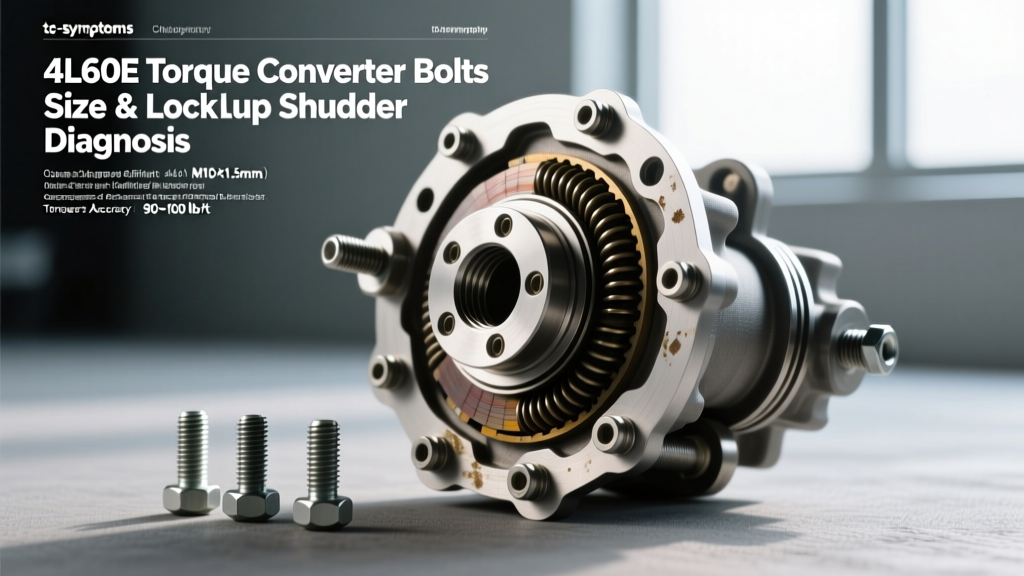
The 4L60E typically features a factory stall speed between 1,800 and 2,200 RPM. A common noise issue on high-mileage units is a distinct whine at idle that disappears above 1,200 RPM. This is often misdiagnosed as a pump issue but is frequently caused by a worn torque converter hub bushing starving the front pump. When replacing the TC, ensure the flexplate-to-TC bolts (typically 3/8"-24 UNF) are torqued to exactly 35 lb-ft. The total dry fluid capacity is 11.2 quarts of Dexron VI.
GM 6L80 / 6L90
The 6L80 utilizes a more complex TCC with controlled slip. Stall speeds generally range from 2,000 to 2,400 RPM. If you hear a low-frequency shudder during the TCC apply phase (usually around 45-55 mph), it indicates the specialized friction material on the TCC piston is wearing unevenly. Preventive maintenance here involves dropping the pan, replacing the internal filter (which is integrated into the pan on some TEHCM configurations), and utilizing strictly validated Dexron VI fluid. TC-to-flexplate bolts are M10x1.5 and must be torqued to 37 lb-ft (50 Nm).
ZF 8HP (8-Speed Automatic)
Found in millions of vehicles from BMW, Chrysler, and Ford, the ZF 8HP operates with highly sophisticated lockup strategies. The TCC is often applied in 1st or 2nd gear to improve efficiency. Because of this, traditional stall testing is heavily restricted by the TCM to protect the driveline. If a ZF 8HP exhibits a 'chuggle' or shudder noise during light throttle acceleration, it is often a TCC slip fault or degraded ZF LifeguardFluid 8. Preventive fluid exchanges every 60,000 miles are critical. As noted by the ZF Global aftermarket guidelines, using non-approved ATF in the 8HP will rapidly destroy the TCC friction linings, leading to severe shudder noises and eventual transmission teardowns.
Fluid Shear and TCC Shudder: The Silent Precursors to Noise
Noise is the final stage of failure; fluid degradation is the first. The torque converter relies on the shear stability of ATF to transfer power and cool the internal components. Over time, the extreme pressure (EP) additives and friction modifiers in the fluid break down.
When friction modifiers deplete, the TCC cannot smoothly transition from hydrodynamic drive to mechanical lockup. This results in micro-slip, which generates a low-frequency rumble or shudder noise. If ignored, this micro-slip generates localized heat exceeding 400°F, which will glaze the friction material and warp the turbine cover. To prevent this, utilize a thermal imaging gun on the transmission cooler lines during your diagnostic road test. A temperature delta greater than 40°F between the cooler inlet and outlet suggests restricted flow, often caused by TCC friction material shedding into the cooler circuit.
The Financial Impact: Preventive vs. Reactive Costs
Understanding what does torque converter stall mean for your diagnostic process directly impacts the customer's wallet. By diagnosing noise early, you can often save the transmission case and planetary gearsets from destructive debris. Here is a realistic look at the financial stakes in the current market:
- Preventive Fluid Service (ZF 8HP / 6L80): $250 - $450 (Includes OEM pan/filter assembly and 6-8 quarts of specialized ATF).
- Torque Converter Replacement (Drop & Swap): $900 - $1,600 (Includes aftermarket or OEM remanufactured TC, rear main seal, flexplate inspection, and fluid refill).
- Reactive Full Transmission Rebuild: $3,200 - $5,500+ (Required when a failed stator or shattered turbine hub sends metallic shrapnel through the valve body and clutch packs).
For deeper insights into torque converter failure modes and rebuild procedures, the Automatic Transmission Rebuilders Association (ATRA) provides extensive powertrain diagnostic flowcharts that corroborate the necessity of combining acoustic profiling with hydraulic stall data.
Conclusion
Torque converter noise diagnosis is not a guessing game; it is a precise science rooted in hydraulic physics. By understanding what torque converter stall means and how internal components behave under maximum load, technicians can decode the whines, clunks, and shudders that enter the service bay. Adhering to strict preventive maintenance protocols—monitoring fluid shear stability, executing safe stall tests, and utilizing platform-specific OEM fluids—will ensure drivetrain longevity and keep catastrophic failures at bay.