The Evolution of 4L60E Lockup Operation
As of 2026, the GM 4L60E remains one of the most widely serviced automatic transmissions in the automotive aftermarket. While its planetary gearsets and clutch packs are robust, the Achilles' heel of this platform has always been lockup torque converter operation. Understanding how the Torque Converter Clutch (TCC) operates is the first step in accurately diagnosing shudder, slip, and harsh engagement complaints.
Unlike older hydraulically switched transmissions, the 4L60E utilizes a Pulse Width Modulated (PWM) TCC solenoid (ACDelco part #24230298 or equivalent). Instead of a simple on/off hydraulic switch, the Powertrain Control Module (PCM) modulates the solenoid's duty cycle. This allows for a 'controlled slip' phase—typically maintaining a 20 to 40 RPM slip differential during the apply transition. This PWM strategy eliminates the harsh driveline shock of a mechanical lockup and reduces heat generation. However, this precision requires exact hydraulic pressure regulation, pristine friction materials, and flawless mechanical assembly.
Diagnosing TCC Shudder: Hydraulic vs. Mechanical Faults
TCC shudder is the most common lockup complaint on the 4L60E. It typically manifests as a rhythmic, low-frequency vibration between 35 and 55 MPH under light throttle, precisely when the PCM commands the TCC to apply. While many technicians immediately suspect a failing torque converter or degraded fluid, the root cause is often a complex intersection of hydraulic wear and mechanical misassembly.
The Hydraulic Culprits
- Worn TCC Regulator Valve Bore: The most notorious hydraulic fault in the 4L60E oil pump is the wear of the TCC regulator valve bore. As the aluminum bore wears, PWM apply pressure leaks past the valve, resulting in insufficient clamping force on the TCC piston. This triggers the classic P1870 (Transmission Component Slipping) code and severe shudder. The industry-standard fix is the Sonnax 77754-04K TCC regulator valve kit, which requires reaming the bore and installing a hardened steel sleeve.
- Fluid Degradation: The 4L60E requires Dexron VI fluid. Using obsolete Dexron III or generic multi-vehicle fluids lacking the specific friction modifiers required for GM's PWM lockup strategy will guarantee shudder. Dexron VI offers superior shear stability and precise friction coefficients necessary for controlled slip.
The Hidden Mechanical Culprit: Flexplate Mounting
While hydraulic faults dominate diagnostic forums, mechanical assembly errors during a rebuild or converter replacement frequently mimic internal lockup failures. This brings us to a highly searched but critically misunderstood specification: the 4l60e torque converter bolts size.
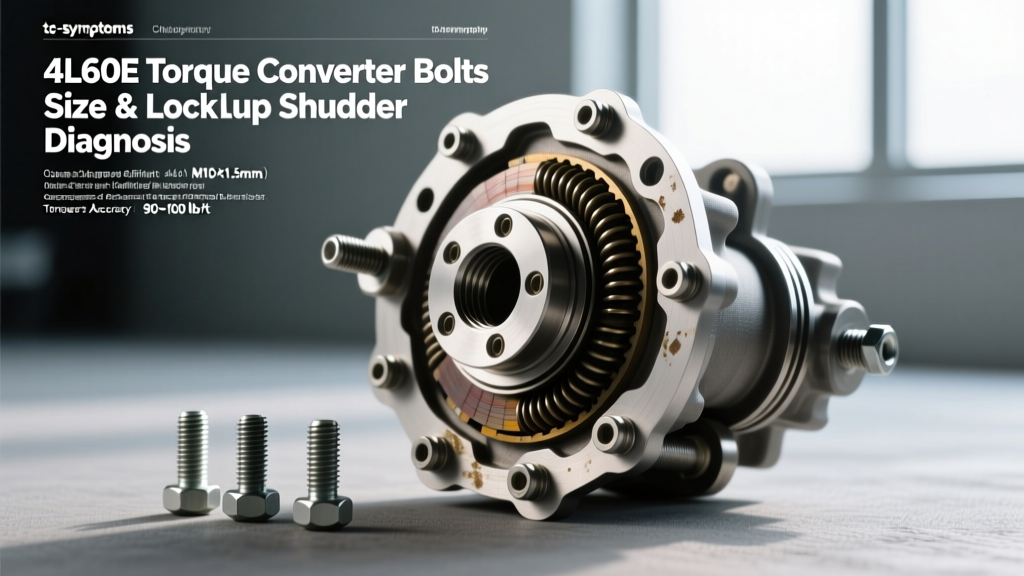
The 4L60E mates to a wide variety of GM V6 and V8 engines, including the 4.3L Vortec, 5.3L LS, and 5.7L LT1. The standard flexplate-to-converter bolt for these applications is an M10 x 1.5mm metric bolt. Using the incorrect bolt size, thread pitch, or length is a catastrophic error that directly destroys lockup operation.
If a builder uses a standard 1/2'-20 UNC bolt (common on older TH350/TH400 applications) or an M10 bolt that is too long, the bolt will bottom out inside the converter's welded internal stud. As the bolt is torqued, it pulls the flexplate against the converter pad, effectively jacking the front cover inward. This distortion pushes the TCC piston against the friction surface prematurely, causing immediate lockup shudder, burnt friction material, or a P0742 (TCC Stuck On) code before the vehicle even leaves the lift.
Bolt Dimension & Torque Matrix
Verifying the correct 4L60E torque converter bolts size and thread engagement is non-negotiable. Refer to the matrix below during assembly to prevent mechanical binding and TCC piston distortion.
| Specification | Requirement / Measurement | Critical Warning |
|---|---|---|
| Thread Size & Pitch | M10 x 1.5mm (Metric) | Never use 1/2' SAE bolts; cross-threading will destroy the converter hub. |
| Bolt Length | Varies by flexplate (Typically 16mm - 22mm under head) | Bolt must NOT bottom out. Verify clearance before final torque. |
| Thread Engagement | Minimum 10mm (Ideal 12-15mm) | Insufficient engagement will strip the hub under high-torque lockup apply. |
| Torque Specification | 35 lb-ft (47 Nm) | Use Blue Threadlocker (Loctite 243). Do not exceed 40 lb-ft. |
| Pilot Clearance | 0.005' - 0.015' gap between flexplate and converter pad | Zero clearance indicates a wrong converter or incorrect engine dowel alignment. |
Step-by-Step Lockup Troubleshooting Matrix
When a vehicle presents with lockup anomalies, use this diagnostic matrix to isolate the fault domain. According to data compiled by Transmission Digest, misdiagnosing a mechanical bind as a hydraulic failure leads to unnecessary warranty returns.
| Symptom / DTC | Probable Root Cause | Diagnostic Verification Step | Recommended Fix |
|---|---|---|---|
| P0741 (TCC Stuck Off / Excessive Slip) | TCC apply circuit leak, bad PWM solenoid, or worn turbine shaft seals. | Command TCC apply via bi-directional scanner. Monitor TCC slip RPM. If slip remains >100 RPM at steady cruise, hydraulic pressure is bleeding off. | Replace PWM solenoid; inspect turbine shaft sealing rings for wear. |
| P0742 (TCC Stuck On) | TCC valve stuck in apply position, or mechanical front cover distortion. | Check for engine stall when coming to a stop. Inspect flexplate bolts for correct M10x1.5 length and verify they did not bottom out. | Clear valve body bore; replace torque converter if internally distorted. |
| P1870 (Component Slipping) | Worn TCC Regulator Valve bore in the oil pump (classic 4L60E failure). | Monitor TCC slip RPM during light-throttle 4th gear cruise. Slip will fluctuate wildly despite steady PWM duty cycle command. | Install Sonnax 77754-04K reamer and sleeved regulator valve kit. |
| Highway Shudder (No Codes) | Degraded friction material, wrong fluid, or failing lockup damper springs. | Perform a 'brake tap' test. Lightly tap brakes during shudder. If shudder instantly stops, the TCC is releasing, confirming the shudder is TCC-related. | Flush with Dexron VI; replace torque converter with upgraded billet TCC piston. |
Advanced Component Verification and Upgrades
For high-torque applications or vehicles exhibiting repeated lockup failures, standard OEM components are often insufficient. The 4L60E's lockup torque converter operation is highly sensitive to line pressure fluctuations. When upgrading the transmission, consider the following enhancements to ensure bulletproof TCC apply:
- Billet TCC Apply Piston: OEM stamped steel pistons can flex under high line pressure, leading to uneven friction material wear and localized hot spots. Upgrading to a billet aluminum or reinforced steel piston ensures uniform clamping force across the entire friction surface.
- Heavy-Duty Lockup Clutch Material: Standard organic friction material degrades quickly under the thermal stress of PWM controlled slip. Kevlar-infused or high-energy carbon friction linings provide a more aggressive bite and resist the glazing that causes low-speed shudder.
- Line Pressure Boost: Installing a line pressure booster (such as the TransGo SK-4L60E-HD2 kit) increases base hydraulic pressure. This ensures the TCC regulator valve receives adequate feed pressure, preventing the slip that triggers P1870 codes under heavy load or towing conditions.
Final Assembly Protocol
The intersection of hydraulic precision and mechanical tolerance defines the success of any 4L60E rebuild. Always verify the 4l60e torque converter bolts size before mating the transmission to the engine. Measure the depth of the converter's internal threads and compare it against the bolt length and flexplate thickness. A simple $2 set of metric bolts can be the difference between a seamless, shudder-free lockup operation and a catastrophic warranty failure. Always rely on OEM torque specifications, utilize proper thread-locking compounds, and mandate the use of full-synthetic Dexron VI to protect the intricate PWM lockup strategy engineered into this legendary transmission.