Understanding the Heart of the Class 8 Drivetrain
When you are looking at the undercarriage of a Class 8 freight hauler, the semi truck differential is the unsung hero translating thousands of pound-feet of engine torque into forward motion. Whether you are working on a legendary Dana S130, a heavy-haul Dana S150, or a Cummins (formerly Meritor) RT-40-145 tandem axle, the ring and pinion gear set is the critical interface that makes it all happen. For beginners stepping into the world of heavy-duty drivetrain maintenance, setting up these massive gears can seem like dark magic. However, it is entirely based on precise measurements, rigid physics, and repeatable mechanical procedures.
Unlike the automotive world, where a mechanic might slap a set of 4.10 gears into a Jeep Wrangler Dana 44 using a basic shim kit, a commercial semi truck differential demands aerospace-level precision. A flawed setup in a heavy-duty axle will not just cause a minor whine; it will rapidly generate extreme heat, destroy the gear teeth, and potentially strand an 80,000-pound load on the shoulder of an interstate. In this 2026 beginner-friendly explainer, we will demystify the ring and pinion setup process, highlighting the crucial differences between automotive and heavy-duty commercial axles.
The Heavy-Duty Difference: Solid Spacers and Threaded Adjusters
The biggest mistake beginners make is applying light-duty automotive logic to commercial truck axles. In a standard automotive differential (like a GM 14-bolt or Ford 9-inch), pinion bearing preload is typically set by crushing a collapsible steel spacer with a massive impact gun. Furthermore, backlash is adjusted by tapping in thin metal shims behind the carrier bearings.
Throw that knowledge out the window for semi trucks.
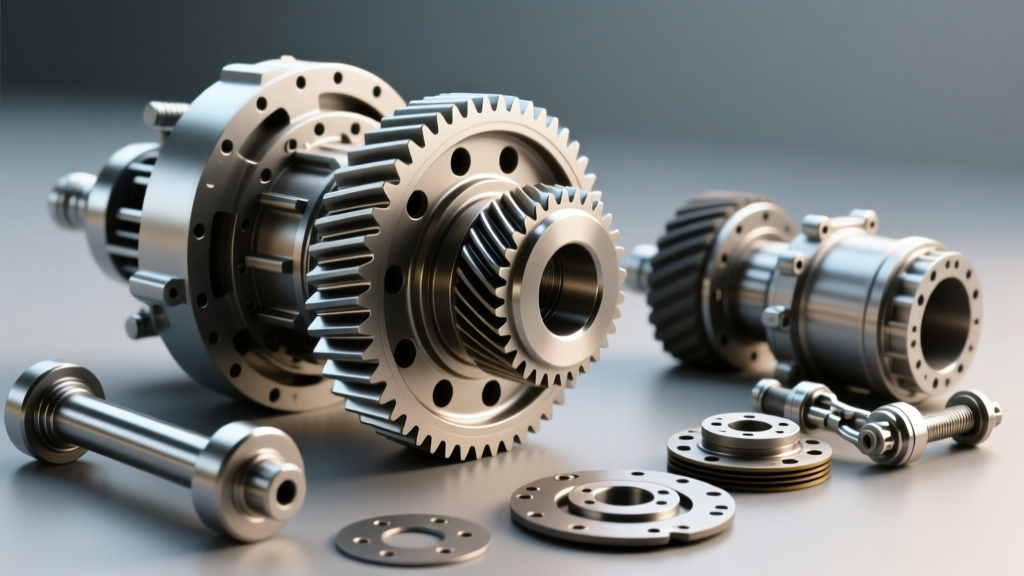
According to Dana Incorporated engineering standards, heavy-duty commercial axles utilize solid pinion spacers paired with a precise stack of metal shims to set bearing preload. This ensures the pinion bearings can withstand the immense shock loads of heavy hauling without the spacer collapsing over time. Additionally, instead of shimming the carrier for backlash, commercial axles use large, threaded carrier bearing adjusters (adjusting nuts) that screw directly into the axle housing. This allows for micro-adjustments on the fly without pulling the carrier out of the housing.
The Holy Trinity of Gear Setup
To achieve a perfect semi truck differential rebuild, a technician must balance three interdependent measurements. Changing one will almost always affect the others.
1. Pinion Depth
Pinion depth dictates how far the pinion gear protrudes into the center of the axle housing relative to the ring gear's centerline. This is controlled by a thick shim (or a machined spacer) located behind the inner pinion bearing. If the pinion is too deep, it will bind against the root of the ring gear teeth. If it is too shallow, it will ride on the very tips of the teeth, causing immediate spalling and catastrophic failure under load. Depth is measured using a specialized pinion depth gauge and a precision straight edge across the housing bore.
2. Bearing Preload
Preload is the amount of rotational resistance applied to the pinion and carrier bearings when no load is present. It eliminates internal clearance, ensuring the bearings roll smoothly rather than skidding, which generates fatal friction heat. For a semi truck pinion using new bearings, the target rolling torque is typically between 25 and 45 in-lb, measured with a specialized inch-pound dial torque wrench. The shims behind the solid spacer are added or removed until this exact rotational drag is achieved before the massive pinion nut is torqued down.
3. Backlash
Backlash is the microscopic gap between the non-driving face of the pinion tooth and the driving face of the ring gear tooth. This gap is mandatory; without it, thermal expansion of the steel and the physical squeezing of the gear oil film would cause the gears to lock up when the axle reaches operating temperatures (often exceeding 200°F). Heavy-duty commercial axles typically require a backlash specification between 0.012 in. and 0.018 in., measured at the outer edge of the ring gear using a magnetic-base dial indicator.
Step-by-Step: The Assembly and Paint Test
Once the mathematical measurements (depth, preload, backlash) are within the OEM specifications provided by manufacturers like Cummins (Meritor Axles), the technician must verify the physical interaction of the gears using the 'Paint Test'.
- Apply Marking Compound: A specialized gear marking paste (usually bright yellow or Prussian Blue) is painted onto the ring gear teeth in three distinct clusters spaced 120 degrees apart.
- Apply Resistance: A shop rag is stuffed into the pinion yoke to create drag, forcing the gears to bite into each other.
- Rotate and Inspect: The ring gear is rotated forward (Drive side) and backward (Coast side) to transfer the paint pattern from the pinion to the ring gear.
Decoding the Contact Pattern Matrix
Reading the paint pattern is the ultimate test of a technician's skill. The goal is a centered, slightly biased pattern that accounts for the extreme deflection of the axle housing under 80,000 lbs of payload.
| Pattern Observation | Drive Side Appearance | Coast Side Appearance | Required Adjustment |
|---|---|---|---|
| Ideal Pattern | Centered vertically, slightly toward the heel (inner edge) | Centered vertically, slightly toward the toe (outer edge) | None. Lock adjusters and proceed to final assembly. |
| Pinion Too Deep | Pattern rides low on the root of the tooth (flank) | Pattern rides high on the tip of the tooth (face) | Decrease pinion depth shim thickness. |
| Pinion Too Shallow | Pattern rides high on the tip of the tooth (face) | Pattern rides low on the root of the tooth (flank) | Increase pinion depth shim thickness. |
| Backlash Too Tight | Pattern pushed heavily toward the toe (outer edge) | Pattern pushed heavily toward the heel (inner edge) | Move ring gear away from pinion via threaded adjusters. |
| Backlash Too Loose | Pattern pushed heavily toward the heel (inner edge) | Pattern pushed heavily toward the toe (outer edge) | Move ring gear closer to pinion via threaded adjusters. |
Pro-Tip from the Bay: Never trust the paint pattern over your dial indicator measurements. The paint test is a verification tool, not a primary setup tool. If your backlash is mathematically correct at 0.015 in., but the paint pattern looks slightly off, trust the math. Under heavy load, the axle housing will deflect, pulling the pattern perfectly into the center of the tooth face.
Real-World Torque Specs and Fastener Discipline
A semi truck differential is subjected to violent torsional shock every time the driver shifts an automated manual transmission (AMT) or engages a locking differential on a grade. Fastener failure is not an option.
- Ring Gear Bolts: Typically 5/8 in. or 3/4 in. SAE Grade 8 hardware. These must be torqued in a star pattern to specifications ranging from 250 lb-ft to 450 lb-ft depending on the exact axle model and bolt diameter. Always apply a high-strength threadlocker (like Loctite 271) to the threads, never the bolt head seating surface.
- Pinion Nut: Because heavy-duty axles use solid spacers, the pinion nut is torqued to a massive 450 to 600 lb-ft simply to stretch the threads and lock the assembly. It is then secured via a heavy-duty staking washer, a cotter pin, or a set screw, depending on the OEM design.
- Carrier Bearing Adjuster Locks: Once backlash is set, the threaded adjusters must be locked down with specialized tabbed lock washers to prevent them from backing out due to housing vibration.
Fluid Fill and the Critical Break-In Procedure
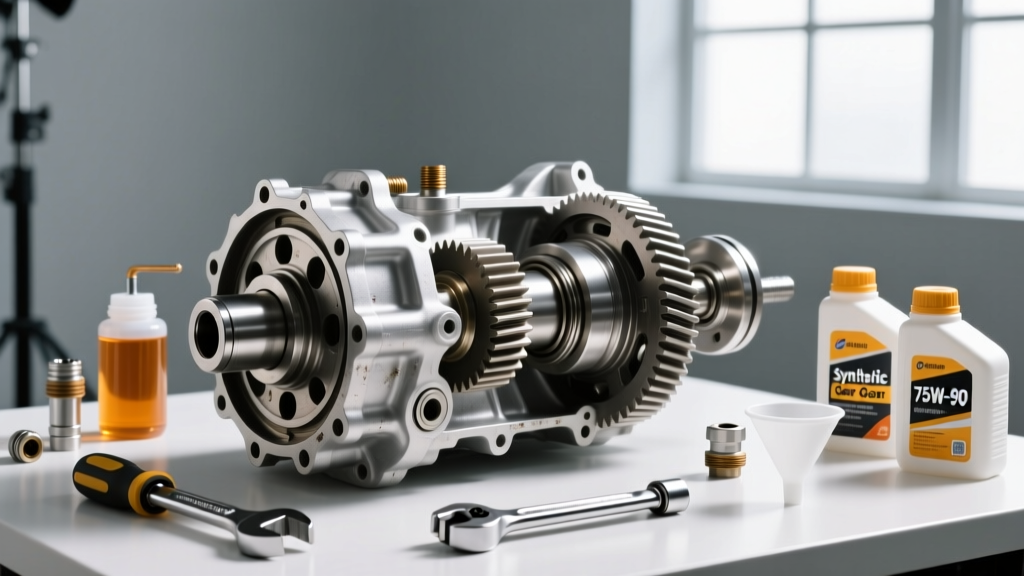
The setup is not complete until the correct chemistry is introduced to the housing. Modern Class 8 differentials demand high-quality synthetic gear oils to handle extended drain intervals and extreme thermal loads. According to Mobil Commercial Vehicle Lubricants guidelines, a full synthetic 75W-90 or 80W-90 API GL-5 gear oil (such as Mobil Delvac 1 Synthetic Gear Oil) is the industry standard.
A typical tandem axle setup requires between 18 and 22 quarts of fluid total (9 to 11 quarts per housing). The fill level is exactly to the bottom of the fill plug hole on the front face of the differential carrier.
The 500-Mile Rule
Even with a flawless setup, the microscopic high spots on the newly machined ring and pinion gears will wear off during the first few hundred miles. This creates metallic paste that circulates through the oil, acting like liquid sandpaper. Therefore, a mandatory first oil change at 5,000 to 10,000 miles (or as specified by the OEM for severe duty) is critical to flush out the break-in metals. Failing to perform this break-in drain is the number one cause of premature differential bearing failure in freshly rebuilt commercial axles.
Diagnosing Post-Setup Noise
If a technician rushes the setup, the differential will speak up. Learning to listen to the axle is a vital diagnostic skill:
- Drive Whine (Under Acceleration): Usually indicates the pinion depth is too deep, or the backlash is too tight. The gears are binding under load.
- Coast Whine (Deceleration/Engine Braking): Typically means the pinion depth is too shallow. The load is concentrated on the weak tip of the gear tooth.
- Clunk on Engagement: Excessive backlash, worn carrier bearings, or improperly torqued ring gear bolts allowing the gear to shift on the carrier spigot.
- Continuous Howl: Often a sign of mismatched gear sets, poor quality aftermarket castings, or incorrect pinion bearing preload causing harmonic resonance.
Final Thoughts for the Aspiring Drivetrain Tech
Mastering the semi truck differential ring and pinion setup bridges the gap between a parts-changer and a true heavy-duty drivetrain specialist. It requires patience, a willingness to invest in precision measuring tools (like high-grade Mitutoyo dial indicators and specialized depth gauges), and a strict adherence to OEM torque sequences. By respecting the solid spacer architecture, meticulously checking backlash with threaded adjusters, and validating your work with the paint test, you ensure that the axle will reliably haul freight across the country for a million miles or more.