The Critical Role of Gear Oil in Class 8 Axles
The hypoid gear sets found in Class 8 semi trucks operate under extreme sliding friction and immense torque loads. Unlike standard passenger vehicle differentials, heavy-duty truck axles require specialized lubrication to prevent catastrophic spalling, bearing failure, and ring-and-pinion wipeouts. Performing a proper semi truck differential oil change is not just about swapping fluid; it is a critical diagnostic opportunity to assess the health of your drivetrain.
Modern fleet maintenance in 2026 heavily favors extended-drain synthetic lubricants, but the fundamental procedure remains rooted in precision, correct torque specifications, and strict adherence to API (American Petroleum Institute) classifications. This guide covers the exact step-by-step procedure for servicing industry-standard axles, including the Dana Spicer S170 series and the Cummins Meritor MT-40-14X.
Understanding Fluid Specifications: API GL-5 and MT-1
Before draining a single drop, it is vital to understand what goes into the housing. Most heavy-duty differentials require an API GL-5 rated gear oil for extreme pressure (EP) protection. However, for severe-duty and extended-drain applications, the fluid must also meet the API MT-1 specification.
API MT-1 provides superior thermal stability and protects copper-alloy bearings and bushings from corrosion, which GL-5 alone does not guarantee over extended intervals. Top-tier synthetic options like Mobil Delvac 1 Synthetic Gear Oil 75W-90 or Shell Spirax S6 CXME 75W-90 are industry standards for long-haul fleets.
Semi Truck Differential Oil Intervals and Capacities
Service intervals vary drastically based on the fluid chemistry and the specific axle manufacturer's guidelines. Below is a reference matrix for standard tandem-axle configurations.
| Axle Model | Fluid Specification | Capacity (Pints) | Mineral Interval | Synthetic Interval |
|---|---|---|---|---|
| Dana Spicer S170-145R | API GL-5 / MT-1 | 14 - 16 | 100,000 Miles | 500,000 Miles |
| Meritor MT-40-14X | API GL-5 / MT-1 | 16 - 18 | 100,000 Miles | 500,000 Miles |
| Dana Spicer D46-170 | API GL-5 / MT-1 | 18 - 20 | 100,000 Miles | 500,000 Miles |
Note: Always verify exact capacities on the axle housing tag or via the Dana Spicer or Cummins Meritor online manuals, as aftermarket differential covers can alter total volume.
Tools and Materials Required
Servicing a heavy-duty differential requires specialized equipment to handle high-viscosity fluids and large fasteners.
- Fluid: 4 to 5 gallons of 75W-90 Synthetic API MT-1 Gear Oil per axle (Approx. $45 - $65 per gallon).
- Transfer Pump: 15-gallon pneumatic or heavy-duty manual fluid pump with a 3/4-inch delivery hose.
- Wrenches: 1/2-inch drive torque wrench (capable of 150 lb-ft), 3/4-inch NPT socket, and 1-1/4-inch hex socket.
- Consumables: Loctite 567 (for NPT threads), new copper crush washers (if applicable), and brake cleaner.
- Safety: Nitrile gloves, safety glasses, and a minimum 25-gallon drain pan.
Step-by-Step Semi Truck Differential Oil Change Procedure
Step 1: Thermal Preparation and Safety
Cold 75W-90 or 80W-140 gear oil is incredibly viscous and will trap metallic particulates and sludge in the housing. Drive the truck for at least 20 miles under load to bring the axle temperature up to roughly 140°F (60°C). Park the truck on a level surface, set the parking brakes, and chock the front wheels. Never rely solely on the air brake system when working under a Class 8 vehicle.
Step 2: The Golden Rule — Remove the Fill Plug First
Before touching the drain plug, locate and remove the fill plug on the side of the differential housing. This is a cardinal rule in heavy-duty mechanics. If you drain the axle first and subsequently discover the fill plug is seized or stripped, the truck is immobilized until the housing is removed and machined. The fill plug is typically located on the driver's side of the housing, near the axle shaft tube.
Step 3: Draining the Old Gear Oil
Place your 25-gallon drain pan directly beneath the bottom drain plug. Remove the drain plug using the appropriate socket. Allow the fluid to drain completely, which can take 15 to 20 minutes due to the high viscosity of the oil. Once the flow slows to a drip, carefully pull the magnetic drain plug out and set it aside for inspection.
Step 4: Inspecting the Breather Vent
While the housing is draining, locate the axle breather vent, usually situated on the top of the differential housing or routed up a tube to the frame rail. A clogged breather will cause internal axle pressure to build as the differential heats up, eventually blowing out the inner wheel seals and contaminating the brake shoes with gear oil. Remove the breather cap, clean it with brake cleaner, and ensure it cycles freely. Replace it with a new OEM part (e.g., Dana Part #3948582) if it shows signs of corrosion.
Step 5: Magnetic Plug Diagnostics
Inspect the material collected on the magnetic drain plug. A fine, gray, paste-like 'fuzz' is normal wear from the clutch packs and bearings. However, if you find distinct metallic flakes, chunky debris, or brass-colored shavings, this indicates severe spalling on the ring gear or copper bearing cage failure. If brass is present, the axle must be torn down immediately.
Step 6: Refilling with Fresh Semi Truck Differential Oil
Reinstall the drain plug. If your axle uses a 3/4-inch NPT (tapered pipe thread) plug, apply a bead of Loctite 567 pipe sealant to the threads. Torque the NPT drain plug to 35 - 45 lb-ft. If your axle uses a straight-thread plug with an O-ring, torque it to 120 - 150 lb-ft per Cummins Meritor specifications.
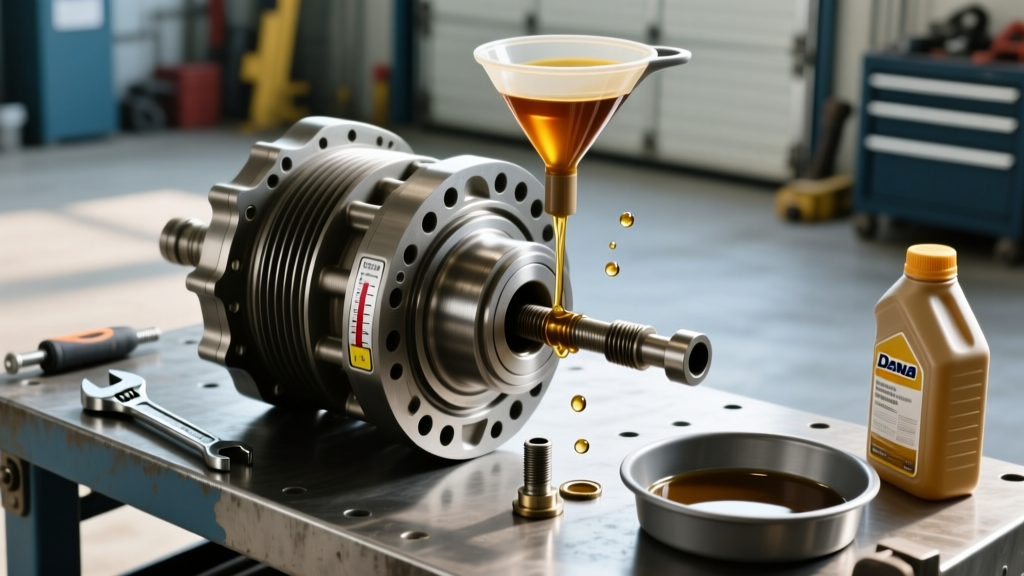
Insert your pump hose into the fill opening and begin transferring the synthetic gear oil. Fill the housing until the fluid level is exactly flush with the bottom edge of the fill hole. Overfilling can cause foaming and overheating, while underfilling will starve the pinion bearings.
Step 7: Final Torque and Clean-Up
Once the fluid reaches the fill hole, reinstall the fill plug. Apply thread sealant if it is an NPT fitting, and torque to 35 - 45 lb-ft. Wipe down the entire differential housing with a degreaser to remove any spilled oil. This ensures that any future leaks from the pinion seal or axle shaft seals can be easily spotted during your next pre-trip inspection.
Cost Analysis: Fleet vs. Owner-Operator
Changing your own semi truck differential oil yields significant savings. A tandem-axle setup requires roughly 7 to 9 gallons of synthetic gear oil. At an average retail price of $55 per gallon, the material cost is between $385 and $495. If you take the truck to a heavy-duty service center, expect to pay an additional $250 to $400 in shop labor and environmental disposal fees. Over a 500,000-mile synthetic interval, performing the service in-house saves an owner-operator upwards of $300 per axle set.
Common Mistakes to Avoid
Expert Warning: Never mix synthetic and mineral-based gear oils. If you are upgrading a high-mileage axle from conventional 80W-90 to a full synthetic 75W-90, the superior detergents in the synthetic oil can dislodge decades of accumulated sludge, potentially clogging the oil galleries and starving the pinion bearings. Always perform a flush or drop the differential cover to manually clean the housing when making the switch.
Conclusion
Mastering the semi truck differential oil change procedure is a cornerstone of preventative fleet maintenance. By adhering to strict API MT-1 specifications, utilizing the correct torque values, and performing thorough magnetic diagnostics, you can extend the life of your Dana or Meritor axles well past the million-mile mark. Regular, meticulous service ensures that your drivetrain remains quiet, efficient, and ready for the heavy haul.