The Anatomy of Rear Differential Whine
When a rear axle begins to howl, whine, or chatter, the immediate instinct for many vehicle owners is to seek out a quick chemical fix. The rear differential is a high-load, high-friction environment where the ring and pinion gears operate under immense boundary pressure. Unlike an automatic transmission like the ZF 8HP or GM 6L80, which relies on complex hydraulic valve bodies and clutch packs, a traditional solid rear axle relies entirely on gear geometry, bearing preload, and the tribological properties of its gear oil.
Before pouring a differential noise additive into the fill hole, it is critical to understand the acoustic signature of your axle. Gear whine is not a monolith; its pitch and trigger conditions tell a precise story about internal wear:
- Whine on Acceleration: Indicates wear on the drive (convex) side of the ring gear teeth. Often caused by insufficient pinion bearing preload or incorrect pinion depth.
- Whine on Deceleration: Points to wear on the coast (concave) side of the gear teeth. Common in high-mileage trucks that see heavy engine-braking or towing.
- Chatter on Low-Speed Turns: A classic symptom of limited-slip differential (LSD) clutch pack binding. This is the only scenario where a specific type of additive is the factory-approved cure.
- Continuous Howling (Speed-Sensitive):strong> Usually indicates pitting or spalling on the pinion or carrier bearings, rather than the gears themselves.
Can a Differential Noise Additive Actually Fix Gear Whine?
The short answer is: it depends entirely on the root cause. The term 'differential noise additive' is frequently misused in the aftermarket. To diagnose and treat the issue correctly, we must separate friction modifiers from boundary-lubrication treatments.
Friction Modifiers vs. Anti-Wear Quiet-Downs
If your rear differential is equipped with a clutch-type limited-slip unit (like the Ford Traction-Lok or GM G80), chatter during tight turns is caused by the friction material gripping and releasing erratically. API GL-5 gear oils contain high levels of sulfur-phosphorus extreme pressure (EP) additives, which can actually be too 'slippery' for LSD clutch packs over time. In this case, adding a friction modifier restores the correct slip coefficient.
However, if your axle is whining due to gear tooth micro-pitting or bearing wear, a standard friction modifier will do nothing. Instead, you need a heavy synthetic ester or a PTFE/Molybdenum-based gear treatment designed to dampen acoustic resonance and fill microscopic surface voids.
| Additive / Treatment Type | Primary Function | Best Use Case | Popular Part Numbers |
|---|---|---|---|
| LSD Friction Modifier | Alters clutch pack slip coefficient | Chatter on turns (LSD only) | Motorcraft XL-3, GM EOS (1052358) |
| Synthetic Ester / PTFE Treatment | Dampens acoustic resonance, fills micro-pits | Mild gear whine, aging open diffs | Lubegard 63090, Red Line ShockProof |
| Ceramic / Nano-Boron Coatings | Creates sacrificial boundary film on metals | High-load towing, preventive maintenance | BestLine, Archoil AR9100 |
Expert Warning: Never use LSD friction modifiers in an open differential or a helical/Torsen-style gear-driven LSD (like the Detroit Truetrac). These units rely on gear binding friction to transfer torque; friction modifiers will render them completely inoperative.
Step-by-Step Rear Differential Service & Diagnosis
If you suspect gear wear or fluid breakdown, a full rear differential service is the only way to accurately diagnose the health of the axle. A simple drain-and-fill will not reveal the metallurgical truth hiding on the bottom of the housing.
1. Drain, Inspect, and Analyze
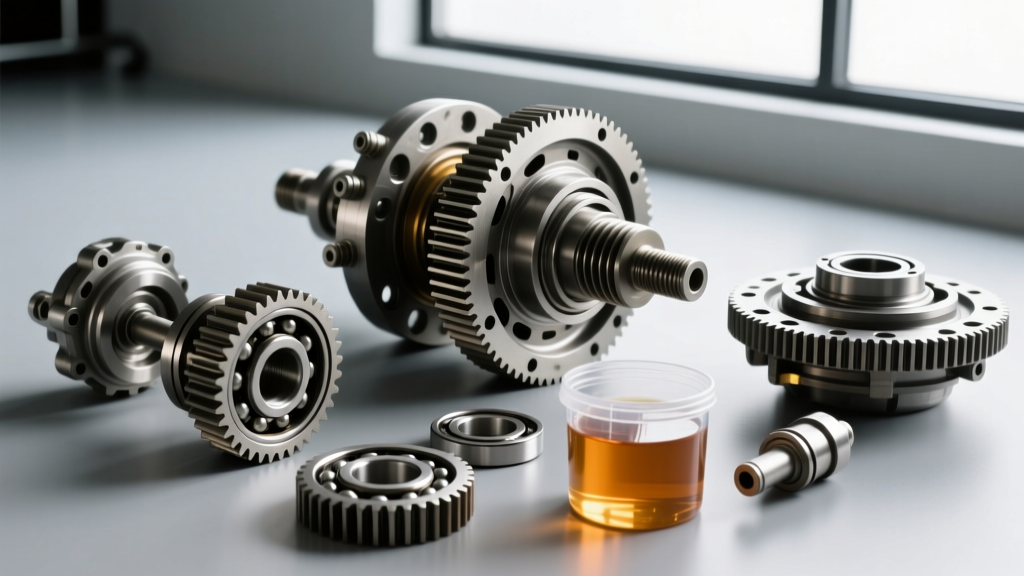
Remove the differential cover (or drain plug). As the fluid drains, pay close attention to its condition. Healthy 75W-90 or 75W-140 synthetic gear oil should be translucent amber to dark brown. If it is opaque black and smells heavily of sulfur and burnt coffee, the EP additives have depleted, and boundary lubrication has failed.
Inspect the magnetic fill plug or the RTV-sealed housing floor. Fine, glitter-like metallic paste is normal for axles with over 80,000 miles. However, if you find chunky metal shards, needle bearings, or brass-colored cage fragments, no additive will save this axle. It requires a teardown and rebuild.
2. Cleaning and Sealing
Scrape the housing and cover mating surfaces down to bare metal using a plastic scraper to avoid gouging the cast iron or aluminum. Clean with brake cleaner. Apply a 3/16-inch bead of high-temp RTV silicone (such as Permatex Ultra Black, Part #85084) to the cover. Allow 10 minutes of skin-over time before installation.
3. Refilling and Additive Application
If you are treating a mild whine or servicing an LSD, this is the time to add your treatment. Pour the recommended dose of friction modifier or anti-wear additive into the housing before adding the base gear oil. This ensures the additive mixes thoroughly as the new oil splashes in.
Real-World Axle Specifications & Torque Data
Proper maintenance requires adhering to exact engineering specifications. Over-torquing differential cover bolts will warp the housing and misalign the ring gear, instantly causing the whine you were trying to fix. Below are the critical service specifications for the most common light-truck and SUV axles on the road today.
| Axle Model | Fluid Capacity | Cover Bolt Torque | Fill Plug Torque | OEM Gear Oil Spec |
|---|---|---|---|---|
| Ford 8.8 (Super 8.8) | 2.5 - 3.0 Qts | 28 - 38 lb-ft | 22 lb-ft | 75W-140 Synthetic GL-5 |
| GM 8.6 / 9.5 (10-Bolt) | 2.0 - 2.4 Qts | 25 lb-ft | 22 lb-ft | 75W-90 Synthetic GL-5 |
| Dana 60 (Heavy Duty) | 3.25 - 3.75 Qts | 35 lb-ft | 25 lb-ft | 75W-140 Synthetic GL-5 |
| Chrysler 8.25 (C213R) | 2.2 - 2.5 Qts | 30 lb-ft | 20 lb-ft | 75W-85 GL-5 |
Note: Always fill the differential until the fluid is level with the bottom of the fill plug hole. For vehicles equipped with aftermarket heavy-duty covers (e.g., PML or Mag-Hytec), consult the cover manufacturer, as internal baffling may alter the required fluid volume by up to 1.5 quarts.
The 2026 Landscape: EV and Hybrid Axle Considerations
As the automotive market shifts, rear differential maintenance is evolving. Modern hybrid trucks and EVs (like the Rivian R1T or Ford F-150 Lightning) utilize independent rear suspension (IRS) with integrated electric drive units (EDUs). These units operate at significantly higher RPMs than traditional solid axles and are subjected to instant, massive torque spikes.
In these high-RPM applications, traditional sulfur-phosphorus GL-5 additives can cause copper corrosion on the electric motor windings and bearings if the EDU shares fluid with the reduction gears. Always verify if your electrified axle requires a specialized EV-specific fluid (such as Mobilfluid EV 1 or Castrol ON) rather than standard GL-5 gear oil and aftermarket noise additives.
When Additives Fail: Recognizing Terminal Gear Damage
A differential noise additive is a band-aid, not a cure for mechanical failure. If you have performed a complete fluid service with high-quality synthetic 75W-140 and the appropriate modifier, but the whine persists or worsens under load, you are dealing with terminal mechanical wear.
At this stage, the ring and pinion backlash has likely exceeded the 0.010-inch threshold, or the pinion bearing preload has collapsed. Continuing to drive the vehicle will result in catastrophic gear tooth shearing, which can lock the rear wheels at highway speeds. A professional differential rebuild—requiring a master bearing kit, new crush sleeve, pinion seal, and matched ring/pinion set—typically costs between $1,500 and $2,800 depending on the axle and labor rates.
Diagnostic Summary Checklist
- Identify the noise type: Chatter (clutches) vs. Whine (gears/bearings).
- Pull the cover: Inspect for chunky metal, spalling, or bearing cage failure.
- Measure backlash: Use a dial indicator on the ring gear; spec is typically 0.006' to 0.010'.
- Check pinion preload: Measure rotational torque required to turn the pinion yoke (typically 15-30 in-lbs for used bearings).
- Select the correct treatment: Apply LSD modifier for chatter, or heavy synthetic esters for mild gear wear masking.
For further technical reading on extreme pressure gear lubrication and axle service intervals, refer to the American Petroleum Institute (API) guidelines on GL-5 MT-1 specifications, and consult the Dana Spicer Technical Resources library for specific axle ratio and torque mapping.