When you notice a thick, sulfurous puddle forming under the center of your truck or SUV, you are looking at a problem that threatens the very core of your drivetrain. A leaking axle or differential cover doesn't just make a mess; it starves the hypoid ring and pinion gears of the extreme pressure (EP) lubrication they require to survive. Understanding the rear differential leak cost is only the first half of the battle. Once the mechanical repair is complete, refilling the housing with the incorrect fluid specification can lead to catastrophic gear wear, clutch-pack chatter, or synchronizer degradation in as little as 5,000 miles.
This comprehensive guide bridges the gap between mechanical repair economics and advanced tribology. We will break down the exact costs associated with common differential leaks and provide a rigorous buyer’s guide to differential fluid types, API classifications, and synthetic formulations available in 2026.
The True Rear Differential Leak Cost: Breakdown by Failure Point
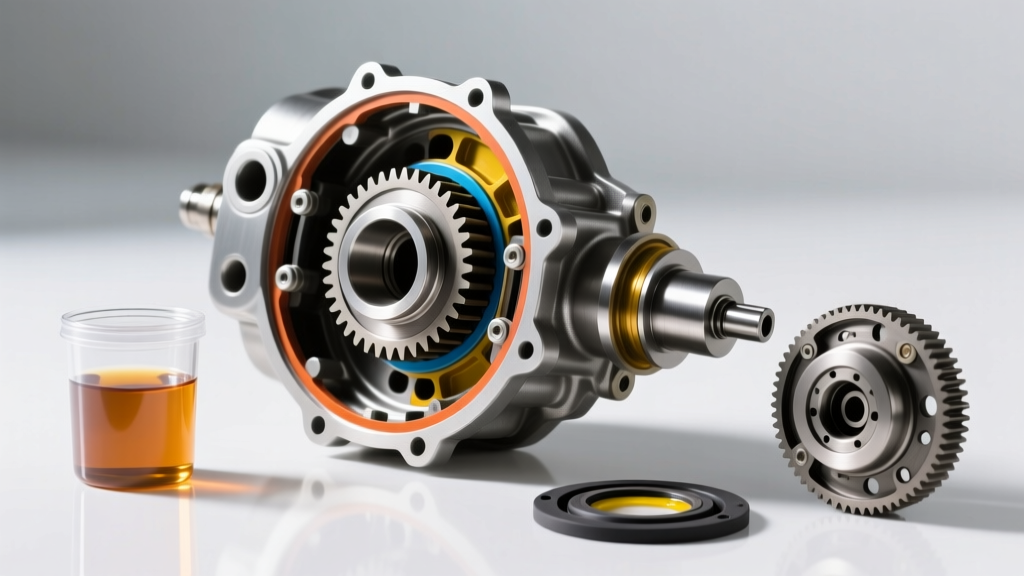
Before you can fill the differential, you must seal it. The rear differential leak cost varies wildly depending on which seal has failed and the labor intensity required to access it. Below is a realistic cost matrix for common solid rear axles (such as the Ford 8.8, GM 10-bolt, and Dana 44).
| Failure Point | Part Cost | Labor Cost | Total Estimated Cost | Complexity & Notes |
|---|---|---|---|---|
| Differential Cover Gasket/RTV | $10 - $25 | $80 - $130 | $90 - $155 | Low. Requires draining, scraping old RTV, and resealing. |
| Pinion Seal | $15 - $45 | $150 - $250 | $165 - $295 | Medium. Must mark yoke to retain bearing preload; crush sleeve risk. |
| Axle Shaft Seal | $10 - $30 | $180 - $350 | $190 - $380 | High. Requires removing wheels, brakes, and C-clips to pull the axle shaft. |
Note: If a differential is run dry due to an ignored leak, the cost to replace a scored ring and pinion gear set will escalate to $1,200–$2,500. Addressing leaks immediately is paramount.
The Chemistry of Gear Oil: API GL-4 vs. GL-5
Once your mechanic has resolved the leak, the next critical decision is fluid selection. Gear oils are classified by the American Petroleum Institute (API) based on their additive packages. According to the API's official lubricant standards, the two most common classifications for manual drivetrains are GL-4 and GL-5.
GL-5: The Hypoid Gear Standard
Modern solid rear axles utilize hypoid gear sets, where the pinion gear sits below the centerline of the ring gear. This geometry creates a massive amount of sliding friction alongside rolling friction. GL-5 gear oils contain high levels of sulfur-phosphorus (S-P) extreme pressure (EP) additives—typically 4% to 5% by weight. Under high loads, these additives react with the metal surfaces to form a sacrificial iron sulfide/phosphate film, preventing metal-on-metal welding. Almost all rear differentials require API GL-5.
GL-4: The Yellow Metal Protector
GL-5 fluids should never be used in manual transmissions or transaxles that contain brass, bronze, or copper synchronizers. The high sulfur content in GL-5 becomes corrosive to yellow metals at high operating temperatures, leading to synchronizer pitting and failure. GL-4 fluids contain roughly half the S-P additives (2% to 2.5%), making them safe for yellow metals while providing adequate protection for moderate-load gear sets. Always consult your owner's manual; if the transfer case or manual transmission calls for GL-4, do not substitute GL-5.
Viscosity Grades and the SAE J306 Standard
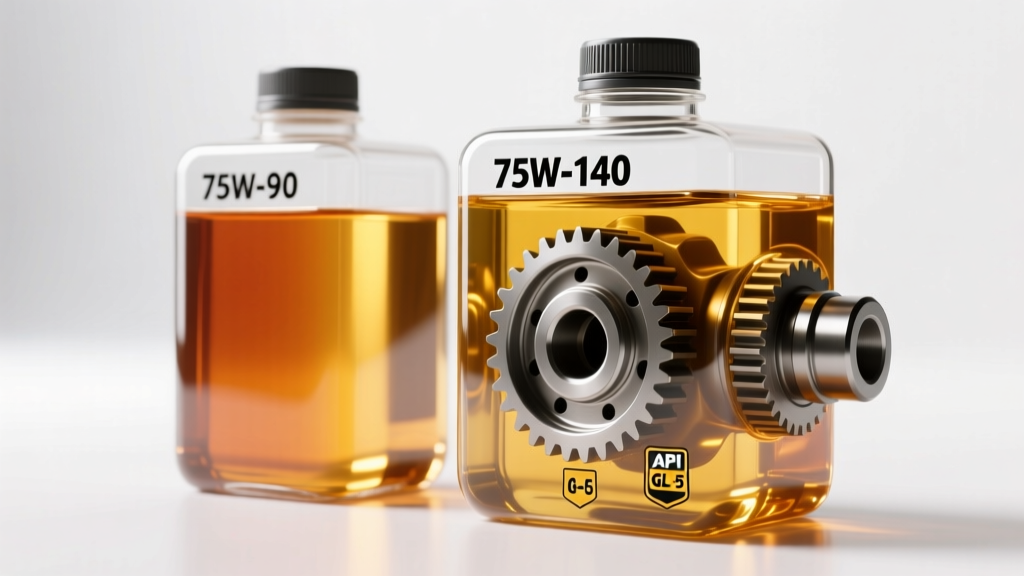
Viscosity dictates the fluid's resistance to shear and its ability to maintain a hydrodynamic wedge between gear teeth. The Society of Automotive Engineers (SAE) governs these classifications under the SAE J306 standard. In 2019, SAE updated J306 to better align with engine oil viscosity boundaries, meaning a modern 75W-90 has slightly tighter kinematic viscosity parameters than legacy formulations.
| Viscosity Grade | Primary Application | Temperature Range | Pros & Cons |
|---|---|---|---|
| 75W-90 | Standard OEM fill for most light trucks, SUVs, and passenger cars. | -40°F to 100°F+ Ambient | Excellent cold-flow; optimal fuel economy. May thin under extreme towing loads. |
| 75W-140 | Heavy-duty towing, off-road crawling, and high-ambient desert climates. | -30°F to 120°F+ Ambient | Superior high-temp shear stability. Higher parasitic drag; poor cold-weather flow. |
| 80W-90 | Older conventional applications, budget-conscious fleet maintenance. | -15°F to 100°F+ Ambient | Cost-effective. High pour point; waxy in sub-zero temperatures. |
2026 Buyer’s Guide: Top Synthetic Differential Fluids
Synthetic base stocks (Group IV PAO and Group V Esters) offer vastly superior oxidation resistance and shear stability compared to Group I/II conventional mineral oils. When repairing a high-mileage differential, upgrading to a premium synthetic is highly recommended. Here are the top-tier contenders for your post-leak refill.
1. Amsoil Severe Gear 75W-90 (SVGQT)
- Price: ~$22.00 per quart
- Specs: API GL-5, MIL-PRF-2105E
- Expert Take: Amsoil utilizes a proprietary ester/PAO blend that excels in high-load, low-speed scenarios (like rock crawling). It boasts an exceptionally high viscosity index, meaning it resists thermal breakdown better than almost any competitor. Ideal for Dana 44 and Dana 60 axles subjected to aftermarket tire loads.
2. Mobil 1 Synthetic Gear Lube LS 75W-90 (104361)
- Price: ~$16.50 per quart
- Specs: API GL-5, LS (Limited Slip)
- Expert Take: The 'LS' designation means this fluid comes pre-blended with a friction modifier. If your vehicle has a clutch-type limited-slip differential (LSD), this fluid can save you the hassle of buying a separate additive bottle. However, if your LSD requires a very specific modifier dose, pre-blended fluids can sometimes make fine-tuning clutch chatter difficult.
3. Red Line 75W-90 Gear Oil (50104)
- Price: ~$21.00 per quart
- Specs: API GL-5 (Non-Sulfur/Synthetic EP)
- Expert Take: As detailed in Red Line's technical literature, their standard 75W-90 uses a unique synthetic EP additive package that is safe for yellow metals, bridging the gap between GL-4 and GL-5. It contains no friction modifiers, making it the perfect baseline fluid for open differentials or helical gear LSDs (like the Eaton Truetrac).
The Limited-Slip Differential (LSD) Additive Matrix
If your rear axle houses a clutch-type limited-slip differential (e.g., Auburn Pro-Series, Ford Traction-Lok, GM G80 Eaton locker), the fluid you choose is only half the equation. Clutch packs require a specific friction modifier to prevent 'stiction'—the phenomenon where clutches bind and release abruptly, causing a shuddering chatter during tight, low-speed turns.
- Helical Gear LSDs (Eaton Truetrac, Torsen): Require NO friction modifiers. Use standard GL-5 synthetic.
- Clutch-Type LSDs: Require OEM-specific modifiers. Do not rely solely on 'LS' pre-blended fluids if chatter persists.
- GM Additive (Part #88900338): The gold standard for GM/Chevy clutch-type axles. Add 4 oz initially, test drive in figure-eights, and add in 1 oz increments if chatter remains.
- Ford XL-3 Friction Modifier (Part #EOAZ-19546-A): Required for Ford 8.8 and 9.75 Traction-Lok differentials.
Torque Specs & Refill Procedures: Ford 8.8 & GM 10-Bolt
Proper refill procedure is just as critical as the fluid itself. Overfilling can lead to aeration and blown pinion seals due to thermal expansion, while underfilling starves the pinion bearings.
Ford 8.8-Inch Axle
- Capacity: 2.5 to 3.0 pints (varies slightly by cover design).
- Cover Bolt Torque: 25 - 30 lb-ft. Use a star-pattern sequence to prevent warping the stamped steel cover.
- Fill Level: Fluid should be exactly level with the bottom of the fill plug hole. Insert your pinky finger; the fluid should just touch the first knuckle.
GM 10-Bolt (8.5 / 8.6-Inch Ring Gear)
- Capacity: 2.1 to 2.5 pints.
- Cover Bolt Torque: 22 - 25 lb-ft. GM covers are prone to stripping if over-torqued; use a calibrated torque wrench.
- Fill Level: Level with the bottom of the fill hole. Note that some GM axles feature a 'wet' axle tube design where fluid migrates down the tubes; allow 15 minutes for the fluid to settle before finalizing the fill level.
Final Verdict: Protecting Your Investment
The rear differential leak cost is an unavoidable maintenance hurdle, but it presents an opportunity to upgrade your drivetrain's protection. By matching the correct API GL-5 specification, selecting a high-shear synthetic base stock like Amsoil or Red Line, and carefully dosing your LSD friction modifiers, you ensure that the ring and pinion gears will survive hundreds of thousands of miles. Never compromise on fluid chemistry to save a few dollars after paying for a premium mechanical seal repair.