The Visual Diagnostic: Decoding Differential Fluid Color
When it comes to drivetrain longevity, the gear oil inside your axle housing is the only barrier between catastrophic metal-on-metal failure and smooth power delivery. Modern hypoid gear sets operate under extreme sliding pressures, relying on specialized Extreme Pressure (EP) additives—typically zinc dialkyldithiophosphate (ZDDP) or sulfur-phosphorus compounds—to maintain a protective boundary layer. Over time, thermal cycling, shear stress, and environmental contamination degrade these additives. For fleet managers, off-road enthusiasts, and daily drivers alike, understanding how to read differential fluid color and condition is the single most effective way to predict internal wear and ultimately control your rear differential service cost.
Ignoring the visual and tactile clues hidden in your gear oil can turn a routine $180 maintenance task into a $2,500 axle rebuild. According to technical guidelines from Yukon Gear & Axle, the majority of premature ring and pinion failures are traced directly back to fluid breakdown or water intrusion that went undiagnosed during basic inspections.
The Fluid Color Spectrum: What Your Gear Oil is Telling You
Before draining the housing or removing the differential cover, extract a small sample using a clean syringe or fluid pump. Evaluate the sample in natural light against a white paper towel. Here is the definitive diagnostic matrix for differential fluid condition:
| Fluid Color | Condition / Meaning | Required Action | Estimated Cost Impact |
|---|---|---|---|
| Honey / Clear Amber | New or excellent condition. Additives are intact; no significant wear metals. | No action needed. Re-check at next interval. | $0 (Baseline) |
| Dark Brown / Opaque | Normal oxidation and thermal aging. EP additives are depleting but no catastrophic wear. | Perform full drain and fill. Inspect magnetic plug. | $150 - $250 (Routine Service) |
| Jet Black / Sludge | Severe thermal breakdown. Oil has coked due to extreme overheating or extended neglect. | Immediate flush. Inspect pinion seal and bearings for heat damage. | $250 - $600 (Seals/Bearings at risk) |
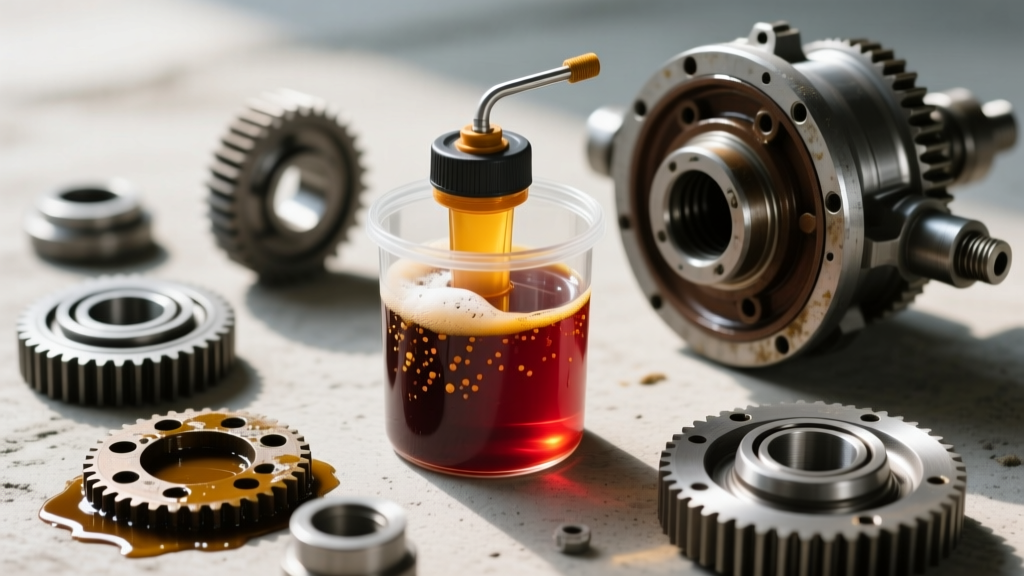
| Milky / Chocolate Milk | Water emulsification. Breather tube is clogged, or axle seals are compromised. | Flush immediately. Replace seals, clear breather, check for rust on bearing races. | $400 - $1,200 (Seal & Bearing Service) |
| Silver / Glittering | Suspended metallic particles. Bearing spalling, ring/pinion gear wear, or thrust block failure. | Do not drive. Complete teardown, magnet inspection, and likely rebuild required. | $1,800 - $3,500+ (Full Rebuild) |
Olfactory and Tactile Diagnostics: Beyond the Visual
Color is only the first layer of the diagnostic process. To truly minimize your rear differential service cost, you must engage your sense of smell and touch. Gear oil naturally possesses a pungent, sulfur-heavy odor due to the EP additives. However, if the fluid smells distinctly burnt or acrid—similar to burnt toast or scorched brake pads—the oil has exceeded its thermal limits (typically above 350°F / 175°C at the gear tooth contact patch). This thermal event strips the oil of its viscosity, leading to micro-welding on the hypoid gear faces.
The Grit Test
Take a drop of the extracted fluid and rub it firmly between your thumb and forefinger.
- Smooth / Slippery: Normal condition. The fluid's base stock is intact.
- Fine Grit (like talcum powder): Normal clutch pack wear in Limited Slip Differentials (LSD) or minor initial gear seating. Monitor closely.
- Coarse Grit / Metal Flakes: Active destruction. You are feeling spalled bearing needle rollers or chipped ring gear teeth. A full teardown is mandatory.
How Fluid Condition Dictates Your Rear Differential Service Cost
Proactive diagnosis is the ultimate hedge against exponential repair bills. Let us break down how the condition of your fluid directly correlates to the invoice you will receive at the drivetrain shop in 2026.
Scenario A: The Dark Brown Fluid (Routine Preventive Maintenance)
You pull the plug at 60,000 miles and find dark brown, sulfur-smelling fluid. There are no metallic flakes on the magnetic drain plug. The internal components are perfectly healthy. Your rear differential service cost is limited to the price of high-quality synthetic gear oil (e.g., Mobil 1 104361 75W-90, approx. $18/quart) and 30 minutes of labor. Total Cost: $150 - $220.
Scenario B: The Milky Emulsion (Water Intrusion)
You extract a milky, frothy sample. This indicates water has bypassed the axle seals or been sucked in through a clogged axle breather valve during a cold-water crossing. Water causes rapid flash-rusting on the polished bearing races and pinion bearings. If caught immediately, a seal replacement and thorough flushing might keep your rear differential service cost between $400 and $700. If ignored for another 10,000 miles, the pitted bearings will destroy the pinion depth setting, requiring a complete ring and pinion setup. Deferred Cost: $2,200+.
Scenario C: The Glitter Bomb (Catastrophic Wear)
The fluid looks like metallic paint. The magnetic plug is covered in a thick, fuzzy layer of steel wool. This means a side bearing or pinion bearing has failed, allowing the gear set to run out of alignment. The shop will need to quote a full rebuild kit (bearings, seals, crush sleeve, ring gear bolts) plus precision setup labor. According to Spicer/Dana technical manuals, setting up a hypoid gear set requires exact backlash and pattern readings; it is not a simple plug-and-play repair. Total Cost: $1,800 - $3,500.
Expert Insight: Never use a flush machine on a differential housing. Unlike automatic transmissions, differentials rely on splash lubrication and precise clearances. High-pressure flushing can force contaminated fluid past the inner axle seals into the brake drums or rotors, turning a simple fluid swap into a massive safety hazard and liability.
Step-by-Step Preventive Inspection & Torque Specifications
Whether you are servicing a Ford Super Duty 10.5-inch Sterling axle, a GM 9.5-inch, or a classic Jeep Dana 44, precision matters. Using an impact gun on differential cover bolts will warp the mating surface and guarantee future leaks.
Essential Tools for the Job
- 3/8-inch Drive Torque Wrench (inch-pounds and foot-pounds)
- Fluid Evacuator Pump (if no drain plug is present, common on Ford 8.8 covers)
- Brake Parts Cleaner (Non-chlorinated) and RTV Silicone (e.g., Permatex 81182 The Right Stuff) for cover resealing
- Nitrile Gloves and Safety Glasses
Common Axle Torque Specifications
Always verify with your specific OEM service manual, but these are the industry-standard baseline torque specs for popular light-truck and SUV axles:
- Ford 8.8-inch (Explorer/Mustang/F-150): Fill plug 33 lb-ft. Cover bolts (if equipped) 28-38 lb-ft.
- GM 8.5 / 8.6-inch (10-Bolt): Cover bolts 25 lb-ft. Use a criss-cross tightening pattern.
- Dana 44 / Dana 60: Cover bolts 30-35 lb-ft. Fill/Drain plugs 25-35 lb-ft.
- Ford 10.5-inch Sterling (Super Duty): Fill plug 33 lb-ft. Cover bolts 70 lb-ft.
Choosing the Correct Replacement Fluid
Once you have diagnosed the condition and determined that a standard service is all that is required, selecting the correct fluid is paramount to keeping future rear differential service costs at bay. Gear oils are classified by API GL ratings. Modern differentials require API GL-5 due to the high sliding friction of hypoid gears.
Viscosity and Application
- 75W-90: The standard for most half-ton trucks, SUVs, and passenger cars. Offers excellent cold-weather flow and fuel economy. (Recommended: Motul Gear 300 75W-90 or Amsoil Severe Gear 75W-90).
- 75W-140: Required for heavy towing, commercial use, or high-horsepower applications. The thicker film strength prevents metal-on-metal contact under extreme loads. (Recommended: Red Line 57904 75W-140).
The Limited Slip Differential (LSD) Factor
If your vehicle is equipped with a clutch-type Limited Slip Differential (e.g., Ford Traction-Lok, GM Eaton Posi), the fluid must contain a friction modifier. Without it, the clutch packs will chatter violently during low-speed cornering, leading to premature destruction. Many modern synthetic GL-5 fluids (like Mobil 1 Synthetic Gear Lube LS) come pre-blended with friction modifiers. However, if chatter persists, adding a dedicated modifier bottle (e.g., Lucas Oil 10009) is a cheap insurance policy compared to replacing an LSD clutch pack.
Conclusion: The ROI of Fluid Analysis
Treating your differential fluid as a diagnostic window rather than just a consumable liquid is the hallmark of elite automotive maintenance. By taking five minutes to analyze the color, smell, and texture of your gear oil, you can intercept water intrusion, thermal breakdown, and bearing failure long before they escalate. In an era where 2026 shop labor rates frequently exceed $165 per hour, a $200 preventive fluid service is the most cost-effective insurance policy your drivetrain can have. For further reading on drivetrain maintenance intervals and synthetic oil shear stability, consult the engineering resources available at AMSOIL Technical Services.