The Thermodynamics of Limited Slip Differentials
When evaluating heavy-duty drivetrain upgrades for towing and off-road applications, thermal management is often the missing link in long-term reliability. This technical banks differential cover review focuses specifically on how aftermarket cooling solutions interact with clutch-type limited slip differentials (LSDs), fundamentally altering maintenance intervals and fluid degradation rates. As of 2026, with modern diesel trucks pushing over 1,000 lb-ft of torque to the wheels, the thermal load placed on the rear axle assembly has never been higher.
To understand why an upgraded cover matters, we must first examine the internal mechanics of a clutch-based LSD, such as the Ford Traction-Lok or the Auburn High-Performance series. Unlike helical gear-biased units (e.g., the Eaton Truetrac), clutch-type LSDs rely on alternating stacks of friction discs and steel separator plates. These packs are compressed by heavy-duty preload springs, often requiring 400 to 800 lb-ft of breakaway torque to initiate slip.
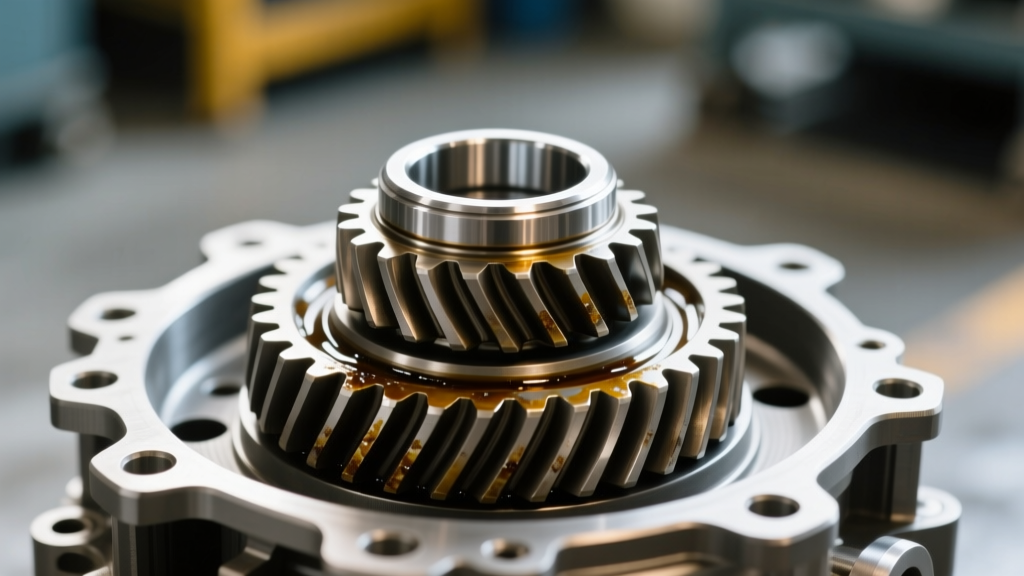
During cornering or when one wheel loses traction, the clutch pack slips to allow wheel speed differentiation. This slip generates immense localized friction and heat. If the differential fluid cannot absorb and dissipate this thermal energy, the gear oil undergoes mechanical shearing. The viscosity index improvers (VIIs) in the 75W-140 synthetic oil literally tear apart at a molecular level, leading to a permanent loss of film strength. Once the fluid thins out, the clutch packs experience accelerated wear, resulting in the notorious 'LSD chatter' and eventual total failure of the locking mechanism.
Engineering Analysis: Banks Ram-Air Cover (Part #19042)
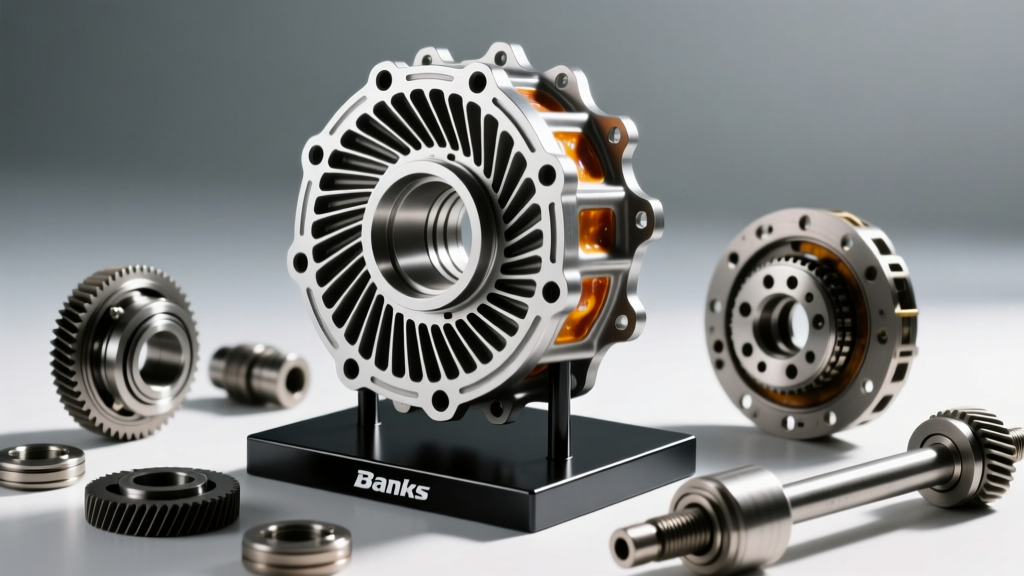
For this analysis, we are focusing on the Banks Ram-Air differential cover (Part #19042), designed for the ubiquitous AAM 11.5-inch rear axle found in 2001-2026 GM 2500/3500 HD trucks. The OEM stamped steel cover is a thermal bottleneck. It relies entirely on radiant heat transfer, which is highly inefficient in low-speed, high-load scenarios like rock crawling or steep grade towing.
The Banks unit is cast from A356-T6 aerospace-grade aluminum. The T6 tempering process involves solution heat treatment and artificial aging, yielding a tensile strength of roughly 42,000 PSI. This rigidity is crucial; under heavy axle wrap, a flexible stamped steel cover can actually deflect, altering the ring gear backlash and accelerating gear tooth wear. The Banks cover's computer-optimized external fin geometry is aligned with the longitudinal airflow of the vehicle, maximizing convective heat transfer.
Thermal and Capacity Comparison Matrix
| Specification | OEM Stamped Steel Cover | Banks Ram-Air (19042) |
|---|---|---|
| Material Composition | 14-Gauge Stamped Steel | A356-T6 Cast Aluminum |
| Fluid Capacity | ~3.5 Quarts | ~4.1 Quarts (+17% Volume) |
| Heat Dissipation Method | Passive Radiant | Active Convective (Directional Fins) |
| Drain Plug Configuration | None (Requires Siphon/RTV Peel) | Magnetic, Recessed, 3/8-inch Square |
| Temperature Probe Port | No | Yes (1/8-inch NPT Threaded) |
| Average Retail Cost (2026) | $45 - $65 | $360 - $395 |
Fluid Chemistry and Friction Modifier Protocols
The increased fluid capacity of the Banks cover (an extra 0.6 quarts) provides a larger thermal mass, meaning it takes longer for the fluid to reach its critical degradation temperature of 250°F (121°C). However, hardware upgrades must be paired with precise fluid chemistry.
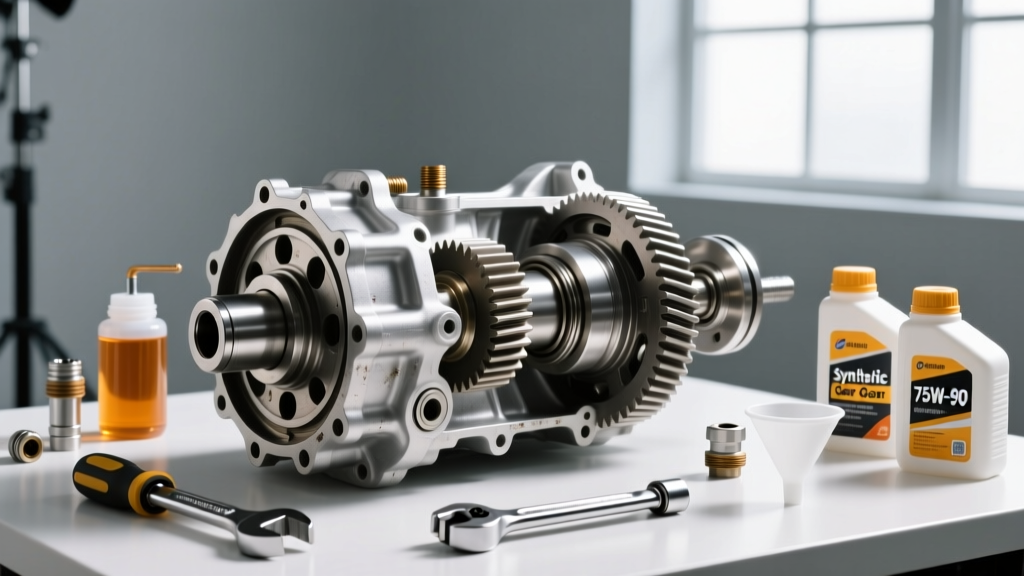
For clutch-type LSDs, standard API GL-5 gear oil is insufficient on its own. It requires a friction modifier additive—typically long-chain organic polymers (esters)—that bond to the clutch surfaces to prevent stick-slip oscillation. When performing a service on a Banks-equipped axle, we recommend a full synthetic 75W-90 or 75W-140 gear oil paired with an OEM-grade modifier.
- Base Fluid: AMSOIL Severe Gear 75W-90 or Mobil 1 Synthetic Gear Lubricant LS 75W-90 (Mobil 1 already contains a baseline modifier).
- Additive: Motorcraft XL-3 Friction Modifier Additive (Part # E9FZ-19B546-A) or GM EOS (Engine Oil Supplement).
- Dosage: Generally, 4 ounces of modifier per 2 quarts of gear oil is the baseline. Always perform the 'figure-eight' test drive and add in 1-ounce increments if chatter persists, never exceeding 8 ounces total to avoid clutch slippage under heavy load.
Precision Installation and Torque Protocols
A common failure point in differential maintenance is improper sealing, leading to fluid loss and catastrophic bearing failure. The Banks cover is designed to use a specific RTV silicone rather than a traditional cork or rubber gasket, which can compress unevenly and leak under high axle temperatures.
Expert Tip: Never reuse old RTV. Use a plastic gasket scraper and brake cleaner to achieve a perfectly bare metal mating surface on the axle housing. Any residual oil will compromise the silicone bond.
For sealing, apply a continuous 1/4-inch bead of Permatex Ultra Black Maximum Oil Resistance RTV (Part #81878) to the cover flange. Ensure you circle every bolt hole to prevent capillary leaks. Allow the RTV to skin over for 10 to 15 minutes before mating the cover to the housing.
The AAM 11.5 axle housing utilizes 14 cover bolts. The factory torque specification is 35 lb-ft (47 Nm). It is critical to use a star-pattern tightening sequence, starting from the center and working outwards, to ensure even clamping force and prevent the cast aluminum cover from warping. Apply a medium-strength threadlocker (such as Loctite 243) to the bolt threads to prevent backing out due to high-frequency axle vibrations.
2026 Diagnostic Framework: Utilizing the Temp Probe Port
One of the most valuable features highlighted in this Banks differential cover review is the integrated 1/8-inch NPT temperature probe port. In modern towing setups, monitoring rear differential temperatures is just as critical as monitoring EGTs (Exhaust Gas Temperatures) or transmission fluid temps.
By installing an electronic sending unit into this port, operators can establish a baseline operating temperature. For a heavily loaded 3/4-ton truck towing 15,000 lbs on a 6% grade, differential temperatures can easily spike past 220°F. If your telemetry indicates sustained temperatures above 240°F, the synthetic gear oil is rapidly oxidizing, and the LSD clutch packs are at immediate risk of glazing. This real-time data allows fleet managers and heavy-duty owners to shift from arbitrary mileage-based fluid changes to condition-based maintenance, ultimately saving hundreds of dollars in premature differential rebuilds while preventing catastrophic trail-side failures.
Conclusion: Is the Thermal Upgrade Justified?
When assessing the intersection of aftermarket cooling and limited slip differential operation, the data strongly supports the upgrade. The Banks Ram-Air cover transforms the differential from a sealed, heat-trapping oven into an actively cooled component. By increasing thermal mass, improving convective dissipation, and enabling precision fluid diagnostics via the NPT port, this cover directly extends the service life of both the 75W-140 synthetic fluid and the internal LSD clutch packs. For any vehicle subjected to high-torque towing, off-road articulation, or competitive sled pulling, addressing differential thermodynamics is a mandatory step in drivetrain preservation.
For further reading on differential gearing and torque management, refer to the engineering catalogs provided by Eaton Performance Differentials and the official product specifications at Banks Power Engineering.