When a rear differential begins to whine, howl, or clunk,盲目 swapping gear oil will not fix a failing pinion bearing or a chewed-up ring and pinion set. Whether you are driving a classic Ford 8.8, a GM 10-bolt, or a heavy-duty Dana 44, diagnosing the root cause requires a systematic approach. In 2026, with modern trucks towing heavier loads and generating more drivetrain heat, rear axle maintenance is more critical than ever. Before you tear into the differential cover, you must perform a comprehensive auto differential test to separate gear mesh issues from bearing failures, clutch pack degradation, or simple fluid starvation.
The 4-Phase Auto Differential Test Protocol
A proper road test isolates the exact load condition causing the noise. According to the drivetrain experts at Ring-Pinion.com, differential noises change drastically depending on whether the gears are under drive torque, coast torque, or floating. Find a safe, empty stretch of road and execute these four phases:
Phase 1: Acceleration (Drive Load)
Accelerate firmly from 20 mph to 50 mph. This loads the drive side of the ring and pinion gears. A high-pitched whine during this phase typically indicates worn gear teeth, improper gear backlash, or severe fluid starvation causing gear glazing.
Phase 2: Deceleration (Coast Load)
Lift off the throttle and let the vehicle coast down from 50 mph to 20 mph (do not brake). This loads the coast side of the gears and puts the pinion bearing under a different stress profile. A pronounced howl during deceleration is the classic hallmark of a failing pinion bearing or an incorrectly set pinion depth shim.
Phase 3: Cruise (Float Condition)
Maintain a steady speed on a flat road. The drivetrain is essentially 'floating' with minimal torque applied. If a low-frequency rumble or vibration persists above 20 mph regardless of throttle position, you are likely dealing with a worn carrier bearing or an out-of-balance driveshaft, rather than the ring and pinion itself.
Phase 4: Lock-to-Lock Turns (LSD Clutch Test)
Find an empty parking lot and perform tight, low-speed figure-eights. If you feel a binding sensation or hear a rhythmic 'chatter' or 'clunk' from the rear axle, your Limited-Slip Differential (LSD) clutch packs are failing to slip, usually due to degraded friction modifier or burnt clutch discs.
Diagnostic Matrix: Mapping Sound to Component
Use this matrix to cross-reference your road test findings before ordering parts or scheduling a teardown.
| Test Condition | Sound Profile | Probable Failure Point |
|---|---|---|
| Acceleration (Drive) | High-pitched whine | Ring/Pinion gear wear, low fluid, improper backlash |
| Deceleration (Coast) | Howling or growling | Pinion bearing failure, incorrect pinion depth |
| Cruise (Float) | Low rumble / vibration | Carrier bearing, axle shaft bearing, driveshaft U-joint |
| Tight Turns | Chatter / Binding | LSD clutch pack wear, missing friction modifier |
| Sudden Throttle Lift | Single metallic 'clunk' | Excessive gear backlash, worn side gears, loose yoke |
The Fluid Autopsy: Reading the Rear Differential Drain
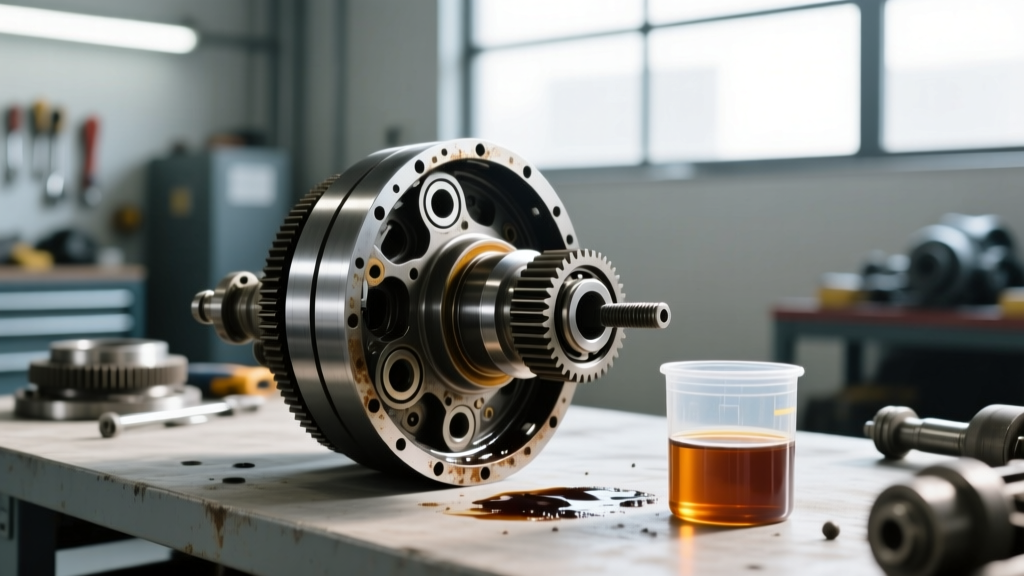
Once the auto differential test points you toward an internal issue, or if you are simply performing routine rear differential service, the condition of the drained 75W-90 or 75W-140 gear oil is your best diagnostic tool. Drain the fluid into a clean pan and inspect it under bright light.
- Fine Metallic Glitter (Paste-like): Normal wear. The phosphorus-bronze thrust washers and steel gears naturally shed microscopic particles over 50,000 miles. Safe to proceed with standard service.
- Chunky Ferrous Shards: Critical failure. If you find metallic pieces larger than a grain of rice, a bearing cage has likely disintegrated, or a gear tooth has sheared. A full differential rebuild is mandatory.
- Brass/Yellow Flakes: Indicates the bronze thrust washers behind the side gears are disintegrating. Common in high-mileage open differentials. Requires a carrier teardown and washer replacement.
- Burnt Smell / Black Sludge: The gear oil has exceeded its thermal breakdown point. In LSDs, this means the friction modifiers have burned off, and the clutch discs are likely glazed. Flush with a synthetic cleaner before refilling.
Executing the Rear Differential Service (2026 Specs)
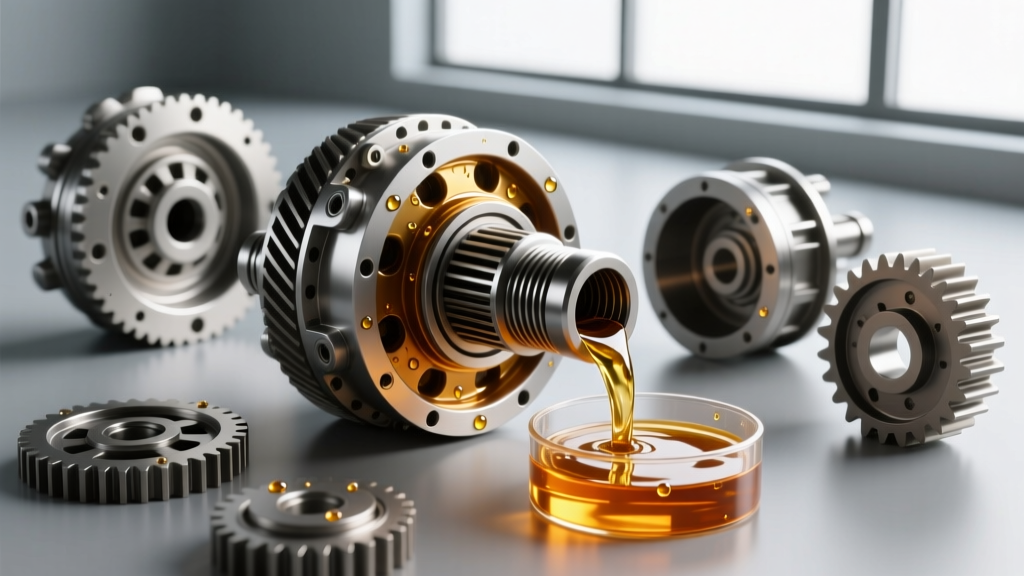
If your diagnostic test confirms the hardware is sound, a meticulous fluid service will restore quiet operation and protect against future wear. Modern synthetic gear oils, such as those detailed in the AMSOIL Technical Guides, offer vastly superior shear stability compared to conventional 80W-90 oils of the past.
Prep and RTV Application
Avoid cheap, pre-cut cork or rubber gaskets for stamped steel differential covers; they notoriously leak under high axle-articulation loads. Instead, use a high-temp RTV silicone like Permatex Ultra Black (Part #81878). Clean the mating surfaces on the axle housing and cover with brake cleaner until the rag comes away white. Apply a continuous 3mm bead of RTV around the cover, circling the inside of every bolt hole. Let the RTV skin over for 15 minutes before mating, and wait a full 12 hours before filling with fluid to ensure a complete cure.
Torque Specifications & Fluid Capacities
Over-torquing differential cover bolts will warp stamped steel covers, guaranteeing a leak. Always use a calibrated inch-pound or low-range foot-pound torque wrench. Fill the differential until the fluid reaches the exact bottom lip of the fill hole—not the top.
| Axle Type | Cover Bolt Torque | Fluid Capacity | Recommended Viscosity |
|---|---|---|---|
| Ford 8.8 (F-150 / Mustang) | 28 - 38 lb-ft | 2.5 - 3.0 Pints | 75W-140 Synthetic (Towing) |
| GM 8.5 / 10-Bolt (Silverado) | 22 lb-ft | 2.1 - 2.4 Pints | 75W-90 Synthetic |
| Dana 44 (Jeep Wrangler) | 30 - 40 lb-ft | 2.0 - 2.5 Pints | 75W-140 Synthetic (Off-Road) |
| Chrysler 8.25 (Ram 1500) | 30 lb-ft | 2.2 Pints | 75W-90 Synthetic |
Troubleshooting LSD Chatter Post-Service
If your vehicle is equipped with a clutch-type Limited-Slip Differential (e.g., Ford Traction-Lok, GM G80, or aftermarket Eaton Detroit Truetrac), the base gear oil alone is insufficient. You must add a Friction Modifier (FM) to alter the coefficient of friction on the clutch discs.
Expert Troubleshooting Tip: Do not dump the entire bottle of FM into the axle blindly. Over-dosing the differential with friction modifier will cause the clutch packs to slip excessively under heavy throttle, effectively turning your LSD into an open differential.
The Dosing Protocol:
- Fill the axle with your chosen synthetic 75W-90 or 75W-140 gear oil, leaving about 4 ounces of head-space at the fill hole.
- Add exactly 2 ounces of a high-quality FM, such as Motorcraft XL-3 or GM EOS (Limited Slip Axle Lubricant).
- Top off the fill hole with base gear oil and reinstall the plug (torque to 22-30 lb-ft).
- Drive the vehicle and perform the Phase 4 lock-to-lock turn test. If chatter persists, drain 2 ounces of fluid and add 2 more ounces of FM. Do not exceed 4-6 ounces total, depending on the axle's total capacity.
Final Verification: Axle Shaft End-Play
While the cover is off during your rear differential service, take two minutes to check the C-clip axle shaft end-play. Grab the axle flange and push it in and out. On a Ford 8.8 or GM 10-bolt, you should feel no more than 0.010 to 0.020 inches of lateral movement. Excessive end-play indicates worn C-clips or a degraded thrust block inside the carrier, which will eventually cause the axle shaft to eat into the wheel bearing and ABS tone ring. Catching this during a routine fluid service can save you from a catastrophic highway wheel-bearing failure.
By combining a rigorous auto differential test with a meticulous, spec-driven fluid service, you can extend the life of your rear axle well past the 150,000-mile mark, ensuring quiet, reliable power delivery to the pavement.