Auditory Triage: Diagnosing RAV4 Rear Differential Noises
The Toyota RAV4 has dominated the compact SUV segment for years, and its All-Wheel Drive (AWD) system relies heavily on a robust, albeit compact, rear differential. As these vehicles accumulate mileage—particularly Gen 4 (2013-2018) and Gen 5 (2019-2026) models—owners frequently report rear-end whining, howling, or clunking. Before tearing into the drivetrain, an accurate auditory diagnosis is critical. Hypoid gearsets produce distinct acoustic signatures depending on the failure mode.
- Coast-Down Whine: A high-pitched whine that occurs exclusively when you lift off the throttle (deceleration) typically indicates pinion bearing wear or improper pinion preload. The pinion gear is being pulled away from the ring gear, altering the contact pattern.
- Load Howl: A deep, resonant howling noise under acceleration points to ring and pinion gear wear, often exacerbated by depleted Extreme Pressure (EP) additives in degraded gear oil. The sliding friction of the hypoid gears is literally scuffing the metal.
- Clunk on Engagement: A sharp metallic clunk when shifting from reverse to drive, or during initial throttle tip-in, suggests excessive backlash. This can be caused by worn differential spider gears, degraded axle shaft splines, or a failing rear driveshaft coupling.
- Chatter in Tight Turns: While most RAV4 rear differentials are open (relying on the front transfer case and AWD coupling for torque vectoring), if your specific trim features a rear torque-vectoring LSD (like the Adventure/TRD Off-Road trims), chatter during low-speed turns indicates degraded limited-slip friction modifiers.
The AWD Coupling vs. Rear Differential Misdiagnosis
One of the most common pitfalls in RAV4 drivetrain diagnostics is confusing rear differential noise with a failing electromagnetic AWD coupling. On the RAV4, the rear differential is not a standalone unit; it is bolted directly to the rear driveshaft coupling assembly. If you hear a grinding or binding noise from the rear of the vehicle that correlates with steering angle or wheel slip, the issue is frequently the electromagnetic clutch pack located just forward of the differential, not the hypoid gears inside the differential housing itself. Always verify the AWD lock/unlock logic and scan for coupling-related OBD-II codes before condemning the rear differential.
Selecting the Correct Toyota RAV4 Differential Fluid Type
Choosing the correct Toyota RAV4 differential fluid type is not merely a maintenance suggestion; it is a critical diagnostic and operational variable. The RAV4 rear differential utilizes a hypoid gear design, where the pinion gear intersects the ring gear below the centerline. This geometry creates massive sliding friction alongside rolling friction, requiring specialized lubrication.
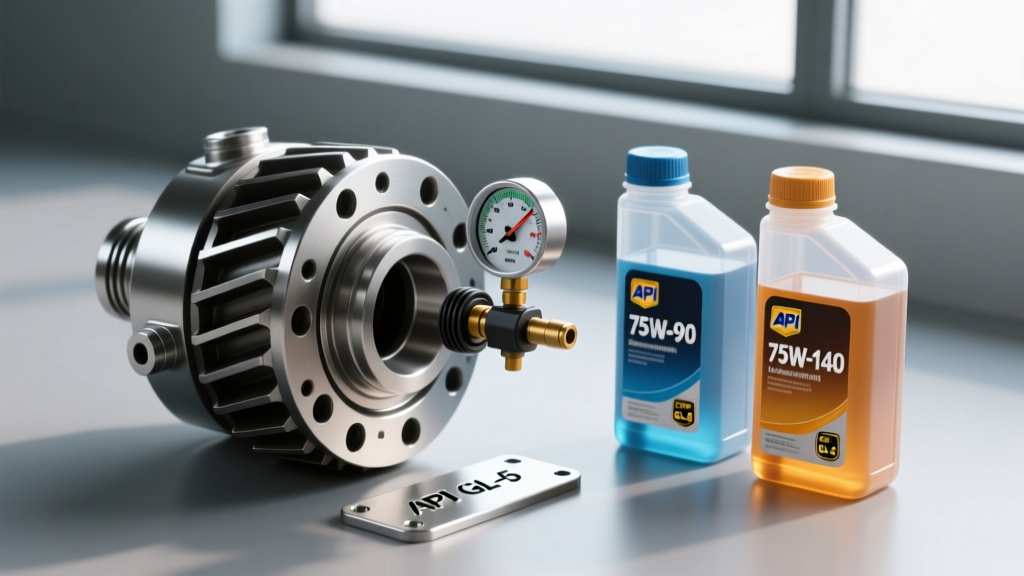
You must exclusively use an API GL-5 rated gear oil. GL-5 fluids contain high levels of sulfur-phosphorus EP additives that form a sacrificial tribofilm on the gear teeth under extreme pressure. Using an API GL-4 fluid, which has roughly half the EP additive concentration, will result in rapid gear scuffing, pitting, and catastrophic failure. Furthermore, modern RAV4s require lower viscosity fluids to reduce parasitic drag and meet stringent CAFE fuel economy standards. As of 2026, the shift toward ultra-low viscosity 75W-85 and even 70W-80 gear oils in newer Toyota platforms is standard practice, but you must match the exact OEM specification for your generation.
Generational Fluid Specifications & Capacities
Below is the definitive reference chart for rear differential service on AWD RAV4 models. Always consult your specific owner's manual or Toyota Technical Information System (TIS) for your exact VIN.
| Generation (Years) | OEM Fluid Type & Viscosity | API Rating | Capacity | OEM Part Number (Reference) |
|---|---|---|---|---|
| Gen 3 (2006-2012) | SAE 85W-90 (Above 0°F) / 80W-90 (Below 0°F) | GL-5 | 0.55 L (1.16 pt) | 08885-81016 |
| Gen 4 (2013-2018) | SAE 85W-90 or 80W-90 Hypoid Gear Oil | GL-5 | 0.50 L (1.05 pt) | 08885-81016 |
| Gen 5 (2019-2026) | SAE 75W-85 Hypoid Gear Oil SX | GL-5 | 0.48 L (1.01 pt) | 08885-02606 |
Note: For extreme cold climates (consistently below -18°C / 0°F), synthetic 75W-90 GL-5 is an acceptable and often superior aftermarket alternative for Gen 3 and Gen 4 models, provided it meets the American Petroleum Institute (API) GL-5 certification.
Precision Service Procedure & Torque Specifications
Performing a rear differential drain and fill on a RAV4 is straightforward, but ignoring torque specs or reusing crush washers will lead to leaks and fluid starvation. The rear differential holds less than half a liter of fluid; even a minor leak will quickly expose the pinion bearing, leading to a $1,500+ replacement bill.
- Preparation: Drive the vehicle to warm the gear oil, then park on a perfectly level surface. If the vehicle is tilted, the fluid level will be inaccurate.
- The Golden Rule: Always remove the FILL plug before the DRAIN plug. The fill plug on the RAV4 rear diff is typically a 10mm hex or a 24mm socket head, located on the passenger side of the housing. If the fill plug is seized or stripped, you do not want to drain the fluid and leave the vehicle stranded.
- Draining & Inspection: Place a catch pan beneath the rear diff. Remove the bottom drain plug. Inspect the magnetic tip of the drain plug. A fine, dark metallic paste is normal wear. However, if you find metallic glitter, shards, or chunky spalling, the ring and pinion or bearings are failing, and a fluid change will not fix the underlying mechanical damage.
- Hardware Replacement: Never reuse the aluminum crush washers. Order OEM Toyota crush washers (Part # 90430-24003 or equivalent for M24 plugs) prior to starting the job.
- Filling & Torque: Use a fluid transfer pump to inject the new gear oil until it begins to weep out of the fill hole. Reinstall both plugs and torque them precisely to 38 Nm (28 ft-lbf). Over-torquing can crack the aluminum differential housing or strip the threads.
Post-Service Troubleshooting & Edge Cases
What happens if you have performed the service using the exact Toyota RAV4 differential fluid type, torqued everything to spec, but the noise persists? Here is how to isolate the remaining edge cases:
1. Milky or Chocolate-Milk Fluid
If the drained fluid resembles a milkshake, water has breached the differential. This is almost always caused by a failed rear axle seal or a compromised pinion seal. Water destroys the sulfur-phosphorus EP additive package in GL-5 oil, leading to rapid corrosion of the bearing races. You must replace the seals, flush the housing with a cheap GL-5 rinse oil, and refill with fresh OEM fluid.
2. Persistent Whine After Fluid Change
While fresh 75W-85 or 85W-90 gear oil can mask minor gear whine by dampening acoustic frequencies, it cannot repair physical wear. If the whine persists, the pinion bearing preload has likely degraded. Adjusting pinion preload requires specialized inch-pound torque tools and a dial indicator to measure gear backlash. This is not a DIY job; it requires a drivetrain specialist to reset the contact pattern using marking compound.
3. Differentiating Driveshaft Carrier Bearing Noise
If the noise sounds like a low-frequency rumble that increases directly with vehicle speed (rather than throttle load), suspect the rear driveshaft center support bearing (carrier bearing) or the U-joints, rather than the differential itself. The gear oil analysis community frequently notes that misdiagnosed drivetrain noises often lead to unnecessary differential teardowns when the culprit is a $40 dry-rotted carrier bearing.
By combining precise auditory diagnostics with strict adherence to OEM fluid chemistry and torque specifications, you can reliably maintain the RAV4’s AWD system and accurately identify when a simple fluid service is no longer sufficient.