The Chemistry of Axle Survival: API GL-5 and MIL-PRF-2105E
When selecting the correct differential fluid for your vehicle's axle assembly, understanding the underlying chemical specifications is just as critical as matching the viscosity grade. Modern automotive and heavy-duty differentials operate under extreme boundary lubrication conditions, particularly in hypoid gear sets where the pinion gear intersects the ring gear below the centerline. This sliding action generates immense localized heat and shear forces that would instantly destroy standard motor oils or manual transmission fluids.
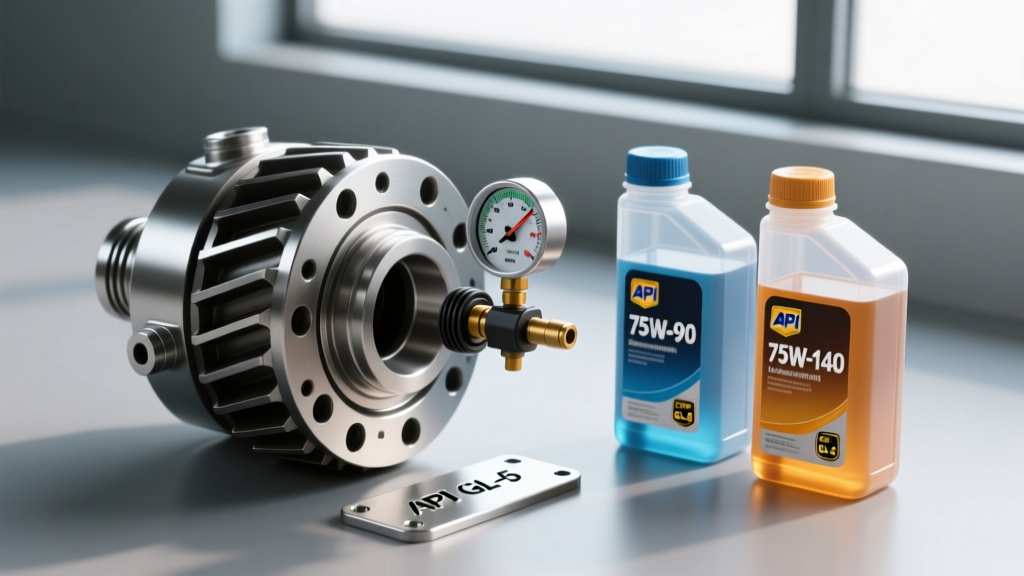
To combat this, the American Petroleum Institute (API) established the GL-5 classification, which mandates a high concentration of Extreme Pressure (EP) additives—typically sulfur-phosphorus compounds. These additives react with the iron surfaces of the ring and pinion gears under high heat to form a sacrificial, solid-film barrier that prevents metal-on-metal welding. Military specifications like MIL-PRF-2105E build upon the API GL-5 standard by adding stringent requirements for thermal oxidation stability, corrosion protection, and seal compatibility, ensuring the fluid can survive the brutal environment inside a locked or heavily loaded differential.
SAE Viscosity Grades: 75W-90 vs. 75W-140 vs. 80W-90
Viscosity dictates the fluid's ability to maintain a hydrodynamic wedge between moving parts. The SAE J308 standard classifies gear oils based on their kinematic viscosity at 100°C and their Brookfield viscosity at sub-zero temperatures. Choosing the wrong weight can lead to either catastrophic starvation at high temperatures or excessive parasitic drag and gear whine in cold climates.
| SAE Grade | Kinematic Viscosity at 100°C (cSt) | Brookfield Viscosity Limit | Primary Application |
|---|---|---|---|
| 75W-90 | 13.5 to <18.5 | 150,000 cP at -40°C | OEM standard for most light-duty trucks, SUVs, and passenger cars. Balances fuel economy with protection. |
| 80W-90 | 13.5 to <18.5 | 150,000 cP at -26°C | Older conventional mineral oils. Common in legacy commercial fleets and budget maintenance intervals. |
| 75W-140 | 24.0 to <32.5 | 150,000 cP at -40°C | Severe-duty towing, heavy off-roading, and high-horsepower applications. Required for many Dana 80 and AAM 11.5 axles under load. |
While a 75W-90 synthetic offers excellent cold-weather flow and minimizes drivetrain parasitic loss (improving fuel economy by up to 2% compared to mineral 80W-90), a 75W-140 provides a vastly superior film strength for vehicles consistently towing over 8,000 lbs or running large aftermarket tire setups that multiply the torque load on the ring and pinion.
Advanced Telemetry: What a Differential Pressure Indicating Transmitter Reveals
While your daily-driver F-150 or Wrangler relies on simple magnetic fill plugs and time-based maintenance intervals, heavy-duty fleet validation and industrial mining haul trucks utilize advanced telemetry to monitor axle health in real-time. In these extreme environments, engineers frequently install a differential pressure indicating transmitter across the axle's internal lube filtration or forced-cooling circuits.
Why use a differential pressure indicating transmitter for gear oil? The answer lies in polymer shear. Multi-grade gear oils (like 75W-140) rely on viscosity index improvers (long-chain polymers) to maintain their thickness at high temperatures. Under the immense mechanical shearing action of hypoid gears, these polymers can physically break apart, causing the fluid to permanently lose viscosity and drop from a 140-weight down to a 90-weight or lower.
As the fluid degrades and thins, its flow characteristics through the axle's internal baffles and external cooling loops change. A differential pressure indicating transmitter measures the exact pressure drop (Delta P) across the filtration or cooling circuit. A sudden spike in differential pressure can indicate filter bypass due to sludge buildup (oxidation), while an abnormal drop can indicate severe fluid shear and thinning. By monitoring this transmitter data, heavy-duty fleet managers can transition from arbitrary mileage-based fluid changes to true condition-based maintenance, pulling the differential cover only when the fluid's chemical and physical properties have genuinely failed.
2026 Buyer’s Guide: Top Synthetic Gear Oils for Severe Duty
For automotive enthusiasts and heavy-duty truck owners looking to replicate severe-duty protection without industrial telemetry, selecting a high-quality synthetic gear oil with robust shear-stable polymers is mandatory. Here is how the top contenders compare for demanding applications:
1. Amsoil Severe Gear 75W-90 / 75W-140
Amsoil's Severe Gear line is formulated with a proprietary synthetic base stock and a high treat-rate of EP additives. It is specifically engineered to resist thermal runaway in differential sumps that lack cooling fins. Best for: Heavy towing, rock crawling, and vehicles with poor differential airflow.
2. Red Line Heavy ShockProof Gear Oil
Red Line takes a unique approach by utilizing a film-strength additive package that includes microscopic solid particles (similar to a liquid grease). This creates an incredibly thick boundary layer that absorbs shock loads. Best for: Drag racing, high-horsepower drag axles, and extreme off-road shock loading. Note: Not recommended for axles with internal pumps or tight filtration due to its high viscosity index.
3. Mobil Delvac 1 Gear Oil 75W-90
A staple in the commercial trucking industry, Mobil Delvac 1 meets API MT-1 and GL-5 specifications, meaning it is safe for both hypoid differentials and heavy-duty manual transmissions. It offers exceptional oxidation stability, easily exceeding 500,000-mile drain intervals in over-the-road Class 8 trucks. Best for: Commercial fleets, highway towing, and mixed-fleet operators.
Wrenching Data: Torque Specs, Capacities, and Friction Modifiers
Even the most advanced synthetic gear oil will fail if the differential is improperly serviced. Over-tightening fill plugs can crack cast-aluminum or stamped-steel covers, while under-filling leads to immediate pinion bearing starvation. Always use a calibrated torque wrench and consult OEM specifications. Below are standard baseline specifications for common heavy-duty axles:
- Dana 60 (Front/Rear): Fill Plug Torque: 25-30 lb-ft. Capacity: ~3.5 pints (1.65 L).
- Ford 10.5-inch (Sterling): Fill Plug Torque: 35 lb-ft. Capacity: ~3.5 pints (1.65 L).
- AAM 11.5-inch (Ram HD): Fill Plug Torque: 25 lb-ft. Cover Bolts: 35 lb-ft. Capacity: ~3.8 pints (1.8 L).
- Dana 80: Fill Plug Torque: 35-40 lb-ft. Capacity: ~4.0 pints (1.9 L).
The Friction Modifier Imperative
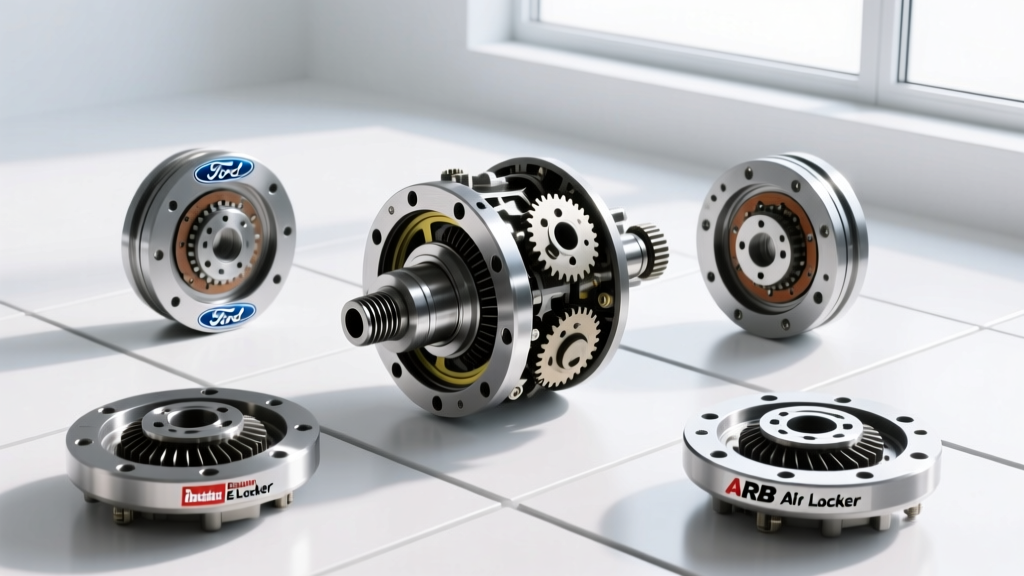
If your axle is equipped with a clutch-type Limited Slip Differential (LSD) such as a Ford Traction-Lok, GM Positraction, or Dana Trac-Lok, the base gear oil is only half the equation. The clutch packs require a specific friction modifier to prevent chatter and binding during low-speed cornering. Adding too much modifier will cause the clutches to slip continuously under load, effectively turning your LSD into an open differential. Adding too little results in aggressive binding and clutch-pack destruction.
Protocol: Fill the differential with your chosen 75W-90 or 75W-140 GL-5 gear oil, leaving room for the modifier. Add exactly 4 oz of the OEM-specified modifier (e.g., Ford XL-3 or GM ACDelco 10-4016). Perform a series of tight, low-speed figure-eights in a parking lot. If chatter persists, add 1 oz increments until the chatter ceases, never exceeding the total capacity of the housing.
Final Thoughts on Fluid Validation
Whether you are relying on the manufacturer's severe-duty maintenance schedule or analyzing data from a differential pressure indicating transmitter on a mining haul truck, the underlying truth remains the same: gear oil is a wearable component. The extreme pressures of hypoid gear sets demand strict adherence to API GL-5 chemistry, proper SAE viscosity selection, and meticulous service procedures. By understanding the science of shear stability and EP additives, you can ensure your axle assembly survives the harshest environments without catastrophic failure.