The Drivetrain Duo: Transfer Cases and Differentials Explained
For most of automotive history, the relationship between the transfer case and the differential has been a straightforward, two-component partnership. If you look at a traditional body-on-frame SUV like a Chevy Tahoe or a Jeep Wrangler, the drivetrain layout is distinctly separated. The transmission sends power to a standalone transfer case (such as the BorgWarner 4494 or the NV246). Think of the transfer case as a traffic cop; its sole job is to split torque between the front and rear axles, allowing the vehicle to operate in two-wheel drive, four-wheel drive high, or four-wheel drive low.
Once the torque is sent to the rear axle via the driveshaft, it enters the rear differential (like a GM 8.6-inch or a Dana 44). The differential's job is entirely different: it takes that longitudinal rotational force, turns it 90 degrees via a ring and pinion gear set, and distributes it to the left and right wheels while allowing them to rotate at different speeds during cornering. In these traditional setups, the transfer case requires a specific ATF or manual transmission fluid, while the rear differential requires a thick, high-sulfur 75W-90 GL-5 gear oil to protect the hypoid gears.
How Honda Flips the Script: The Integrated Dual Pump System
As we navigate the 2026 automotive landscape, millions of unibody crossovers dominate the roads, and Honda's Real-Time All-Wheel-Drive (AWD) system remains one of the most clever engineering solutions on the market. Vehicles like the 3rd and 4th generation Honda CR-V, the Honda Element, and early HR-V models do not have a traditional front-mounted transfer case.
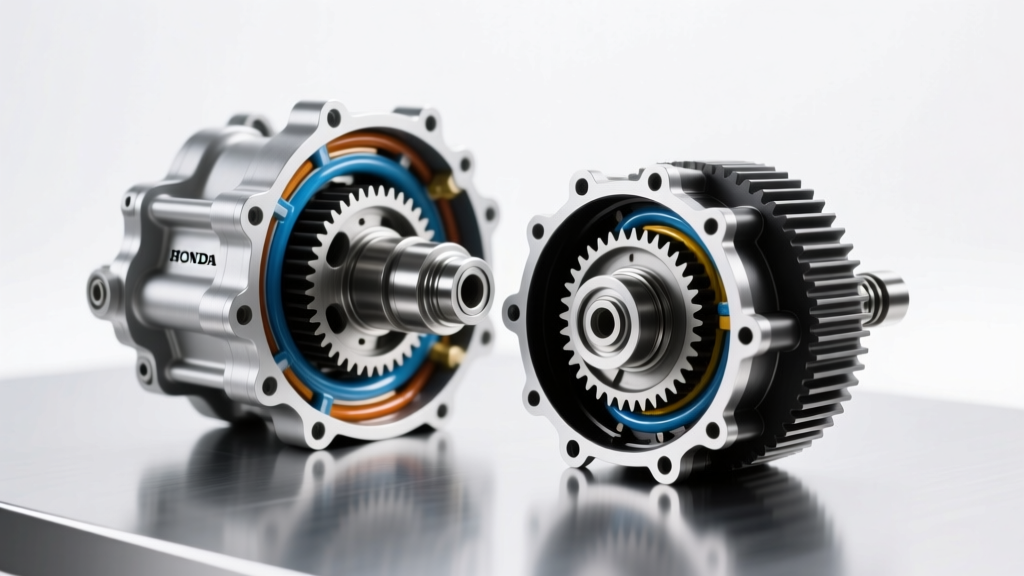
Instead, Honda utilizes a front transaxle with an integrated Power Take-Off (PTO) unit that sends power down a propeller shaft to the rear of the vehicle. However, the rear assembly is where the magic happens. Honda combined the torque-transfer function of a transfer case and the wheel-splitting function of a differential into a single, compact rear housing. This integrated unit relies on a hydraulic dual-pump system and a wet clutch pack to automatically transfer torque to the rear wheels only when front-wheel slip is detected.
The Engineering Behind the Dual Pump Mechanism
To understand why fluid selection is so critical, you must understand how the Honda rear assembly mimics a transfer case. Inside the rear differential housing, there are two hydraulic pumps:
- The Front-Driven Pump: Powered by the propeller shaft connected to the front transaxle.
- The Rear-Driven Pump: Powered by the rear axle shafts connected to the rear wheels.
Under normal, dry-road driving conditions, both pumps spin at the exact same speed, generating equal hydraulic pressure. The system remains in a neutral state, and the vehicle operates as a front-wheel-drive car to save fuel. However, the moment the front wheels slip on snow, ice, or mud, the front-driven pump spins faster than the rear-driven pump. This creates an immediate hydraulic pressure differential. That pressure acts upon a multi-plate wet clutch pack, instantly locking the front and rear axles together and transferring torque rearward. It is a brilliant, fully automatic mechanical computer.
Why Honda Genuine 08200-9007 Dual Pump II Differential Fluid is Non-Negotiable
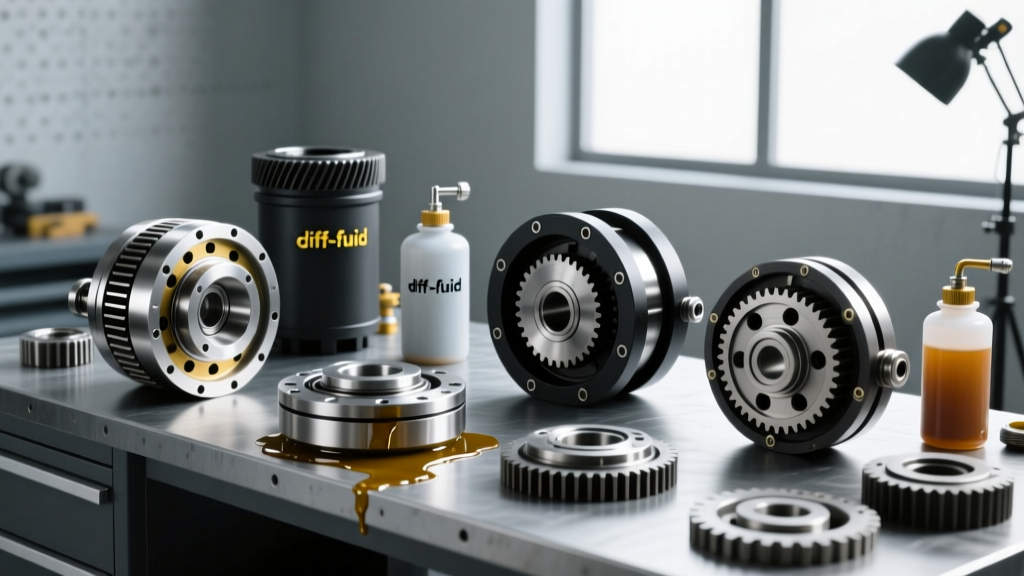
Because this single rear housing is performing the jobs of both a transfer case (hydraulic clutch engagement) and a differential (ring and pinion gear rotation), standard gear oils will destroy it. When sourcing the correct lubricant, the Honda Genuine 08200-9007 Dual Pump II differential fluid is the only acceptable choice for these specific generations of Honda Real-Time AWD systems.
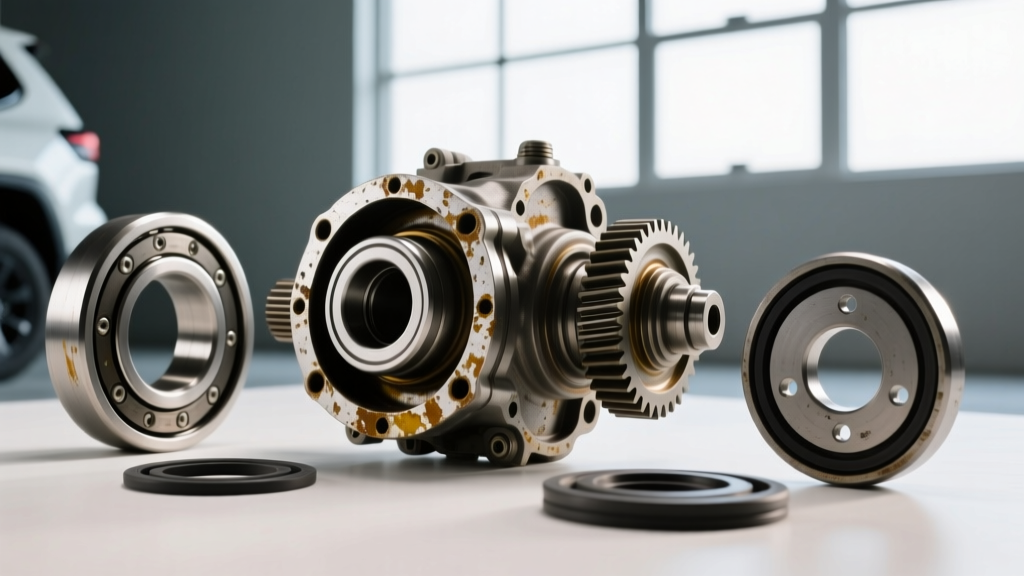
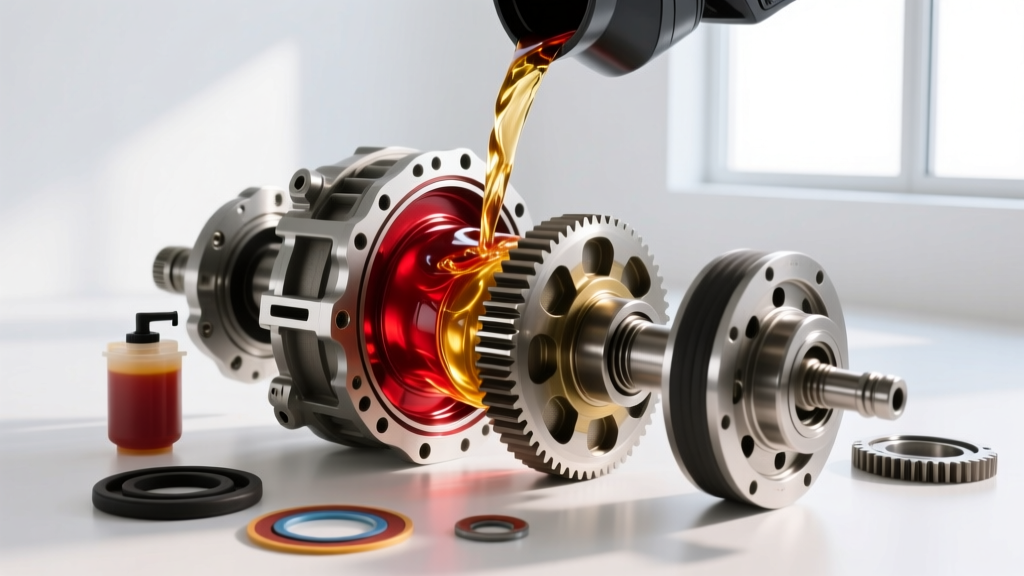
Many beginners make the catastrophic mistake of draining a Honda rear differential and filling it with standard 75W-90 GL-5 gear oil. GL-5 gear oil is far too viscous (thick) for the microscopic clearances inside the Honda hydraulic pumps. Furthermore, the extreme pressure (EP) additives and friction modifiers in standard gear oil will cause the wet clutch pack to slip, chatter, and eventually burn out. The Honda Genuine 08200-9007 Dual Pump II differential fluid is formulated with a highly specific, low-viscosity base stock and proprietary friction modifiers that allow the hydraulic pumps to build pressure instantly while providing just enough boundary lubrication to protect the ring and pinion gears.
Traditional vs. Integrated AWD: A Structural Comparison
| Feature | Traditional 4WD (e.g., Chevy Tahoe) | Honda Real-Time AWD (e.g., Gen 4 CR-V) |
|---|---|---|
| Torque Splitting Device | Standalone Transfer Case (NV246) | Integrated Rear Dual-Pump Assembly |
| Rear Differential | Separate Hypoid Gear Housing | Combined with Torque-Transfer Clutches |
| Required Fluid Type | 75W-90 GL-5 Gear Oil | Honda Genuine 08200-9007 Dual Pump II |
| Engagement Method | Driver-Selected or Auto-4WD Electronics | Fully Automatic via Hydraulic Pressure |
| Fluid Capacity (Rear) | 2.5 to 3.5 Quarts | 1.37 Quarts (1.3 Liters) |
Step-by-Step: Servicing the Honda Dual Pump Rear Assembly
Maintaining the transfer case and differential relationship in a Honda requires strict adherence to factory service procedures. According to Honda Tech Info service manuals, degraded fluid is the number one cause of premature clutch pack failure. Here are the exact specifications and procedures for servicing the Gen 3 and Gen 4 Honda CR-V rear assembly:
Required Parts and Tools
- Fluid: 2 Quarts of Honda Genuine 08200-9007 Dual Pump II (Available via Honda Automotive Parts dealerships).
- Crush Washers: 2x OEM Honda Drain/Fill Plug Washers (Part #90471-PX4-000).
- Tools: 3/8-inch square drive breaker bar (for drain/fill plugs), 10mm hex socket (for certain HR-V/Pilot variant plugs), torque wrench, fluid transfer pump.
The 'Double-Flush' Service Procedure
If your Honda rear differential has never been serviced, or if it is exhibiting groaning noises, a single drain-and-fill is not enough to remove the debris trapped in the wet clutch pack. You must perform the legendary Honda Double-Flush:
- Level the Vehicle: The vehicle must be perfectly level on jack stands or a lift. The fill hole is the exact level indicator; if the car is tilted, you will under-fill or over-fill the 1.37-quart capacity.
- Drain: Remove the lower drain plug (Torque spec: 33 lb-ft / 44 Nm). Allow the fluid to drain completely. Inspect the magnetic plug for excessive metal shavings (a fine gray paste is normal; chunks are bad).
- First Fill: Reinstall the drain plug with a new crush washer. Torque to 33 lb-ft. Remove the upper fill plug. Pump in exactly 1.37 US Quarts of Dual Pump II fluid until it weeps out of the fill hole. Reinstall the fill plug with a new washer and torque to 33 lb-ft.
- The Agitation Drive: Lower the vehicle and drive it to a large, empty parking lot. Perform 10 to 15 tight, low-speed 'figure-8' turns. This forces the dual pumps to engage and disengage the clutch pack, flushing old, degraded fluid and clutch material out of the internal galleries and into the main sump.
- Second Drain and Fill: Put the vehicle back on the lift, drain the fluid again, and refill it a second time with fresh 08200-9007 fluid. This ensures the clutch pack is bathed in 100% clean fluid with the correct friction modifiers.
Symptoms of Degraded Dual Pump Fluid
Because the transfer case and differential functions are combined, fluid degradation manifests in very specific, noticeable ways. If you ignore the maintenance interval, you will likely experience the following:
- The 'Honda Groan': A distinct, low-frequency groaning or moaning noise coming from the rear of the vehicle during tight, low-speed turns (like pulling into a parking space). This is caused by the wet clutch pack chattering due to depleted friction modifiers.
- Delayed AWD Engagement: When accelerating on slippery surfaces, the front wheels will spin excessively before the rear wheels engage. This indicates the hydraulic pumps are struggling to build pressure due to fluid aeration or viscosity breakdown.
- Binding on Dry Pavement: If the incorrect, overly thick gear oil was previously installed, the clutch pack may fail to disengage fully, causing the drivetrain to bind and hop during dry-pavement cornering.
Final Thoughts on Drivetrain Maintenance
Understanding the relationship between the transfer case and the differential is crucial for modern DIY mechanics. While traditional trucks separate these duties into two distinct, robust housings, Honda's Real-Time AWD system elegantly combines them to save weight and improve packaging. However, this integration means there is zero margin for error when it comes to lubrication. By strictly adhering to the factory service procedures and exclusively using the correct Honda Genuine 08200-9007 Dual Pump II differential fluid, you can easily push your Honda's integrated AWD system well past 200,000 miles without a single clutch-pack failure.