The Drivetrain Architecture: AAM 9.25 and the BorgWarner 44-44
As we navigate the automotive landscape in 2026, the 2015 Ram 1500 remains a staple on both job sites and highways. However, vehicles of this vintage are now accumulating well over 120,000 miles, bringing complex drivetrain quirks to the forefront of diagnostic bays. One of the most misunderstood issues plaguing this specific platform involves the relationship between the transfer case and the 2015 Ram 1500 front differential. To accurately diagnose noise, binding, or premature wear, technicians and DIY enthusiasts must first understand that this truck does not use a traditional center differential like a Subaru or Audi AWD system. Instead, it relies on an active, clutch-based transfer case that mimics center differential behavior in its 'Auto-4WD' mode.
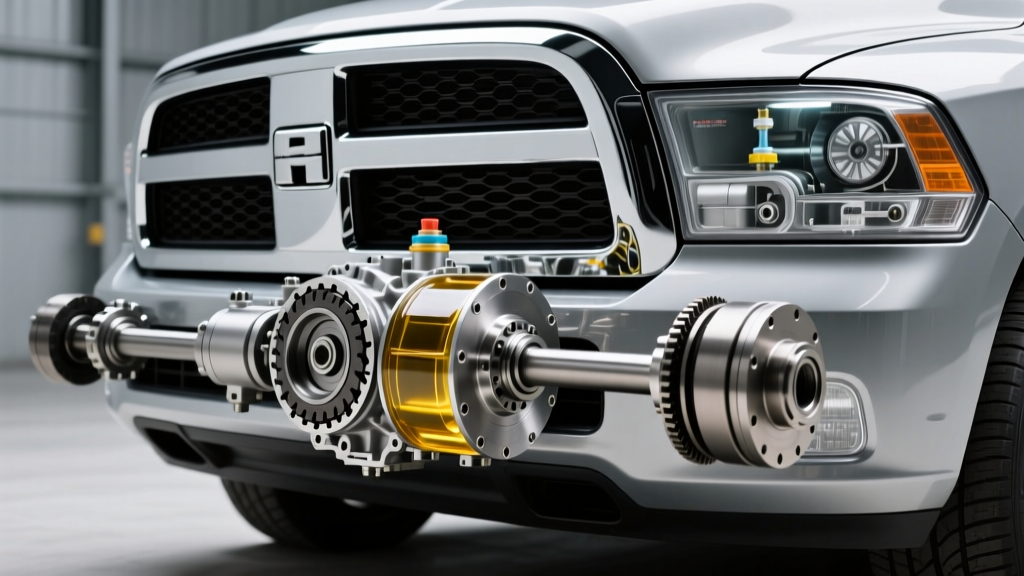
The 2015 Ram 1500 is equipped with the American Axle & Manufacturing (AAM) 9.25-inch Independent Front Suspension (IFS) axle. This front differential is tasked with receiving torque from the front driveshaft and distributing it to the CV half-shafts. Upstream, the BorgWarner 44-44 (or 44-45, depending on the exact build date and trim) transfer case acts as the functional equivalent of a center differential. Inside the transfer case, an electronically controlled clutch pack modulates torque transfer to the front axle. When this system ages, fails, or is serviced with the incorrect fluid, it creates a parasitic bind that transmits destructive shockloads directly into the front differential's ring and pinion gears.
The 'Center Differential' Misconception and Torque Feedback
When a driver selects 'Auto-4WD' on the rotary dial, the transfer case encoder motor applies pressure to the internal clutch pack. This allows for a slight speed differential between the front and rear driveshafts, accommodating the different turning radii of the axles during cornering on dry pavement. In a traditional AWD vehicle, a mechanical center differential or a viscous coupling handles this slip. In the Ram 1500, it is entirely dependent on hydraulic pressure, clutch friction material, and precise software mapping.
When the BorgWarner clutch pack begins to glaze, or when the encoder motor (Mopar part #68304684AA) loses its positional calibration, the transfer case fails to slip appropriately. It essentially locks the front and rear driveshafts together in a part-time 4WD state while the vehicle is on dry pavement. Because the front and rear tires rarely have the exact same rolling circumference due to wear disparities and weight distribution, a severe driveline bind occurs. This torque feedback has nowhere to go but into the weakest mechanical link: the pinion bearing and gear teeth of the 2015 Ram 1500 front differential.
Fluid Chemistry: The Cost of Cross-Contamination
Because the transfer case acts as the AWD center differential, fluid maintenance is frequently botched by quick-lube shops and inexperienced owners. The fluid requirements for the front axle and the transfer case are radically different, and cross-contamination is a leading cause of catastrophic failure.
Front Differential Fluid Specifications
The AAM 9.25 front differential requires a high-viscosity, extreme-pressure (EP) gear oil to protect the hypoid ring and pinion gears. The OEM specification is 75W-140 Synthetic Gear Oil (Mopar part #68218655AA). This fluid contains sulfur-phosphorus additives designed to handle the massive sliding friction of hypoid gear teeth. The front differential fluid capacity is exactly 1.3 liters (2.75 pints). Using a lighter 75W-90 fluid in a truck that tows or operates in Auto-4WD frequently will lead to rapid fluid degradation and pinion bearing whine.
Transfer Case (Center Diff) Fluid Specifications
The BorgWarner 44-44 transfer case requires ATF+4 Automatic Transmission Fluid (Mopar part #05013457AA). ATF+4 is a low-viscosity hydraulic fluid packed with specific friction modifiers designed to allow the clutch pack to engage smoothly and slip without shuddering. The transfer case capacity is 1.9 liters (2.0 quarts).
Critical Warning: If a shop mistakenly drains the transfer case and fills it with 75W-140 gear oil, the high viscosity and EP additives will cause the clutch pack to lock up permanently and burn out within 500 miles. Conversely, if ATF+4 is put into the front differential, the hypoid gears will strip the protective boundary layer, resulting in metal-on-metal shearing and total differential failure.
Symptom Matrix: Front Axle vs. Transfer Case Bind
Diagnosing the root cause of a driveline complaint requires isolating the noise and physical feedback. Use the following matrix to differentiate between a failing front differential and a binding AWD center differential (transfer case).
| Symptom | Front Differential (AAM 9.25) Failure | Transfer Case (Center Diff) Binding |
|---|---|---|
| Cornering Behavior | Smooth, but may produce a clicking or popping sound if CV joints or side gears are damaged. | Severe 'hopping' or skipping sensation from the front tires on dry pavement; steering wheel fights the driver. |
| Noise Profile | Constant whine that changes pitch with vehicle speed; howl on deceleration indicates pinion bearing wear. | Clunking from the center console; front diff may whine secondary to the bind, but noise stops when shifted to 2WD. |
| 2WD vs Auto-4WD | Noise and vibration persist regardless of transfer case selector position. | Symptoms completely disappear when the rotary dial is set to strict 2WD mode. |
| Fluid Inspection | Drain plug magnet is covered in fine metallic paste or large gear chunks. | Fluid smells severely burnt; clutch material visible in the drain pan. |
The 4-Wheel Lift Bind Test: A Step-by-Step Diagnostic
To definitively prove that the transfer case is destroying the front differential, you must perform a mechanical bind test. According to Ram Body Builder Manuals and BorgWarner service documentation, this test isolates the driveline components.
- Vehicle Elevation: Lift the truck on a four-post hoist so all four tires are completely off the ground and hanging freely. Ensure the transmission is in Neutral and the parking brake is disengaged.
- Transfer Case Selection: Turn the ignition to the 'Run' position (engine off) and rotate the transfer case dial to 'Auto-4WD'. Listen for the encoder motor to cycle.
- Driveshaft Rotation: Manually rotate the rear driveshaft clockwise. Observe the front driveshaft. In a properly functioning system with worn-in clutches, the front driveshaft should rotate, but you should be able to momentarily hold the front shaft still while the rear shaft turns, feeling the clutch pack slip inside the transfer case.
- The Bind Check: If the front driveshaft locks instantly and cannot be held back without stopping the rear shaft entirely, the transfer case clutch pack is fused or the encoder motor is over-stroking. This confirms that torque feedback is being sent to the front axle on dry pavement.
- Front Axle Backlash Check: With the front driveshaft held stationary, grab the front CV flange and attempt to rotate it back and forth. Excessive rotational play (more than 15 degrees of backlash) indicates that the parasitic bind has already destroyed the front differential's ring gear thrust washers and pinion bearings.
Torque Specifications and Rebuild Metrics
If your diagnosis confirms that the front differential has been damaged by the AWD system's binding, a rebuild or replacement of the AAM 9.25 is required. Precision torque application is non-negotiable during reassembly. Reference the Mopar Parts Catalog for OEM replacement components.
- Differential Cover Bolts: 35 lb-ft (47 Nm). Use a crisscross pattern to prevent warping the stamped steel cover.
- Drain and Fill Plugs: 25 lb-ft (34 Nm). Always replace the crush washers.
- Front Axle Shaft Nuts: 175 lb-ft (237 Nm). These require a heavy-duty torque wrench and a new staked nut every time the CV axle is removed.
- Pinion Nut (Crush Sleeve): The pinion nut torque is not a static number; it is measured by rotational friction. The target rotating torque for used bearings is 15-25 in-lbs. For new bearings and a new crush sleeve, the target is 20-30 in-lbs. Overtightening will instantly destroy the new pinion bearing.
- Ring Gear Bolts: 70 lb-ft (95 Nm) with red Loctite, torqued in a star pattern.
2026 Market Repair Costs and Component Replacement
Addressing this cascading failure requires a dual-pronged financial approach. Ignoring the transfer case will simply destroy the newly rebuilt front differential within 10,000 miles. In the current aftermarket and OEM landscape, expect the following pricing for a proper resolution:
- Transfer Case Clutch Pack & Fluid Service: $450 - $700. This includes dropping the transfer case, replacing the BorgWarner friction plates, installing a new encoder motor if calibration codes are present, and refilling with exactly 1.9L of Mopar ATF+4.
- Front Differential Rebuild (AAM 9.25): $1,400 - $2,200. This covers a master bearing kit, a new ring and pinion set (typically 3.92 or 4.10 ratio depending on factory build), crush sleeve eliminator kit (highly recommended for longevity), and 1.3L of 75W-140 synthetic gear oil.
- Remanufactured Front Axle Assembly: $2,800 - $3,500. If the differential housing is cracked from severe bind-shock, a complete drop-in axle assembly from an OEM supplier is the most reliable route.
Ultimately, maintaining the 2015 Ram 1500's drivetrain requires respecting the distinct roles of its fluids and mechanical linkages. By understanding how the transfer case functions as an AWD center differential, technicians can stop replacing front differentials that are merely victims of upstream torque feedback, saving thousands of dollars in misdiagnosed repairs.