The Misunderstood Center Differential in Ram AWD Systems
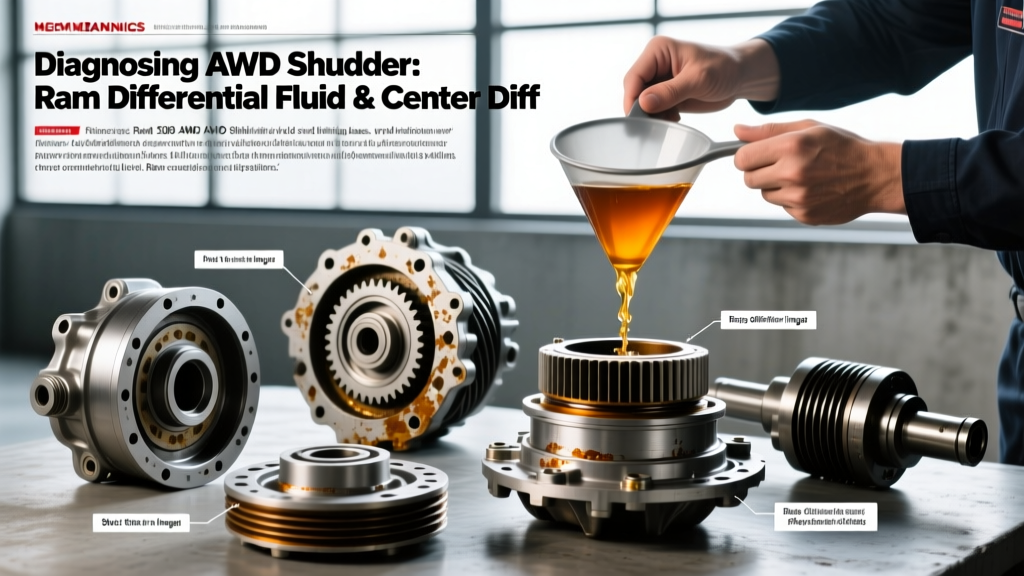
When truck owners research drivetrain maintenance, the search for ram differential fluid typically yields results for the front and rear axle differentials. However, for Ram 1500 models equipped with the Torque-On-Demand (TOD) Auto-4WD system, the "center differential" is actually housed inside the transfer case. As of the 2026 model year, Stellantis continues to rely heavily on BorgWarner 44-44 and 44-45 transfer cases to manage front-to-rear torque distribution. These units utilize an internal clutch pack rather than a traditional planetary gearset to act as a center differential, allowing for seamless AWD operation on dry pavement.
Because this center differential relies on a wet clutch pack, the fluid requirements are drastically different from the hypoid gear oil used in the axles. Misdiagnosing AWD binding or shuddering as a transmission issue or a worn suspension component is a common mistake. In reality, degraded friction modifiers in the transfer case fluid are often the root cause. Understanding the distinction between your axle differentials and your center differential is the first step in accurate symptom diagnosis.
4 Symptoms of Center Differential & Transfer Case Fluid Breakdown
Diagnosing drivetrain noise and vibration requires isolating the source. If you are experiencing any of the following symptoms, your center differential fluid may be compromised.
1. Low-Speed Binding and Tire Chirp
In a traditional part-time 4WD system, driving on dry pavement in 4-High causes binding because the front and rear driveshafts are locked together. In a Ram equipped with the BorgWarner TOD system, the "Auto" mode should allow for slight speed differences between the axles via clutch slip. When the ATF+4 fluid degrades and loses its friction-modifying properties, the clutch pack can stick and bind instead of slipping smoothly. This manifests as tire chirp or a harsh jerking sensation from the center console during low-speed, tight-radius turns, such as pulling into a driveway or navigating a parking garage.
2. Transfer Case Shudder During Tight Turns
Often described as a "rumble strip" feeling beneath the driver's seat, this shudder occurs when the wet clutches inside the center differential experience stick-slip friction. The degraded fluid fails to maintain a microscopic boundary layer between the friction and separator plates. As the clutch pack rapidly grabs and releases, it sends high-frequency torsional vibrations through the driveshafts. This is the most definitive symptom that your transfer case requires an immediate fluid exchange.
3. Whining from the BorgWarner TOD Unit
While axle differential whine usually points to worn ring and pinion bearings, a high-pitched whine originating from beneath the center console indicates transfer case cavitation or low fluid levels. The internal oil pump in the BW 44-44 is driven by the rear output shaft. If the fluid is low due to a leaking output shaft seal, or if the fluid has oxidized and thickened, the pump will starve, leading to a distinct mechanical whine that increases with vehicle speed.
4. Delayed Engagement in "Auto" 4WD Mode
The TOD system uses an encoder motor to apply pressure to the clutch pack via a cam mechanism. If the fluid is heavily contaminated with clutch material or metallic particulate, the internal hydraulic passages and cam ramps can experience delayed actuation. You may notice a 1-to-2 second delay before the front axle engages when the rear wheels break traction on wet pavement.
Fluid Matrix: Center Diff vs. Ram Differential Fluid Specs
A critical error made by DIY mechanics and inexperienced lube technicians is filling the transfer case (center diff) with standard 75W-90 gear oil. This will destroy the TOD clutch pack in a matter of miles. Below is the definitive fluid matrix for late-model Ram 1500 AWD/4WD platforms.
| Component | Function | OEM Fluid Specification | Capacity | Plug Torque Spec |
|---|---|---|---|---|
| Center Diff (BW 44-44/45 TC) | TOD Clutch Pack Lubrication & Cooling | Mopar ATF+4 (68218925AB) | 2.0 Quarts (1.9L) | 18 lb-ft (24 Nm) |
| Rear Axle Differential (AAM/ZF) | Hypoid Gear & Bearing Lubrication | 75W-85 Synthetic (68218655AB) | 2.2 Quarts (2.1L) | 25 lb-ft (34 Nm) |
| Front Axle Differential (AAM 9.25) | Hypoid Gear & Bearing Lubrication | 75W-85 Synthetic (68218655AB) | 1.5 Quarts (1.4L) | 25 lb-ft (34 Nm) |
Note: Always consult the Ram Owner's Manuals for your specific VIN, as heavy-duty (2500/3500) models utilize different AAM transfer cases and axle assemblies with varying capacities.
Step-by-Step Diagnostic and Service Procedure
If your Ram is exhibiting the shudder or binding symptoms outlined above, perform the "Figure-8 Test" before tearing into the drivetrain. Find a clean, dry, paved area and drive the truck in a tight figure-8 pattern in "Auto" 4WD mode. If the binding is severe, the fluid change is urgently needed.
Pro-Tip from the Drivetrain Bench: Never use aftermarket "friction modifier" additives designed for limited-slip axle differentials in your BorgWarner transfer case. ATF+4 already contains the exact friction modifier package required for the TOD clutch pack. Adding LSD modifiers will cause the clutches to slip excessively, leading to premature wear and AWD failure.
The Drain and Fill Protocol
- Vehicle Preparation: Raise the vehicle on a lift or level jack stands. The transfer case must be perfectly level to ensure an accurate fill.
- Remove the Fill Plug FIRST: Using a 3/8-inch drive ratchet, remove the upper fill plug. Torque spec on reinstallation is 18 lb-ft. Never remove the drain plug first; if the fill plug is seized or stripped, you will be left with a drained transfer case and a stranded vehicle.
- Drain the Fluid: Remove the lower drain plug. Inspect the magnetic plug for metallic fuzz. A fine, glitter-like paste is normal for clutch wear; large metal shards indicate planetary gear or chain guide failure.
- Refill with ATF+4: Using a fluid transfer pump, inject Mopar ATF+4 or a licensed equivalent (such as Valvoline ATF+4) until the fluid begins to weep out of the fill hole. This typically takes exactly 2.0 quarts.
- Torque and Clean: Reinstall both plugs to 18 lb-ft (24 Nm) and wipe down the case to monitor for future leaks.
When Fluid Changes Fail: Mechanical Edge Cases
If you have serviced the center differential with the correct Mopar Parts and fluids, but the AWD shudder persists, you are likely dealing with a mechanical failure inside the BorgWarner Transfer Case.
1. Glazed or Worn Clutch Packs
If the transfer case was driven for thousands of miles with degraded fluid, the friction material on the clutch plates may be permanently glazed or worn down to the steel backing plates. In this scenario, a fluid change will not restore the friction coefficient. The clutch pack assembly (Mopar Part # RL12738201 or equivalent BorgWarner rebuild kit) must be replaced. Expect a dealership repair cost between $1,200 and $1,800 for parts and labor.
2. Transfer Case Chain Stretch
The BorgWarner 44-44 utilizes a heavy-duty link chain (often part # HV-072 or similar depending on the exact build year) to connect the rear output shaft to the front output sprocket. Over time, and exacerbated by low fluid levels, this chain can stretch. A stretched chain will skip teeth on the sprockets under heavy AWD load, causing a violent "clunk" or binding sensation that mimics a center differential failure. Chain replacement requires a complete teardown of the transfer case.
3. Encoder Motor and Cam Ramp Wear
The electric encoder motor physically rotates a cam that squeezes the clutch pack together. If the plastic cam ramps wear down, or if the encoder motor loses its positional calibration, the clutch pack will not receive the correct clamping force. This results in erratic AWD engagement. Diagnosing this requires a bi-directional OBD2 scan tool capable of reading the transfer case module's encoder motor position sensor data in real-time.
Summary: Protect Your Drivetrain Investment
Troubleshooting AWD issues in modern Ram trucks requires looking beyond the standard axle differentials. By understanding that your transfer case acts as the center differential, and by strictly adhering to the ATF+4 fluid specification rather than standard ram differential fluid gear oils, you can eliminate shudder, prevent binding, and extend the life of your drivetrain well past the 150,000-mile mark. Always prioritize the Figure-8 diagnostic test and follow precise torque specifications to ensure your truck remains capable in all conditions.