The Missing Link in Your 2021 Ram 1500 Differential Fluid Change
When truck owners begin researching a 2021 Ram 1500 differential fluid change, the focus almost exclusively lands on the front and rear axles. It is easy to understand why: the differentials are the final mechanical stop before power reaches the tires. However, if you own a 4x4 model, treating the differentials as isolated components is a fundamental misunderstanding of your drivetrain. As we navigate the extended ownership cycles of these trucks in 2026, understanding the critical relationship between your transfer case and your differentials is the difference between a routine maintenance day and a catastrophic drivetrain failure.
For beginners, the drivetrain can seem like a complex web of gears and shafts. But at its core, it operates as a synchronized triangle. The transfer case acts as the heart, pumping torque to the front and rear differentials, which act as the lungs, distributing that power left and right. If you change your differential gear oil but ignore the mechanical realities dictated by the transfer case, you are only doing half the job. Let us break down exactly how these components interact, why it matters for your fluid maintenance, and how to execute the service properly.
The Drivetrain Triangle: Transfer Case and Differential Relationship
To understand why your differential fluid degrades, you must first understand the load placed upon it by the transfer case. The 2021 Ram 1500 4x4 typically utilizes a BorgWarner transfer case—either the 44-45 (part-time 4WD) or the 48-11 (Torque-on-Demand). According to BorgWarner's engineering documentation, these units are responsible for splitting engine torque along the vehicle's longitudinal axis (front-to-back).
Once the transfer case sends that torque down the driveshafts, the front and rear differentials take over. Manufactured largely by American Axle & Manufacturing (AAM) for the Ram 1500, these differentials split the torque laterally (left-to-right) while allowing the wheels to rotate at different speeds during a turn. The relationship is entirely codependent: the transfer case dictates the volume of torque the differentials must handle, while the differentials manage the variance in wheel speed.
How the Transfer Case Punishes Differential Fluid
Here is where the beginner-friendly explainer turns into a vital mechanical warning. When you engage 4-High (4HI) in a part-time transfer case like the BW 44-45, the transfer case locks the front and rear output shafts together, forcing them to spin at the exact same speed.
However, when you drive on a high-traction surface (like dry pavement), the front and rear axles naturally need to spin at slightly different speeds due to the vehicle's turning radius and suspension geometry. Because the transfer case forbids this speed difference, the drivetrain experiences "wind-up" or "binding." This binding force has to go somewhere, and it is absorbed by the ring and pinion gears inside your front and rear differentials. The immense mechanical stress generates extreme heat, which rapidly shears the molecular bonds of your differential gear oil, destroying its protective film strength long before the recommended mileage interval is reached.
Drivetrain Fluid Specifications and Capacities
Before you crawl under your truck, you need the exact data. The 2021 Ram 1500 features different axle configurations depending on whether you have the standard payload or the Max Tow package. Below is the definitive 2026 reference chart for the most common 4x4 configurations.
| Component | Typical Model / Size | Fluid Type | Capacity | Plug Torque Spec |
|---|---|---|---|---|
| Rear Differential | AAM 10.5" (Max Tow / HEMI) | 75W-85 Synthetic GL-5 | 2.8 Quarts (2.65L) | 25 lb-ft (34 Nm) |
| Rear Differential | ZF / AAM 9.25" (Standard) | 75W-85 Synthetic GL-5 | 2.2 Quarts (2.1L) | 25 lb-ft (34 Nm) |
| Front Differential | AAM 9.25" IFS | 75W-85 Synthetic GL-5 | 1.6 Quarts (1.5L) | 25 lb-ft (34 Nm) |
| Transfer Case (BW 44-45) | Part-Time 4WD | Mopar ATF+4 | 1.5 Quarts (1.4L) | 15 lb-ft (20 Nm) |
| Transfer Case (BW 48-11) | Torque-on-Demand | Mopar ATF+4 | 2.0 Quarts (1.9L) | 15 lb-ft (20 Nm) |
Note: If your rear differential is equipped with a limited-slip differential (LSD), verify if your specific 75W-85 gear oil already contains friction modifiers. Modern Mopar synthetic formulations typically include them, eliminating the need for separate additive bottles.
Step-by-Step Service Synergy: Doing the Job Right
Performing a 2021 Ram 1500 differential fluid change is highly accessible for beginners, provided you respect the relationship between the components. Follow this sequence to ensure a clean, stress-free service.
Step 1: Inspect the Drivetrain Breathers
Before draining a single drop of fluid, locate the axle and transfer case breather valves. These small, one-way valves allow expanding gases to escape when the drivetrain heats up, and they seal shut when the housings cool down and contract. If a breather is clogged with mud or debris, the cooling housing will create a vacuum, sucking water and dirt past the axle seals. This is the number one cause of premature differential failure in off-road trucks. Trace the breather hoses up to their mounting points near the frame rails and ensure the caps move freely.
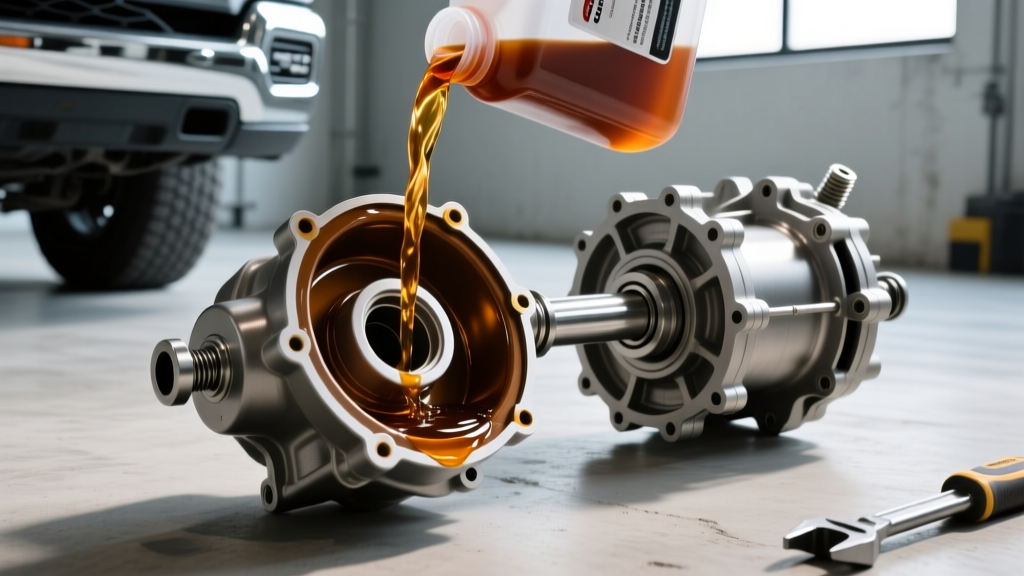
Step 2: The Drain and Fill Protocol
Modern AAM axles on the Ram 1500 are largely equipped with dedicated drain and fill plugs, saving you from the messy ordeal of removing a 10-bolt differential cover.
- Always remove the FILL plug first. If you drain the axle and then discover your fill plug is seized or stripped, your truck is immobilized.
- Use a 3/8-inch or 1/2-inch square drive (depending on the exact axle ratio and housing) to remove the plugs.
- Drain the fluid into a catch pan. Inspect the magnetic drain plug for metal shavings. A fine, glitter-like paste is normal wear; chunky metal shards indicate ring and pinion damage.
- Clean the threads and reinstall the drain plug, torquing it precisely to 25 lb-ft. Over-tightening can crack the aluminum or stamped-steel housing.
- Pump the new 75W-85 synthetic gear oil into the fill hole until it begins to weep out of the opening. Reinstall the fill plug at 25 lb-ft.
Step 3: Transfer Case Alignment
While you are under the truck, service the transfer case using Mopar ATF+4. The relationship between the T-case and the diffs means that a low fluid level in the transfer case will cause it to overheat and bind, which subsequently transfers harsh, jerky torque spikes directly to the differential ring gears. Keeping the T-case properly lubricated ensures smooth torque transitions, protecting your freshly serviced axle fluids from sudden shock-loading.
Real-World Costs and OEM Part Numbers (2026 Pricing)
Sourcing the correct fluids is vital for maintaining your factory warranty and drivetrain longevity. Based on current 2026 market pricing from authorized Mopar dealerships and reputable auto parts retailers, here is what you should expect to spend for a complete front diff, rear diff, and transfer case service:
- Mopar 75W-85 Synthetic Gear Oil (Part # 68218655AA): ~$14 - $18 per quart. (You will need roughly 5-6 quarts for both axles).
- Mopar ATF+4 Automatic Transmission Fluid (Part # 68218925AA): ~$10 - $12 per quart. (You will need 2 quarts for the transfer case).
- Replacement Crush Washers / Plug Gaskets: ~$5 - $10 total.
Total DIY Cost: Approximately $85 to $120. Compare this to a dealership drivetrain service package, which frequently exceeds $350 in labor and markup, and the beginner-friendly nature of this job becomes incredibly appealing.
Expert Insight: "The biggest mistake I see Ram 1500 owners make is treating the differentials as sealed, lifetime units. The transfer case dictates the mechanical stress the axles endure. If you tow heavy loads in 4-Low or frequently drive on mixed traction surfaces, the thermal cycling will break down standard gear oil in as little as 30,000 miles. Upgrading to a high-quality synthetic 75W-85 and respecting your torque specs is the cheapest insurance policy your drivetrain can get."
Final Thoughts on Drivetrain Harmony
A successful 2021 Ram 1500 differential fluid change is not just about swapping old oil for new oil; it is about acknowledging the entire torque pathway. By understanding how your BorgWarner transfer case interacts with your AAM differentials, you can diagnose issues earlier, prevent drivetrain wind-up, and ensure your truck remains capable on the trail and the job site. Grab your torque wrench, source your Mopar fluids, and give your 4x4 system the holistic maintenance it deserves.