The Financial Shock of Post-Replacement Clutch Problems
When drivers research the average clutch life of a modern manual transmission vehicle, they typically expect a lifespan ranging from 60,000 to 120,000 miles, depending on driving habits and vehicle application. However, a deeply frustrating and increasingly common scenario in the automotive repair industry is the premature failure of a brand-new clutch assembly shortly after replacement. Experiencing clutch chatter, slipping, or engagement issues just 2,000 to 10,000 miles after a major drivetrain service is not just a mechanical annoyance; it is a severe financial setback.
In 2026, the average dealership or specialized independent shop labor rate hovers between $165 and $235 per hour. According to AAA Automotive Repair Cost Analysis, the removal and replacement (R&R) of a manual transmission typically requires 6.0 to 9.5 hours of billed labor. If a post-replacement failure occurs out of warranty, or if a DIYer misdiagnoses the root cause of the initial failure, the cost to drop the transmission a second time can easily exceed $1,800 in labor alone, completely negating the investment in the new friction components.
Root Cause 1: The Flywheel Resurfacing Gamble
The single most common culprit behind post-repair clutch chatter and premature disc wear is the improper handling of the flywheel. To achieve the industry-standard average clutch life, the mating surface between the clutch disc and the flywheel must be perfectly flat and possess the correct micro-surface finish (Ra value).
Single Mass Flywheel (SMF) Neglect
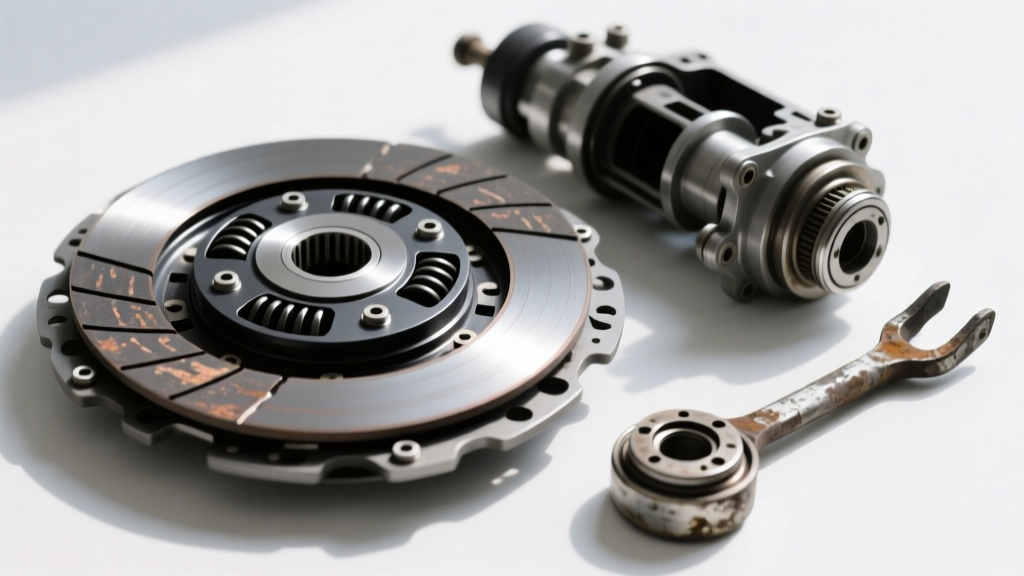
Many budget-conscious repairs skip flywheel resurfacing to save $85 to $150. However, a used SMF often exhibits heat spots, micro-cracks, and runout exceeding the 0.004-inch maximum tolerance. When a new clutch disc is clamped against an uneven flywheel, localized friction generates extreme heat. This glazes the new organic friction material within the first 500 miles, leading to severe slipping under load. The cost to fix this error requires a full R&R, plus the $120 machining fee that was originally avoided.
Dual Mass Flywheel (DMF) Failures
For vehicles equipped with DMFs—such as the VW/Audi 2.0T platform or Ford 6.7L PowerStroke diesels—resurfacing is impossible. The internal arc springs and damping mechanisms wear out concurrently with the clutch. Installing a new clutch kit (e.g., LuK REP part number 624 3180 00, retailing around $650) onto a worn DMF will result in immediate low-RPM chatter and transmission input shaft bearing damage. As noted in the LuK REP Technical Documents, failing to replace the DMF as a complete assembly voids the manufacturer warranty and guarantees a secondary failure well before the expected average clutch life is reached.
Root Cause 2: Hydraulic Drag and Concentric Slave Cylinders
Modern manual transmissions heavily rely on hydraulic Concentric Slave Cylinders (CSC) located inside the transmission bell housing. A frequent post-repair symptom is a clutch that "drags" or refuses to fully disengage, making gear entry into 1st or Reverse difficult. This drag keeps the clutch disc partially engaged while the engine is running, rapidly wearing the friction material down to the rivets in under 5,000 miles.
- Improper Bleeding: CSC systems are notorious for trapping air. If a shop uses a basic manual bleed instead of a pressure bleeder with a specialized clutch line adapter, residual air expands under engine bay heat, reducing throw distance.
- Reusing the Old CSC: A new clutch pressure plate has a different diaphragm spring height than a worn one. An old, fatigued CSC may not have the hydraulic stroke required to accommodate the new, taller pressure plate fingers, resulting in incomplete disengagement.
- Cost Impact: A CSC replacement part costs between $80 and $220. Skipping this $150 part during the initial repair to save money inevitably leads to a $1,500+ transmission removal procedure to replace it later.
Diagnostic Cost Matrix: Post-Repair Failures
Diagnosing a clutch problem after a recent repair requires isolating whether the fault lies in the installation, the parts, or the peripheral hydraulic systems. Below is a breakdown of the diagnostic and repair costs associated with premature clutch symptoms.
| Symptom | Probable Root Cause | Diagnostic Cost | Estimated Repair Cost (Parts + Labor) |
|---|---|---|---|
| Severe Chatter on Takeoff | Unmachined Flywheel / Oil Contamination | $150 (Visual/Runout Check) | $1,400 - $2,200 (R&R + Flywheel) |
| Slipping in 4th/5th Gear | Weak Pressure Plate / Glazed Disc | $120 (Stall Test) | $1,200 - $1,800 (R&R + Kit) |
| Hard Shifting / Gear Crunch | CSC Drag / Air in Hydraulics | $95 (Hydraulic Pressure Test) | $350 (Bleed) or $1,600 (CSC R&R) |
| High-Pitch Squeal (Depressed) | Seized Pilot Bearing / Input Shaft Drag | $110 (NVH Analysis) | $1,300 - $1,900 (R&R + Pilot Tool) |
Root Cause 3: Fastener Fatigue and Torque Spec Neglect
The average clutch life is heavily dependent on the even distribution of clamping force across the pressure plate. This clamping force is dictated by the torque applied to the pressure plate-to-flywheel bolts. Many generalist mechanics rely on impact wrenches or "feel" rather than a calibrated torque wrench and an alignment tool.
The Danger of Uneven Torque
If pressure plate bolts are tightened sequentially rather than in a star pattern, or torqued to incorrect specifications, the pressure plate cover can distort. This distortion leads to uneven wear on the clutch disc and premature diaphragm spring fatigue. Furthermore, failing to apply the correct threadlocker or torque-to-yield (TTY) procedures can result in bolt shear under high-RPM engagement.
OEM Torque Specifications Reference
Adhering to exact factory specifications is non-negotiable for achieving maximum clutch longevity. Below are critical torque specs for popular manual platforms:
- GM LS-Series (T56 / TR6060): Pressure plate bolts (M8 x 1.25) require 15 lb-ft, plus an additional 50 degrees of rotation (TTY). Flywheel bolts require 25 lb-ft plus 80 degrees.
- Ford Mustang GT (MT-82 / Getrag): Pressure plate to flywheel bolts typically torque to 25 lb-ft in a crisscross pattern. Flywheel bolts require 59 lb-ft.
- Honda K-Series (Civic Si / Integra): Pressure plate bolts torque to 19 lb-ft. Flywheel bolts require 76 lb-ft, necessitating a specialized flywheel holding tool to prevent engine rotation and crankshaft thrust bearing damage.
For further installation guidelines and torque tolerances, technicians frequently reference Exedy USA Technical Bulletins, which emphasize that over-torquing can warp the pressure plate fingers, while under-torquing leads to catastrophic fastener failure.
Navigating Warranty Claims and Out-of-Pocket Costs
When a clutch fails prematurely, the financial burden depends entirely on who performed the initial installation and the warranty terms of the parts used.
Professional Shop Installations: If a certified shop installed a premium kit (e.g., Sachs, LuK, or Exedy) and the clutch fails within the warranty period (usually 12 months / 12,000 miles), the shop is generally responsible for the R&R labor, and the parts manufacturer covers the replacement kit. However, if the shop can prove the failure was due to "driver abuse" (e.g., burnt friction material from excessive slip) or a modified ECU increasing torque beyond the clutch's rated capacity, the warranty will be voided, leaving the owner with a $2,500+ bill.
DIY Installations: For the home mechanic, a premature failure is a total financial loss. If an alignment tool was not used, resulting in a bent input shaft or damaged disc hub, the transmission must be pulled, and a new OEM input shaft (costing $300 to $800) must be sourced. The true cost of a DIY mistake is measured in weekends lost, specialty tool rentals, and the physical toll of pulling a 150-pound transmission on jack stands.
Conclusion: Protecting Your Drivetrain Investment
Achieving the expected average clutch life requires more than just swapping out the friction disc. It demands a holistic approach to the entire clutch system: resurfacing or replacing the flywheel, flushing and bleeding the hydraulic system, replacing the CSC, and utilizing a calibrated torque wrench. By understanding the cost breakdown of post-replacement failures, vehicle owners and technicians can make informed decisions during the initial repair, ensuring the drivetrain operates flawlessly for the next 100,000 miles.