The NVH Conundrum: Front Accessory Drive vs. Bellhousing
When a customer complains of a high-pitched whine, metallic grinding, or a rhythmic chirping emanating from the engine bay, the immediate suspect for manual transmission vehicles is often the clutch release mechanism. However, one of the most frequent—and costly—misdiagnoses in modern V8 performance platforms is confusing a failing throw-out bearing (TOB) with a failing AC clutch coil assembly. Because the AC compressor is typically mounted low on the front accessory drive, and the bellhousing sits directly behind the engine block, the acoustic frequencies of these two failing components overlap dramatically. In this 2026 model-specific repair guide, we break down the exact diagnostic procedures for the Ford Mustang MT-82 and the GM Tremec T56 Magnum/TR-6060 platforms to ensure you pull the correct component the first time.
Why the Acoustic Signature Overlaps
The fundamental issue lies in Noise, Vibration, and Harshness (NVH) propagation. A dry or failing throw-out bearing produces a metallic whirring or grinding noise that changes pitch with engine RPM and clutch pedal position. Conversely, when technicians refer to 'AC clutch coil noise,' they are typically diagnosing the integrated pulley bearing that rides over the electromagnetic coil assembly. Because this pulley spins continuously whenever the engine is running (regardless of whether the AC compressor is engaged), a failing pulley bearing on the clutch coil will emit a continuous whine that mimics a TOB riding on a worn pressure plate diaphragm. According to SAE International NVH Standards, high-frequency metallic resonance travels easily through the aluminum engine block, making it nearly impossible to isolate by ear from the driver's seat.
Model-Specific Diagnostic: Ford Mustang MT-82 (5.0L Coyote)
The Ford MT-82 manual transmission, paired with the 5.0L Coyote V8, is notorious for clutch system noise complaints. The diagnostic challenge here is compounded by the hydraulic nature of the release mechanism and the tight packaging of the front accessory drive.
Identifying MT-82 Concentric Slave Cylinder (CSC) Failure
The MT-82 does not use a traditional mechanical fork and throw-out bearing. Instead, it relies on a hydraulic Concentric Slave Cylinder (CSC), part number Motorcraft BR3Z-7A548-B (or equivalent). The CSC acts as both the hydraulic actuator and the release bearing. When the internal bearing races fail, they produce a harsh grinding noise that is most prominent when the clutch pedal is partially depressed (taking up the slack). Furthermore, a failing CSC will often weep DOT 4 brake fluid into the bellhousing. If you inspect the bellhousing inspection cover and find a misting of hydraulic fluid mixed with clutch dust, the CSC is your culprit. Note that air trapped in the hydraulic line can also cause a 'chatter' or 'whirring' noise; always perform a reverse-bleed using a pressure bleeder set to 15 PSI before condemning the bearing.
Testing the Coyote AC Clutch Coil & Pulley Bearing
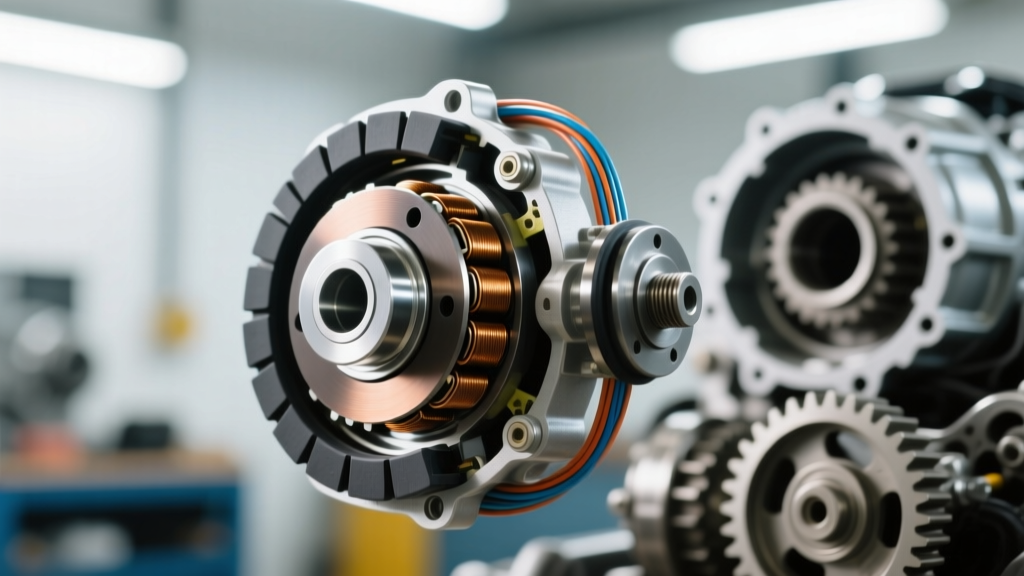
To isolate the AC clutch coil assembly on the 5.0L Coyote, you must perform a two-step physical and electrical test. First, use a mechanic's stethoscope with the probe placed directly on the cast-iron snout of the AC compressor, avoiding the spinning pulley. If the grinding is loudest here, the clutch coil pulley bearing is failing. Second, test the electromagnetic coil itself. Disconnect the electrical connector and use a digital multimeter set to Ohms. Probe the two terminals on the compressor side of the connector. A healthy Coyote AC clutch coil should read between 3.5 and 4.5 ohms at 20°C (68°F). If the reading is 'OL' (open loop), the coil is burnt out and will not engage the compressor, though this electrical failure does not cause mechanical noise. If the bearing is noisy, the entire clutch/pulley assembly must be replaced, which can often be done with the compressor still in the vehicle using a specialized puller tool.
Model-Specific Diagnostic: GM TR-6060 & T56 Magnum (LS/LT V8s)
GM's V8 manual platforms, ranging from the OEM TR-6060 found in the Camaro SS to the aftermarket favorite T56 Magnum, utilize different release mechanisms that change the diagnostic approach entirely.
Mechanical Fork vs. Hydraulic Throw-Out Bearing Noise
Unlike the hydraulic CSC of the Ford, many T56 Magnum crate installations and older LS-platform vehicles use a traditional mechanical release fork with a standard throw-out bearing (e.g., GM part # 24284924 or ACDelco equivalent). A mechanical TOB failure is highly dependent on pedal position. If the noise disappears completely when the pedal is fully depressed (loading the bearing against the spinning pressure plate) but returns when the pedal is released, the TOB is likely starved of grease or the fork pivot ball is worn. Conversely, if the noise is present at all times and changes pitch with RPM regardless of pedal position, you must look to the front accessory drive.
GM Sanden Compressor Clutch Coil Verification
GM applications frequently utilize Sanden or Delphi-style compressors. The clutch coil gap is critical on these units. If the air gap between the clutch plate and the pulley exceeds 0.6mm, the coil will struggle to engage, leading to excessive heat and eventual coil burnout. While a burnt coil causes AC failure, the pulley bearing integrated into the clutch coil assembly is what causes the NVH complaint. To verify, remove the serpentine belt and spin the AC compressor pulley by hand. A healthy pulley bearing should spin freely with a slight viscous drag and zero lateral play. Any gritty sensation or metallic scraping confirms the clutch coil pulley assembly requires replacement. You can source complete clutch assemblies via the RockAuto Parts Catalog to avoid replacing the entire compressor.
Diagnostic Matrix: TOB vs. AC Clutch Coil
| Diagnostic Variable | Throw-Out Bearing (CSC/Mechanical) | AC Clutch Coil Pulley Bearing |
|---|---|---|
| Noise at Idle (Clutch Engaged) | Light whirring or chirping | Continuous metallic whine/grind |
| Noise with Pedal Depressed | Increases in volume/pitch (loading bearing) | No change in acoustic signature |
| Belt Removal Test | Noise persists (belt removed) | Noise eliminated (compressor isolated) |
| Visual Inspection | Fluid in bellhousing (CSC) or fork wear | Rust dust around compressor snout/pulley |
| Electrical Test | N/A (Hydraulic/Mechanical) | 3.5 - 4.5 Ohms across coil terminals |
Repair Realities: Torque Specs, Fluids, and Pricing
Misdiagnosis is expensive. Dropping a transmission to replace a throw-out bearing requires significantly more labor than swapping an AC clutch coil pulley. Adhering to OEM specifications is mandatory to prevent repeat failures and catastrophic drivetrain damage. For further service manual references, technicians should consult Tremec OEM Service Documentation for precise shift rail and bellhousing tolerances.
Critical Fastener Torque Specifications
- Ford MT-82 Bellhousing to Engine Block: 37 lb-ft (50 Nm). Ensure the alignment dowels are fully seated before torquing to prevent input shaft binding.
- Ford Coyote Flywheel to Crankshaft: 59 lb-ft (80 Nm) plus an additional 90-degree turn. These are torque-to-yield (TTY) bolts and must be replaced during every clutch service.
- GM T56 Magnum/TR-6060 Bellhousing to Block: 35 lb-ft (47 Nm) for the M10 bolts, 15 lb-ft (20 Nm) for the M8 bolts.
- GM Flywheel to Crankshaft: 74 lb-ft (100 Nm) plus 90 degrees (TTY replacement required).
Real-World Cost Breakdown (2026 Estimates)
In 2026, average independent shop labor rates hover around $150 to $180 per hour. If you misdiagnose an AC clutch coil pulley bearing as a throw-out bearing, the customer is looking at a massive overcharge. Replacing the MT-82 CSC requires transmission removal (approx. 6.5 hours of labor). At $160/hr, labor alone is $1,040, plus $180 for the Motorcraft CSC and $120 for a high-quality clutch kit if the flywheel was scored. Total repair: $1,340. Conversely, replacing the AC compressor clutch coil and pulley assembly on the Coyote takes roughly 1.5 hours of labor (recovering refrigerant, swapping the pulley, recharging). Labor is $240, and the clutch/pulley assembly is roughly $110. Total repair: $350. The nearly $1,000 delta makes the stethoscope and belt-removal tests absolutely mandatory.
Expert Verdict
Never assume a front-end whine is a transmission issue simply because the vehicle is a manual. The acoustic coupling between the engine block and the bellhousing is a master of deception. By systematically isolating the accessory drive via belt removal, verifying the electrical resistance of the AC clutch coil, and performing a hydraulic pressure bleed on the CSC, you can confidently separate a $350 AC repair from a $1,300 clutch system overhaul. Precision diagnostics protect your shop's reputation and keep these legendary V8 manuals on the road where they belong.