The Economics of Polaris Drivetrain Longevity
Maintaining the drivetrain of a side-by-side or ATV is an exercise in preventive economics. When evaluating the true cost of ownership, the price of Polaris differential fluid is a microscopic fraction of the cost of replacing a shattered ring and pinion or a seized Hilliard clutch assembly. However, not all gear oils are created equal, and misunderstanding the precise specifications of Polaris lubricants can lead to catastrophic mechanical failures and inflated maintenance budgets. In this comprehensive cost analysis and specification breakdown, we dissect the chemical requirements, OEM part numbers, torque specifications, and real-world pricing matrices for Polaris front and rear differentials in 2026.
Decoding Polaris Gear Oil Specifications
To understand the cost structure, you must first understand the engineering requirements. Polaris utilizes two primary lubricants for their drivetrain systems: AGL (All Gear Lubricant) and Demand Drive Fluid. Conflating the two or substituting them with generic automotive gear oil is a leading cause of warranty-denied drivetrain failures.
AGL (All Gear Lubricant) Specifications
Polaris AGL is a custom-formulated synthetic blend (and in newer 2024+ formulations, a full synthetic) designed to meet API GL-5 standards. It is engineered specifically for the high-shear environment of Polaris transmissions and rear differentials. The additive package includes extreme pressure (EP) modifiers, specifically sulfur-phosphorus compounds, which bond to the hypoid gear teeth of the ring and pinion to prevent micro-pitting under heavy shock loads. The viscosity index is optimized for the wide operating temperature ranges of off-road environments, maintaining a stable 75W-90 equivalent film strength whether the differential is at -10°F or 220°F.
Demand Drive Fluid and the Hilliard Clutch
The front differential of a Polaris 4x4 is not a standard open or limited-slip differential; it utilizes a Hilliard one-way sprague clutch system. This mechanism engages the front axle only when the rear wheels lose traction and spin faster than the front wheels. Demand Drive Fluid contains a highly specific, proprietary friction modifier package. If you use standard API GL-5 75W-90 gear oil in the front differential, the friction modifiers will cause the Hilliard clutch to slip under load or, conversely, bind and fail to disengage, resulting in severe drivetrain wind-up and broken CV axles.
2026 OEM Fluid Pricing and Part Number Matrix
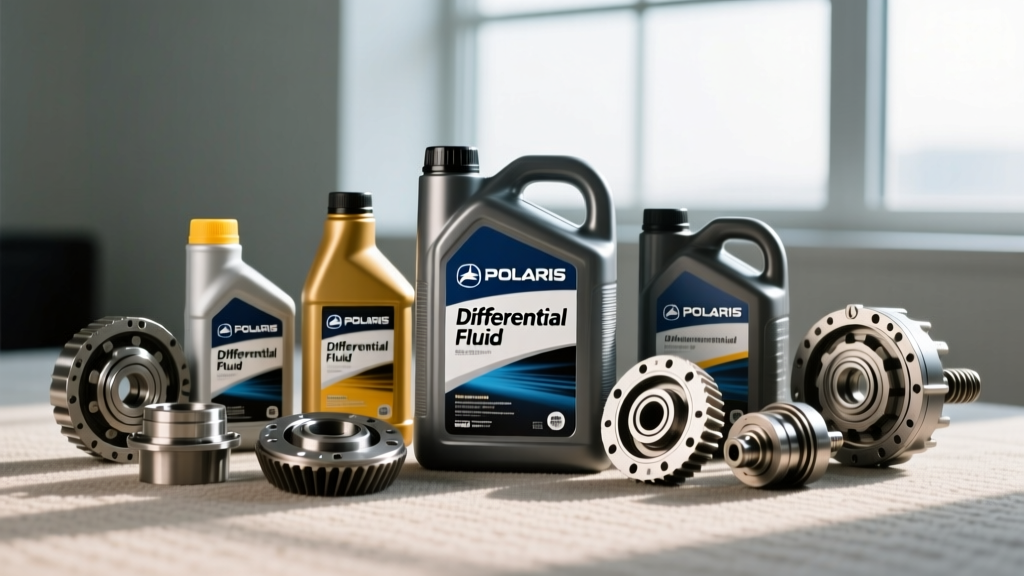
When budgeting for your annual drivetrain service, purchasing the correct OEM fluid is non-negotiable. Below is the current pricing and part number matrix for genuine Polaris OEM Lubricants.
| Part Number | Fluid Type | Volume | MSRP (2026) | Street Price |
|---|---|---|---|---|
| 2878068 | AGL Synthetic Gear Lube | 1 Quart (32 oz) | $19.99 | $16.50 - $18.00 |
| 3235040 | AGL Synthetic Gear Lube | 1 Gallon (128 oz) | $59.99 | $48.00 - $54.00 |
| 2877922 | Demand Drive Fluid | 1 Quart (32 oz) | $28.99 | $24.00 - $26.50 |
| 5812237 | Drain/Fill Plug Crush Washer | Single | $1.99 | $1.25 - $1.50 |
The Cost Analysis: Dealership Service vs. DIY Maintenance
How you execute the fluid swap drastically impacts your bottom line. Let us break down the cost of servicing both the front and rear differentials on a standard Polaris Ranger 1000 or RZR XP 1000.
Dealership Service Invoice Breakdown
- Front Diff Service: $85 - $110 (Includes 1 qt Demand Drive, labor, shop supplies, and hazmat fees).
- Rear Diff / Trans Service: $110 - $145 (Includes 1 qt AGL, labor, shop supplies).
- Total Dealer Cost: $195 - $255 per service interval.
DIY Maintenance Cost Breakdown
- Front Diff (Demand Drive): ~$14.00 (Requires approx. 5.5 to 7.5 oz; buying a quart leaves you with surplus for the next interval).
- Rear Diff (AGL): ~$16.50 (Requires approx. 32 to 44 oz depending on model).
- Crush Washers (x4): $5.00
- Total DIY Cost: $35.50 - $45.00 per service interval.
The ROI: By performing the service yourself, you save an average of $160 per interval. Over a 5-year ownership cycle with bi-annual services, that equates to $1,600 in retained capital—enough to purchase a premium set of replacement CV axles or upgraded clutch components.
Front vs. Rear Differential: Capacity and Torque Specs
Overfilling a differential is just as dangerous as underfilling it. Excess fluid leads to aeration, foaming, and blown seals due to thermal expansion. Conversely, underfilling leads to starved bearings and gear tooth spalling. Always measure by volume, not by the "fill hole" method, as vehicle lift angles can severely skew visual fluid levels.
| Vehicle Model | Front Diff Capacity | Rear Diff / Trans Capacity | Drain Plug Torque | Fill Plug Torque |
|---|---|---|---|---|
| RZR XP 1000 / Turbo | 7.5 oz (220 ml) | 32 oz (950 ml) | 15 ft-lbs (20 Nm) | 15 ft-lbs (20 Nm) |
| Ranger 1000 / XP 1000 | 5.5 oz (160 ml) | 44 oz (1300 ml) | 15 ft-lbs (20 Nm) | 15 ft-lbs (20 Nm) |
| Sportsman 850 / 1000 | 7.0 oz (205 ml) | 9.0 oz (265 ml) - IRS Rear | 14 ft-lbs (19 Nm) | 14 ft-lbs (19 Nm) |
Expert Wrenching Tip: Always remove the fill plug before removing the drain plug. If the fill plug is seized or stripped, you do not want to be left with an empty differential and no way to refill it while the vehicle is on the lift or trail.
Aftermarket Alternatives: Do They Save Money?
Many owners attempt to cut costs by utilizing aftermarket synthetic 75W-90 gear oils like AMSOIL Severe Gear or Mobil 1 Synthetic Gear Lube. While these are exceptional API GL-5 lubricants for the rear differential and transmission, they are fundamentally incompatible with the front differential's Hilliard clutch. The friction modifiers in automotive GL-5 oils are designed for hypoid gear sliding, not the precise engagement/disengagement mechanics of a sprague clutch. Attempting to save $10 by using aftermarket fluid in the front differential risks a $1,200 front differential rebuild. For the rear, high-quality aftermarket synthetics are acceptable and can sometimes offer superior thermal stability in extreme desert racing conditions, but for 95% of riders, OEM AGL remains the most cost-effective and mechanically sound choice.
Hidden Costs: Water Intrusion and Emulsification
The most significant hidden cost in differential maintenance is water intrusion. When a hot differential is suddenly submerged in cold water (such as crossing a creek or mud bogging), the rapid temperature drop creates a vacuum inside the housing. This vacuum pulls water past the axle seals and breathers. Once water mixes with gear oil, it emulsifies into a milky, chocolate-milk-like sludge. This sludge completely destroys the hydrodynamic lubrication film, leading to rapid bearing failure and rust on the precision-machined gear teeth. If your fluid looks milky, the cost analysis shifts from a simple fluid swap to a full differential teardown, bearing replacement, and seal installation—a job that can push maintenance costs well over $600 in parts and labor. Always inspect your breather tubes and ensure they are routed high and clear of water crossings.
Final Verdict: Maximizing Your Drivetrain ROI
When it comes to Polaris differential fluid, the cheapest option is rarely the most economical in the long run. Adhering strictly to the AGL and Demand Drive specifications, utilizing new OEM crush washers, and adhering to precise torque and volume measurements will ensure your ring, pinion, and Hilliard clutches survive the harshest environments. By adopting a strict DIY maintenance schedule using genuine fluids, you effectively insulate your wallet from catastrophic drivetrain failures while keeping your machine operating at peak mechanical efficiency.