The P0841 Misdiagnosis: Why the Pressure Sensor Isn't Always the Culprit
When a vehicle limps into your service bay with a P0841 transmission fluid pressure sensor switch A circuit range performance code, the knee-jerk reaction for many novice technicians is to drop the pan, replace the pressure transducer, or swap the entire solenoid body. However, veteran transmission specialists know that on several prominent platforms—most notably the Ford 6R80, GM 6L80/6L90, and certain ZF 8HP applications—this code is frequently a ghost in the machine. The root cause often originates not from the pressure sensor itself, but from a failing Transmission Range (TR) sensor, also known as the Manual Lever Position Sensor (MLPS).
Understanding the intricate wiring topology of modern Transmission Control Modules (TCM) is critical for accurate diagnostics in 2026. Replacing the transmission position sensor to fix a pressure sensor code sounds counterintuitive until you examine the shared 5-volt reference circuits. This guide will break down the electrical theory, provide a definitive diagnostic flowchart, and detail the exact mechanical procedures for transmission position sensor replacement to permanently resolve this deceptive DTC.
The 5-Volt Reference Shared Circuit Topology
To understand why a P0841 transmission fluid pressure sensor switch A circuit range performance code triggers when the TR sensor fails, we must look at the TCM's internal voltage regulator. The TCM supplies a single 5-volt reference (5V VREF) to multiple analog sensors, including the transmission fluid pressure transducers and the TR sensor.
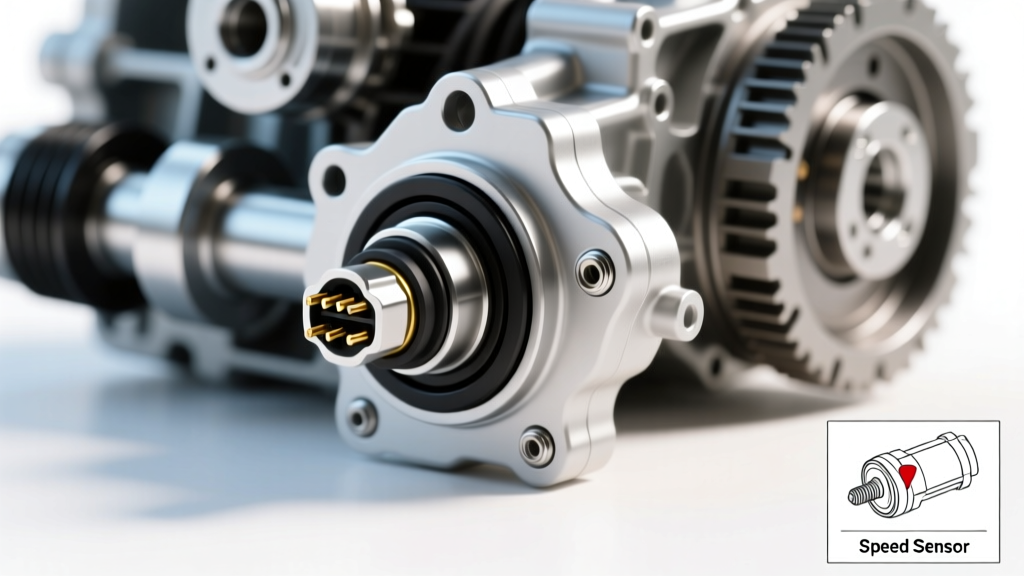
The TR sensor is typically mounted externally on the transmission case, directly exposed to the elements. Over time, the weatherpack seals degrade, allowing moisture and road salt to ingress into the sensor cavity. This causes internal carbon tracking or a dead short across the 5V reference board inside the TR sensor. When the 5V reference is pulled down to 2.3V or lower by the shorted TR sensor, the TCM simultaneously loses the proper voltage supply to the Pressure Sensor A circuit. The TCM interprets this voltage drop as a 'Range/Performance' fault in the pressure sensor circuit, setting P0841, even though the pressure transducer itself is perfectly healthy.
Diagnostic Flowchart: Isolating the Ghost Code
Before ordering a $350 solenoid body or TEHCM (Transmission Electro-Hydraulic Control Module), perform this non-invasive electrical test using a digital multimeter (DMM) and a breakout box or back-probing pins.
Step 1: Monitor the 5V Reference PID
Connect your advanced bi-directional scan tool and monitor the '5V Reference Voltage' or 'Sensor Supply Voltage' PID with the key on, engine off (KOEO). A healthy system will read exactly 4.9V to 5.1V. If you see the voltage hovering around 2.1V to 2.8V, you have a shared circuit short.
Step 2: The Isolation Test
Locate the external TR sensor connector on the transmission case. Disconnect the TR sensor harness. Wait 10 seconds, clear the codes, and re-check the 5V Reference PID on your scan tool. If the 5V reference instantly jumps back to a stable 5.0V, you have conclusively proven that the internal board of the TR sensor is shorted and pulling down the pressure sensor circuit. According to technical bulletins documented by Transmission Digest, this isolation test saves technicians hours of unnecessary internal transmission teardowns.
Step-by-Step Transmission Position Sensor Replacement
Once the TR sensor is condemned, proper replacement and calibration are mandatory. A misaligned TR sensor will result in no-start conditions, harsh shifts, or incorrect gear display on the instrument cluster. Below is the expert procedure for the highly prevalent Ford 6R80 and GM 6L80 platforms.
Ford 6R80 / 6R140 Replacement Procedure
- Preparation: Place the vehicle on a lift. Disconnect the negative battery terminal to prevent TCM voltage spikes. Place the manual shift lever on the transmission in the exact NEUTRAL position.
- Removal: Remove the manual lever retaining nut (15 lb-ft torque spec for reinstallation). Carefully pull the manual lever off the shaft. Unbolt the two TR sensor mounting bolts. Note: The factory torque spec for these 6mm bolts is exactly 89 lb-in (10 Nm). Do not overtighten, as the sensor housing is brittle composite plastic.
- Installation & Alignment: Install the new Motorcraft TR sensor (Part No. SW-7189 / 7L1Z-7F247-A). Before tightening, you must align the sensor. Insert the Ford-specific alignment pin tool (T92P-70010-AH) through the alignment holes on the sensor and the manual lever. If the tool slides in flush without binding, the neutral position is perfectly calibrated.
- Sealing: Apply a thin bead of high-temperature RTV silicone around the mating surface of the sensor to the case to prevent future moisture ingress, which is the primary cause of the P0841 cross-circuit failure.
GM 6L80 / 6L90 External Linkage Sensor Replacement
While the GM 6L80 utilizes an internal TEHCM for pressure switches, the external Manual Lever Position Sensor is still a known failure point for shared ground and reference circuits. Use the GM J-45123 Neutral alignment tool. Torque the sensor mounting bolts to 106 lb-in (12 Nm). Always inspect the main case pass-through connector for green corrosion (cupric oxide), as capillary action can wick fluid from the pan up into the external harness, mimicking a TR sensor failure.
Diagnostic Data: Pressure vs. Position Sensor Failure
| Diagnostic Parameter | Failing Pressure Transducer | Failing TR Sensor (Pulling down 5V Ref) |
|---|---|---|
| Primary DTC | P0841, P0842, P0843 | P0841 + P0706 (TR Sensor Range/Performance) |
| 5V Reference PID | Stable at 5.0V | Drops to 2.1V - 2.8V |
| Scan Tool Gear Display | Shows Correct Gear (P, R, N, D) | May show 'X', '?', or Flashing PRNDL |
| Limp Mode Trigger | Locks in 3rd or 4th gear | Defaults to 2nd gear, disables TCC lockup |
| Multimeter Back-Probe | Signal wire varies 0.5V - 4.5V with pressure | 5V Ref wire reads < 3.0V at TCM connector |
Real-World Cost Breakdown & Part Numbers (2026 Estimates)
When quoting the customer for transmission position sensor replacement, transparency regarding OEM vs. aftermarket parts is vital. Cheap aftermarket potentiometers often suffer from dead spots within 10,000 miles. Always recommend OEM or top-tier tier-1 supplier parts (like Bosch or VDO).
| Transmission Model | OEM Part Number | Part Cost (USD) | Labor Time | Alignment Tool Required |
|---|---|---|---|---|
| Ford 6R80 | Motorcraft SW-7189 | $85 - $115 | 0.8 Hours | T92P-70010-AH |
| GM 6L80 / 6L90 | ACDelco 24255061 | $65 - $95 | 0.6 Hours | J-45123 |
| Chrysler 8HP (ZF) | Mopar 68222595AA | $140 - $180 | 1.2 Hours | Fiat/Chrysler Pin Set |
Expert Best Practices for Long-Term Reliability
Replacing the component is only half the battle. To ensure the P0841 transmission fluid pressure sensor switch A circuit range performance code never returns, implement these shop-level best practices:
- Dielectric Grease Application: Never plug in a dry connector. Pack the TR sensor weatherpack with a high-quality, silicone-based dielectric grease (such as NAPA Echlin DL1013). This displaces oxygen and prevents the galvanic corrosion that causes internal shorting.
- Harness Routing Inspection: On vehicles with high mileage, inspect the main transmission harness where it crosses the exhaust crossover or rests against the bellhousing. Heat degradation melts the loom, causing the 5V reference wire to short to the chassis ground, perfectly mimicking a failed TR sensor.
- TCM Adaptation Reset: After installing the new sensor and verifying the 5V reference is restored to 5.0V, you must perform a TCM Adaptation Reset (or Keep Alive Memory clear). According to NHTSA service guidelines, failing to reset the adaptive shift tables after a sensor replacement can result in harsh 1-2 and 2-3 shifts as the TCM attempts to compensate for the old, degraded voltage parameters.
Conclusion
The P0841 transmission fluid pressure sensor switch A circuit range performance code is a classic example of why modern transmission diagnostics requires a systemic, electrical-first approach. By understanding the shared 5-volt reference topology and recognizing the TR sensor as a primary suspect, you can avoid catastrophic misdiagnoses, save your customers hundreds of dollars in unnecessary internal repairs, and execute a precise transmission position sensor replacement that restores factory drivability. Always trust your multimeter over your assumptions, and let the voltage tell the true story of the failure.