The Mechanical Divide: Open vs. Limited Slip Differentials
When servicing your vehicle's drivetrain, understanding the mechanical differences between an open differential and a limited slip differential (LSD) is critical. This distinction directly dictates your lubrication strategy, specifically whether you need to introduce a rear differential friction modifier into the gear oil. While both differential types utilize hypoid ring and pinion gears that require extreme pressure (EP) protection found in GL-5 gear oils, their internal torque-biasing mechanisms operate on entirely different physical principles.
An open differential relies on a simple spider gear arrangement. It routes torque to the path of least resistance, which is ideal for standard highway driving and reduces drivetrain binding during tight turns. However, if one wheel loses traction, the open diff sends 100% of the available power to the slipping wheel. Because there are no friction clutches inside an open differential, standard 75W-90 or 80W-90 GL-5 gear oil is all that is required. Adding a friction modifier to an open diff is a waste of money and provides zero mechanical benefit.
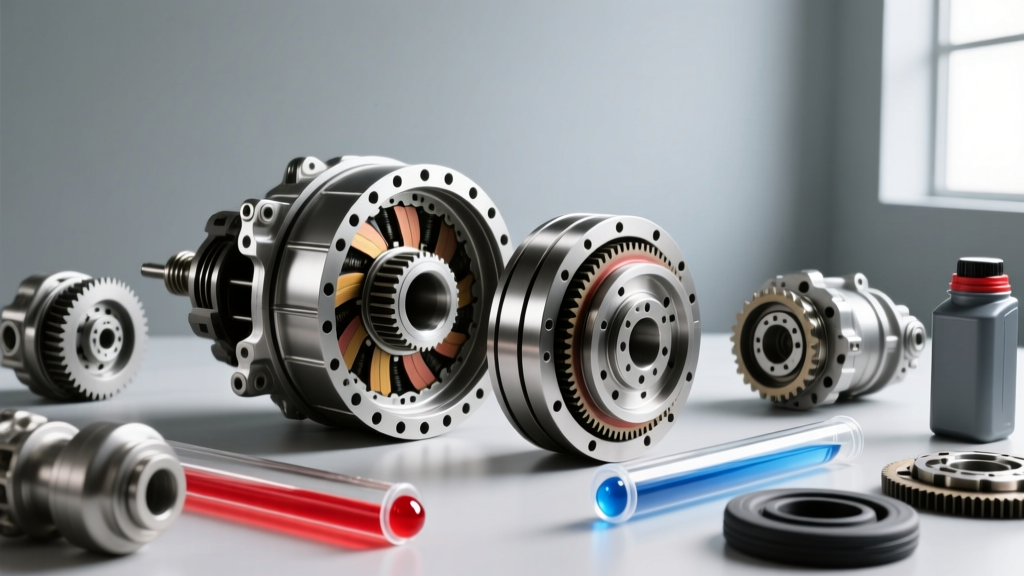
A clutch-type limited slip differential (such as the Eaton Positraction, Dana Trac-Lok, or Auburn Cone-style) utilizes a series of alternating friction and steel clutch packs, preloaded by S-springs or coil springs. When one wheel begins to slip, the clutch packs bind together, transferring torque to the wheel with traction. It is this clutch-pack engagement that necessitates the use of a specialized rear differential friction modifier.
The Physics of Chatter: Why Clutch-Pack LSDs Need Modifiers
To understand the buyer's market for differential additives, you must understand the 'stick-slip' phenomenon. The friction material used in OEM clutch packs (often a paper-based or sintered bronze composite) is designed to grip. However, during low-speed cornering, the outer wheel must rotate faster than the inner wheel. This forces the clutch packs to slip slightly against one another.
Without a rear differential friction modifier, the static coefficient of friction between the clutch plates is too high. The plates will 'stick' momentarily, build up torsional energy, and then violently 'slip' to release the energy. This rapid stick-slip cycle manifests as a low-frequency vibration, groaning, or 'chatter' felt through the chassis and heard from the rear axle. Over time, this violent engagement will glaze the friction discs, generate excessive heat, and lead to premature LSD failure.
Friction modifiers are formulated with long-chain organic polymers that alter the boundary lubrication layer. They lower the static coefficient of friction while maintaining the dynamic coefficient, allowing the clutch packs to slip smoothly during cornering without sacrificing their ability to lock under heavy acceleration.
Buyer’s Matrix: Matching Fluid and Modifiers to Your Differential
Choosing the correct lubrication profile requires identifying your exact differential type. Below is a comprehensive comparison matrix to guide your purchasing decision.
| Differential Type | Common OEM Examples | Base Fluid Requirement | Friction Modifier Required? | Typical Modifier Dosage |
|---|---|---|---|---|
| Open Differential | Standard Toyota Tacoma, Base Ford F-150 | 75W-90 or 80W-90 GL-5 | No | N/A |
| Clutch-Type LSD | Eaton Posi, Dana Trac-Lok, Auburn | 75W-90 or 80W-90 GL-5 | Yes | 4 oz (120 ml) per 2.5 pints |
| Gear-Type LSD (Helical) | Torsen, Detroit TrueTrac | 75W-90 GL-5 | No (Uses gear biasing) | N/A |
| Locking Differential | Eaton Detroit Locker, ARB Air Locker | 75W-90 or 85W-140 GL-5 | No | N/A |
Note: Some modern synthetic gear oils (e.g., AMSOIL Severe Gear or Mobil 1 Synthetic Gear Lube) claim to be 'LS Compatible' out of the bottle. While these contain a baseline dose of modifier, high-mileage clutch packs or aggressive aftermarket setups (like an Auburn Pro-Series) almost always require an additional 2 to 4 oz of dedicated rear differential friction modifier to eliminate chatter.
Top Rear Differential Friction Modifiers for 2026
If you have confirmed your vehicle utilizes a clutch-type LSD, here are the industry-standard additives trusted by drivetrain specialists:
1. Motorcraft XL-3 (Est. $9 - $12)
The gold standard for Ford 8.8-inch and 9.75-inch axles. Formulated specifically to meet Ford specification EST-M2C118-A. It features a highly refined friction profile that eliminates chatter in OEM Trac-Lok and Performance Trac-Lok units without causing excessive clutch slip.
2. GM ACDelco Limited Slip Axle Lubricant Additive 88900401 (Est. $12 - $15)
Required for GM 10-bolt, 12-bolt, and 14-bolt semi-floating axles equipped with Eaton Positraction or G80 locking differentials. According to Eaton's engineering guidelines, using non-OEM approved modifiers in GM corporate axles can lead to clutch pack degradation.
3. Red Line Limited Slip Friction Modifier (Est. $14 - $18)
A premium, synthetic-compatible additive designed for high-performance and racing applications. Red Line's formula is highly concentrated; typically, only 1 to 2 ounces are needed per axle, making it ideal for fine-tuning the breakaway torque of aftermarket carbon-fiber clutch packs.
Diagnostic Protocol: The Figure-8 Chatter Test
Before draining your differential fluid and spending money on additives, verify that chatter is actually your issue. Perform the industry-standard Figure-8 diagnostic test:
- Locate a large, empty, dry, and paved area (a wet surface will mask the chatter).
- Roll all the windows down and turn off the radio and HVAC blower.
- Drive the vehicle in tight, continuous figure-8 patterns at a speed of 5 to 10 MPH.
- Listen and feel for a rhythmic 'thumping' or 'groaning' from the rear axle during the tightest part of the turns.
If chatter is present, drain the existing fluid, inspect the magnetic drain plug for excessive metallic paste (a sign of clutch wear), and refill with fresh GL-5 gear oil plus 4 oz of the appropriate rear differential friction modifier. Drive the vehicle for 50 miles to allow the additive to fully penetrate the porous friction material. If chatter persists, add 1 oz increments of modifier, up to a maximum of 8 oz total. Warning: Overdosing the modifier will lower the dynamic friction coefficient too much, causing the LSD to act like an open diff under heavy throttle.
Service Specifications: Torque, Capacities, and Pricing
Proper servicing requires adherence to exact torque specifications to prevent stripped threads on aluminum differential covers or warped stamped-steel pans. Below are the baseline specifications for the most common light-truck and passenger car axles:
- Ford 8.8-Inch Axle: Fluid capacity is approximately 2.5 to 3.0 pints. The fill plug requires a 3/8-inch drive ratchet. Torque spec: 15-20 lb-ft. Do not overtighten, as the housing is cast iron but the plug threads can gall.
- GM 8.5 / 8.6-Inch 10-Bolt: Fluid capacity is roughly 2.0 to 2.4 pints. Requires RTV silicone (Permatex Ultra Black) or a pre-cut cork/rubber gasket. Cover bolt torque spec: 20-25 lb-ft in a crisscross pattern.
- Chrysler 8.75-Inch / 9.25-Inch AAM: Fluid capacity ranges from 3.0 to 3.5 pints. Fill plug torque spec: 25-30 lb-ft.
For a complete DIY rear differential service in 2026, expect to spend roughly $45 to $65 on high-quality synthetic 75W-90 gear oil, a bottle of rear differential friction modifier, and a can of brake cleaner/RTV. Professional shops typically charge between $120 and $180 for this service, though many quick-lube centers will mistakenly omit the friction modifier unless explicitly instructed, leading to post-service axle noise. Always verify your differential type and supply your own modifier if you are outsourcing the labor.
For further technical reading on hypoid gear wear and lubrication boundary layers, consult the drivetrain engineering resources available at Ring & Pinion. Understanding the precise mechanical needs of your specific axle is the only way to ensure maximum traction and component longevity.