The Mechanical Divide: Open vs. Limited Slip Differentials
The differential is the unsung hero of your vehicle’s drivetrain, tasked with allowing your drive wheels to rotate at different speeds while cornering. However, not all differentials manage torque distribution equally. When evaluating axle setups for trucks, SUVs, and performance cars, the debate always narrows down to two primary architectures: the Open Differential and the Limited Slip Differential (LSD). Understanding how these mechanical systems operate is the first step in diagnosing mechanical wear and identifying bad differential oil symptoms before they escalate into catastrophic ring-and-pinion failure.
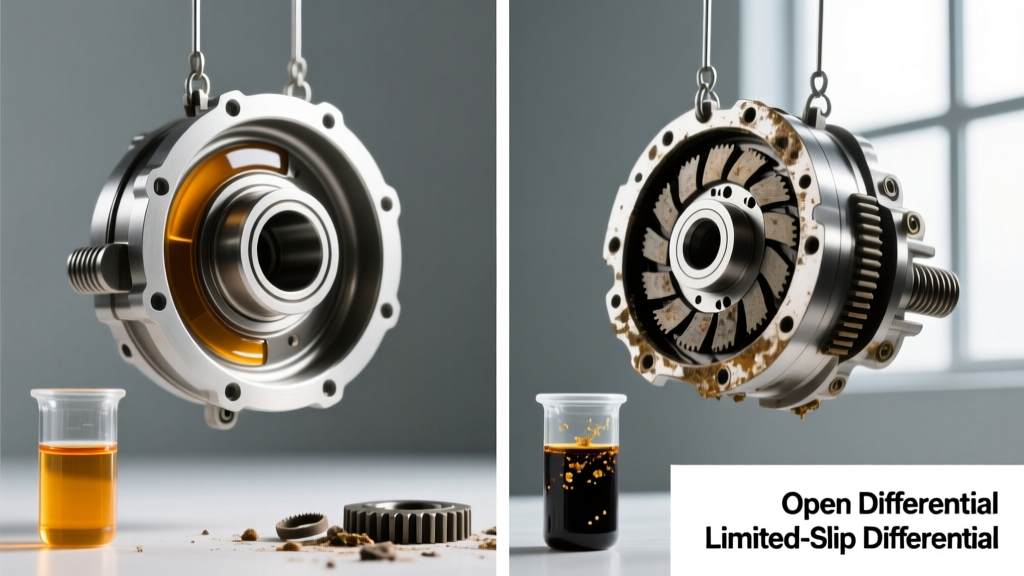
An open differential relies on a simple spider gear and side gear arrangement. It sends torque to the path of least resistance. If your left rear tire hits ice while the right rear tire is on dry asphalt, the open diff sends 100% of the power to the spinning left tire, leaving you stranded. Conversely, a limited slip differential utilizes either clutch packs (e.g., Auburn, GM Positraction) or helical gear sets (e.g., Eaton Truetrac) to mechanically bias torque to the wheel with traction. This fundamental mechanical difference dictates not only your vehicle's off-road and wet-weather capabilities but also how the internal gear oil degrades and how failure symptoms present themselves.
Diagnosing Bad Differential Oil Symptoms by Differential Type
Gear oil operates in an extreme environment. Hypoid gear sets generate massive sliding friction and localized heat spikes exceeding 250°F (121°C) at the tooth contact patch. As the fluid’s viscosity index improvers shear down and extreme pressure (EP) additives deplete, the protective hydrodynamic film collapses. However, the resulting bad differential oil symptoms vary wildly depending on whether you are running an open carrier or an LSD.
Open Differential Fluid Failure Signs
- Highway Howl and Deceleration Whine: As the 75W-90 or 80W-90 fluid loses its film strength, micro-pitting occurs on the convex side of the ring gear teeth. This manifests as a rhythmic howl that changes pitch with vehicle speed, often peaking during coast-down (deceleration) when the gear load shifts to the coast side of the tooth.
- Metallic Paste on the Drain Plug: Open differentials naturally shed microscopic wear metals, but degraded fluid fails to keep these particulates in suspension. If your magnetic drain plug is coated in a thick, glittery sludge rather than a fine grey film, your pinion and carrier bearings are actively disintegrating.
- Spider Gear Cross-Pin Galling: Without adequate lubrication, the spider gear cross-pin can gall and seize inside the carrier block. This is a common failure point in high-mileage GM 8.5-inch 10-bolt axles running neglected fluid, eventually leading to a sheared cross-pin and a destroyed carrier case.
Limited Slip Differential Fluid Failure Signs
- Low-Speed Cornering Chatter: This is the hallmark symptom of depleted friction modifiers in clutch-type LSDs (like the Ford 8.8-inch or Chrysler 8.25-inch axles). When the friction modifier additive package breaks down, the clutch plates grab and release violently during tight turns, causing a shuddering vibration and a distinct 'clunking' or 'chattering' noise from the rear axle.
- Acrid, Burnt Odor: Standard GL-5 gear oil has a pungent sulfur smell. However, if the fluid smells sharply burnt or acrid (like scorched brake pads), the internal clutch packs have been slipping excessively and overheating due to fluid breakdown or incorrect fluid specification.
- Harsh Lock-Up and Binding: If the fluid is heavily contaminated with clutch friction material, the LSD may behave like a locked spool, binding the rear axle during parking lot maneuvers and causing severe tire scrubbing.
The Chemistry of Gear Oil: GL-5 and the Friction Modifier Debate
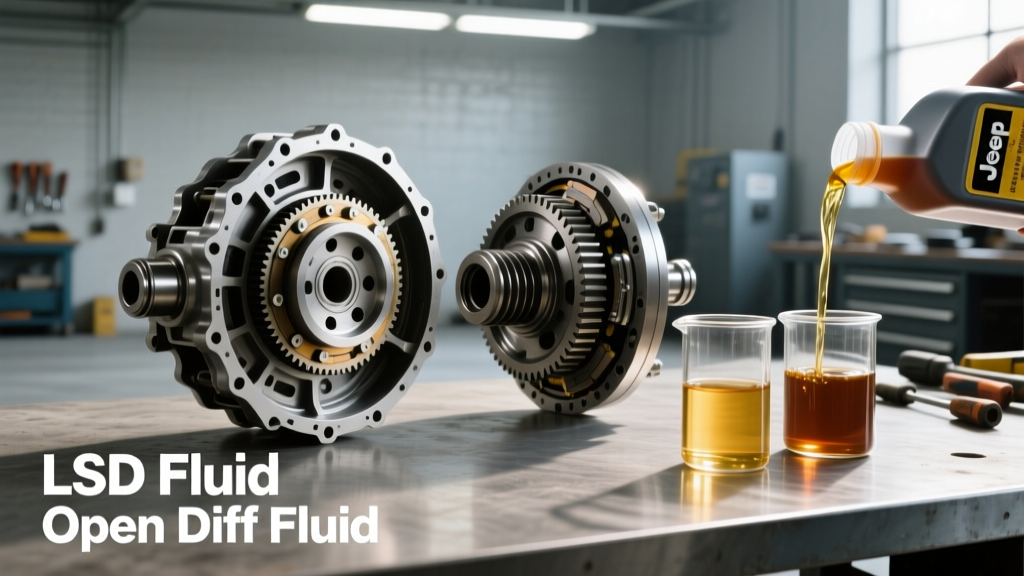
As of 2026, synthetic formulations have vastly improved shear stability, but the API GL-5 specification remains the baseline for hypoid gear sets. GL-5 fluids contain high levels of sulfur-phosphorus EP additives that chemically bond to the metal surfaces under extreme pressure, preventing metal-to-metal contact. However, these same EP additives can be too 'slippery' for clutch-type limited slip differentials.
If you are servicing a clutch-type LSD, you must use a fluid specifically labeled 'Limited Slip' or manually add a friction modifier. For example, General Motors requires their specific Limited Slip Friction Modifier (Part # 88900333), while Ford specifies their XL-3 additive. Note: Helical gear LSDs, such as the highly regarded Eaton Detroit Truetrac, operate on gear biasing rather than clutch friction and explicitly do not require friction modifiers. Adding them to a Truetrac can actually reduce the unit's torque biasing ratio and efficiency.
Cost & Maintenance Comparison Matrix
Understanding the financial implications of maintenance and potential failure is critical for buyers and fleet managers. Below is a comparative breakdown based on current industry averages for light-duty and heavy-duty truck axles.
| Metric | Open Differential | Clutch-Type LSD (e.g., Auburn) | Helical LSD (e.g., Truetrac) |
|---|---|---|---|
| Fluid Capacity (Typical) | 2.0 - 2.5 Quarts | 2.0 - 2.5 Quarts | 2.0 - 2.5 Quarts |
| Fluid Cost (Synthetic 75W-90) | $35 - $50 | $45 - $65 (w/ Modifier) | $35 - $50 |
| Service Interval | 50,000 - 100,000 Miles | 30,000 - 50,000 Miles | 50,000 - 100,000 Miles |
| Rebuild / Replacement Cost | $250 - $450 | $600 - $950 | $750 - $1,100 |
| Primary Failure Mode | Bearing / Gear Pitting | Clutch Pack Burnout | Helical Gear Shearing (Rare) |
Buyer’s Guide: Upgrading from Open to Limited Slip
If you are currently dealing with the bad differential oil symptoms of a worn-out open differential, simply changing the fluid will not restore lost traction. Instead, this is the optimal time to upgrade your carrier. When sourcing parts from drivetrain specialists like Ring-Pinion.com, you will generally face three tiers of upgrades:
- OE-Style Clutch LSDs (e.g., GM Positraction, Ford Traction-Lok): Costing between $350 and $500, these are ideal for street driving and light snow. They require strict adherence to friction modifier protocols and will eventually require a clutch pack rebuild every 80,000 miles.
- Performance Clutch LSDs (e.g., Auburn Pro-Series): Priced around $600-$800, these feature higher preload and carbon-fiber clutch materials. They are excellent for drag racing and aggressive towing but can be harsh on street tires during tight turns.
- Helical Gear LSDs (e.g., Eaton Truetrac): Retailing for $700-$900, the Truetrac is the gold standard for daily-driven trucks, overlanders, and tow rigs. It requires zero friction modifiers, has no wearable clutch packs, and operates silently. It is a true 'install and forget' upgrade.
Precision Service: Torque Specs and Sealing Protocols
Whether you are performing a routine fluid change on an open diff or breaking in a new LSD, precision during reassembly is non-negotiable. Improper torque on differential cover bolts will warp the bearing caps or crush the gasket, leading to leaks that quickly result in low-fluid catastrophic failure.
Industry Standard Torque Specifications:
- Ford 8.8-inch (10-bolt cover): 28 - 38 lb-ft (Star pattern sequence)
- GM 8.5-inch / 9.5-inch (10-bolt / 14-bolt cover): 25 - 30 lb-ft
- Dana 44 / Dana 60: 30 - 35 lb-ft
- Drain/Fill Plugs (where applicable): 33 - 40 lb-ft
Sealing Best Practices: Abandon cheap cork gaskets. The industry standard for modern axle sealing is high-quality synthetic gear lube paired with a premium RTV silicone. Permatex Ultra Black (Part # 81781) is sensor-safe and highly resistant to the sulfur compounds in GL-5 oils. Apply a continuous 3mm bead, ensure the mating surfaces are brake-cleaned and bone-dry, and allow the RTV to skin over for 30 minutes before filling the axle with fluid. Over-tightening the bolts will squeeze the RTV into the axle housing, where it can break off and clog the oil pickup or jam the spider gears.
Final Verdict
Recognizing bad differential oil symptoms early is the difference between a $60 fluid service and a $2,500 axle replacement. Open differentials will warn you with bearing whines and metallic sludge, while limited slip differentials will protest with cornering chatter and burnt odors. By matching your differential type to the correct fluid chemistry—and upgrading to a helical LSD if your application demands it—you can ensure your drivetrain survives the most punishing torque loads for hundreds of thousands of miles.