The Dilemma: Chemical Additives vs. OEM Fluid Specifications
When a faint whine emanates from the rear of your truck at highway speeds, or you spot a damp, oily residue gathering around the axle seal, the immediate temptation is to reach for a chemical band-aid. In 2026, the aftermarket is flooded with stop-leak and gear-masking additives, with Bar's Leaks Axle and Differential Gear Repair frequently topping the search results. But as automotive drivetrain engineers and seasoned mechanics will tell you, dumping a $12 bottle of polymers into a precision-machined hypoid gearset is rarely the optimal long-term solution.
This buyer's guide and technical comparison cuts through the marketing fluff. We will dissect the chemical reality of gear repair additives, contrast them against the strict engineering requirements of modern differential fluid specifications (API GL-5, 75W-90, 75W-140), and provide a concrete decision matrix to help you save your ring and pinion from catastrophic failure.
Decoding Differential Fluid Specifications: The Chemistry of Protection
Before evaluating any additive, you must understand the baseline chemistry protecting your axle. Differential gears—specifically hypoid ring and pinion sets—operate under extreme sliding friction and immense shearing forces. Standard motor oil would instantly vaporize under these loads.
API GL-4 vs. GL-5: The Sulfur-Phosphorus Divide
The American Petroleum Institute (API) categorizes gear oils primarily into GL-4 and GL-5.
- API GL-4: Contains moderate levels of Extreme Pressure (EP) additives. It is safe for yellow metals (brass, bronze, copper) commonly found in manual transmission synchronizers and certain transfer cases.
- API GL-5: Contains high levels of sulfur-phosphorus EP additives. This is the mandatory specification for almost all modern automotive differentials. The sulfur-phosphorus bonds to the steel gear teeth under high heat, creating a sacrificial shear layer that prevents metal-on-metal welding.
Expert Warning: Never use GL-5 gear oil in a drivetrain component containing yellow metals unless explicitly stated by the OEM. The active sulfur in GL-5 will chemically corrode brass synchronizers and bronze bushings over time, leading to catastrophic drivetrain failure.
Viscosity Grades: 75W-90 vs. 75W-140
Viscosity dictates the fluid's load-bearing film thickness. A 75W-90 synthetic is the gold standard for daily-driven passenger vehicles, crossovers, and light-duty trucks (e.g., Subaru WRX rear diffs, Jeep Cherokee Dana 35s). It offers optimal cold-weather flow and adequate high-temperature protection. Conversely, 75W-140 is engineered for severe-duty applications, heavy towing, and high-horsepower builds. The thicker film prevents gear deflection under massive torque loads, though it introduces slight parasitic drag, reducing fuel economy by 1-2%.
Bar's Leaks Axle and Differential Gear Repair: A Technical Deep Dive
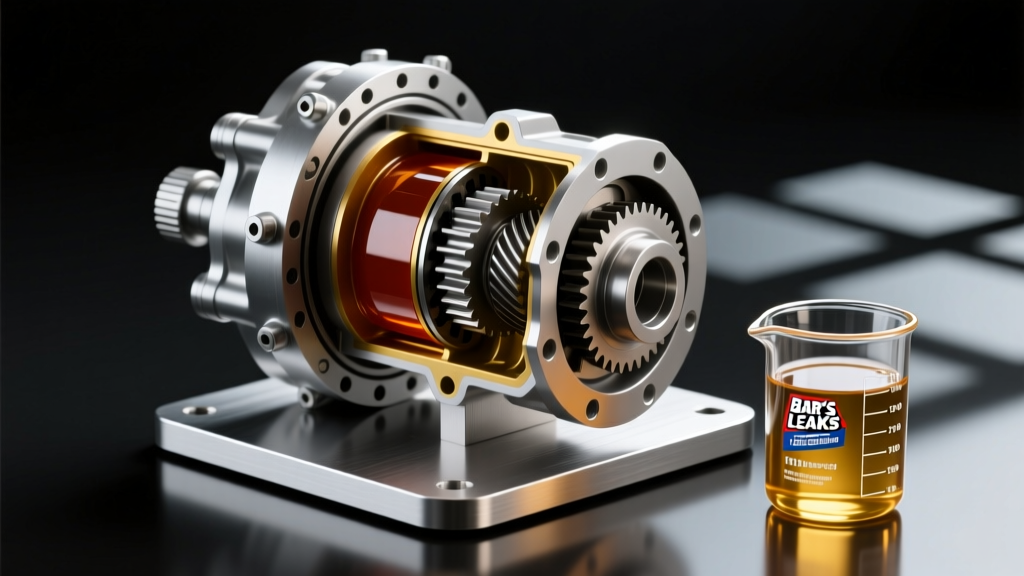
Bar's Leaks Axle and Differential Gear Repair is formulated as a dual-action chemical intervention. It relies on two primary mechanisms:
- Seal Conditioners: Utilizing ester-based swelling agents, the additive attempts to rehydrate and expand hardened, shrunken nitrile or Viton axle seals, potentially stopping minor weeps.
- Viscosity Index Improvers & Friction Modifiers: Long-chain polymers thicken the base oil dynamically as it heats up, while specialized friction modifiers dampen the high-frequency harmonics that cause gear whine.
At a retail price of roughly $10 to $15 per bottle, it is an inexpensive gamble. However, it cannot repair pitted gear teeth, shattered bearings, or a torn axle seal lip. According to technical documentation from Bar's Products, this fluid is designed to extend the life of aging differentials and quiet noisy gears, but it is not a substitute for mechanical overhaul.
Head-to-Head Comparison: Additive vs. Full Synthetic Service
How does a chemical repair stack up against a complete drain, clean, and fill with boutique synthetic gear oil? Let's look at the data.
| Feature | Bar's Leaks Additive (Pour-In) | Full Synthetic Service (e.g., Amsoil/Red Line) |
|---|---|---|
| Material Cost | $10 - $15 | $45 - $85 (Synthetic + Friction Modifier) |
| Labor / Effort | Minimal (Add via fill plug) | Moderate (Remove cover/plug, clean, refill) |
| Gear Whine Reduction | High (Masks harmonics temporarily) | Moderate (Reduces friction, won't fix worn gears) |
| Seal Leak Repair | Effective on dry/shrunken seals | None (Requires physical seal replacement) |
| Long-Term Gear Protection | Low (Alters base oil chemistry) | Exceptional (Maintains OEM shear stability) |
| Warranty Compliance | Voids most OEM warranties | Compliant if matching API/OEM spec |
Real-World Axle Specs & Torque Data (2026 Buyer's Matrix)
To make an informed decision, you must know exactly what your specific axle demands. Below are precise specifications for three of the most common differentials on the road today.
1. Ford F-150 / Mustang (8.8-Inch Rear Axle)
The legendary Ford 8.8 is a staple of the aftermarket.
- Capacity: 2.5 to 3.0 pints (varies by cover).
- OEM Spec: 75W-140 Synthetic Gear Oil.
- Limited Slip Additive: Required for Trac-Lok differentials. Use Motorcraft XL-3 or equivalent (approx. 4 oz).
- Fill Plug Torque: 33 lb-ft.
- Verdict: If the 8.8 is whining under deceleration, the pinion bearing preload is likely off, or the coast-side gear teeth are worn. Bar's Leaks may quiet the whine for 5,000 miles, but a proper 75W-140 synthetic swap with fresh friction modifier is the only way to properly assess gear health.
2. Jeep Wrangler JL (Dana 44 M210/M220)
Modern Dana 44 axles in the JL generation run hotter and handle more torque than their predecessors.
- Capacity: ~2.0 quarts (Front and Rear combined is ~4.5 quarts).
- OEM Spec: Mopar 75W-85 API GL-5 (for standard) or 75W-140 (for Rubicon/towing).
- Limited Slip Additive: Mopar Trac-Lok additive (Part #4318060) if equipped.
- Fill Plug Torque: 25-30 lb-ft (Do not overtighten the aluminum housing plugs).
- Verdict: Do not use swelling additives in the Dana 44. The tight tolerances of the M220 ring and pinion require the exact shear stability of a 75W-140 synthetic. If the axle seal is weeping, the $20 seal and 2-hour labor is vastly superior to risking contaminated brake pads from a failed chemical sealer.
3. GM 9.5-Inch (14-Bolt Semi-Floating)
Found in heavy-duty 3/4-ton and 1-ton GM trucks, this axle is a workhorse.
- Capacity: ~3.5 quarts.
- OEM Spec: 75W-90 Synthetic (ACDelco Part #10-4017).
- Fill Plug Torque: 33 lb-ft.
- Verdict: Because of the massive sump capacity, pouring a single bottle of Bar's Leaks Axle and Differential Gear Repair will dilute the EP additive package of the existing 3.5 quarts of oil. For heavy towing applications, always opt for a full drain and fill with a high-zinc, sulfur-phosphorus GL-5 synthetic.
The Expert Decision Framework: When to Use Which?
As drivetrain specialists, we recommend utilizing Yukon Gear & Axle's diagnostic philosophy: identify the root cause before applying a treatment. Use the following framework to decide your next move:
Scenario A: The Axle Seal is Weeping (Minor Dampness)
Action: Try the additive. If the rubber seal lip has simply hardened due to age and heat cycles, the ester conditioners in Bar's Leaks can swell the rubber just enough to halt the seep. This is highly effective on high-mileage SUVs (e.g., Toyota 4Runner, Lexus GX) where the seal is intact but brittle.
Scenario B: The Differential Whines on Deceleration
Action: Perform a full fluid service with 75W-140. Deceleration whine indicates wear on the coast side of the ring and pinion. A thicker synthetic film will cushion the gears and reduce noise without compromising the EP protection required to keep the gears from shedding metal. Additives will mask the noise but accelerate wear by diluting the GL-5 sulfur-phosphorus package.
Scenario C: Chatter During Tight Turns (Limited Slip)
Action: Add Friction Modifier. Neither a stop-leak nor a standard fluid change will fix a chattering Trac-Lok or Torsen differential. You need a dedicated Limited Slip Friction Modifier (typically 2 to 4 ounces) to alter the coefficient of friction on the clutch packs.
Scenario D: Metal Flakes on the Drain Plug Magnet
Action: Tear down and rebuild. No chemical additive on the market can reverse spalled bearings or chipped pinion teeth. If your magnetic drain plug is covered in a thick, glittery paste, the differential requires a complete rebuild with new master install kits and precise backlash shimming.
Final Verdict
In the landscape of 2026 automotive maintenance, Bar's Leaks Axle and Differential Gear Repair holds a very specific, narrow use case: reviving hardened seals on high-mileage, out-of-warranty vehicles where a mechanical seal replacement is cost-prohibitive or mechanically daunting. However, for protecting the immense financial investment of a modern ring and pinion gearset, adhering strictly to OEM differential fluid specifications—utilizing high-quality API GL-5 synthetics in the correct 75W-90 or 75W-140 viscosity—remains the undisputed champion of drivetrain longevity.