Defining the Baseline: What Does Open Differential Mean?
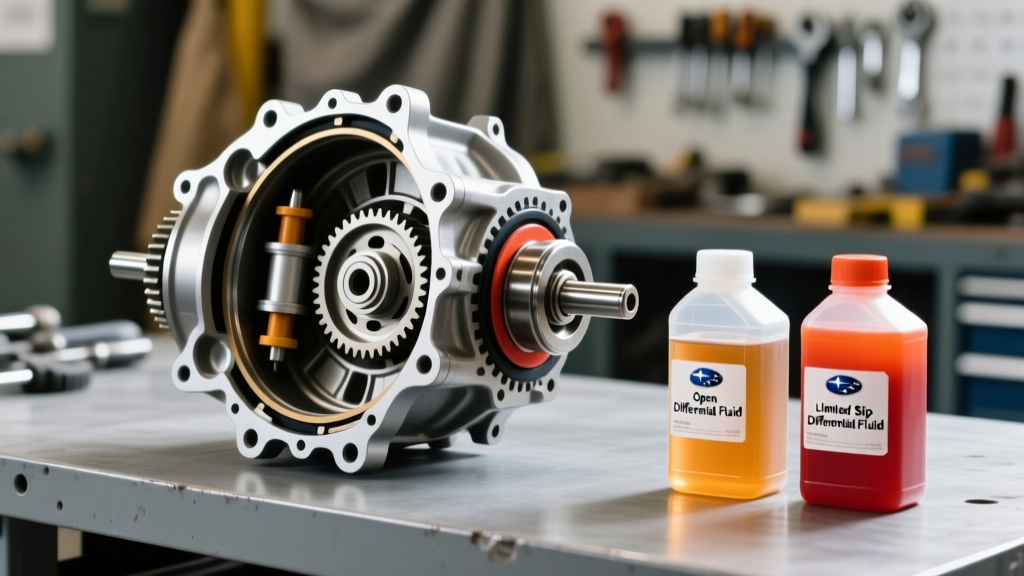
When novice gearheads and off-road enthusiasts first delve into axle mechanics, they inevitably ask: what does open differential mean? In the simplest mechanical terms, an open differential is a gearset that allows the left and right drive wheels to rotate at different speeds, which is essential for cornering. However, its fatal flaw lies in torque distribution. An open differential always sends power to the path of least resistance. If your left tire is on dry asphalt and your right tire is on ice, the open diff will send 100% of the available torque to the spinning ice-bound tire, leaving you completely stranded.
To solve this traction deficit, automakers and performance shops utilize Limited Slip Differentials (LSDs). While modern transmissions like the ZF 8HP or GM 10L80 manage gear multiplication with incredible precision, the final mechanical connection to the pavement relies entirely on the axle. In this 2026 technical deep-dive, we are moving past the limitations of open axles to explore the intricate operation, failure modes, and precise maintenance protocols of clutch-pack Limited Slip Differentials.
The Mechanical Advantage: Clutch-Pack LSD Operation
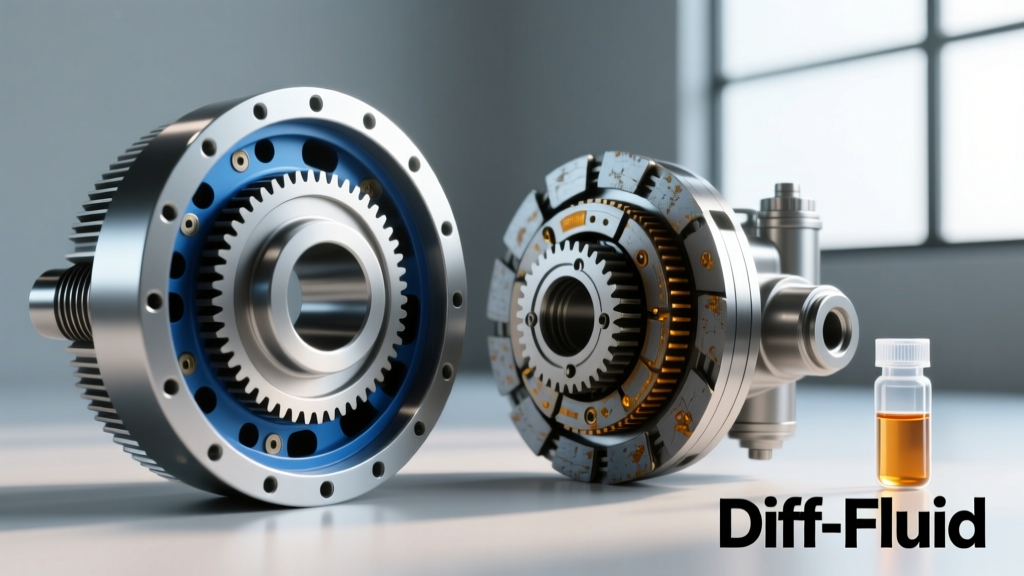
Unlike an open differential, a clutch-pack LSD (such as the iconic Eaton Positraction, Ford Traction-Lok, or Dana Trac-Lok) utilizes a series of alternating friction and steel clutch plates positioned between the side gears and the differential case.
During straight-line acceleration, the differential case, clutch packs, and side gears lock together, rotating as a single unit and delivering a true 50/50 torque split. When cornering, the resistance of the clutch packs is overcome by the speed differential, allowing the clutches to slip slightly so the outside wheel can rotate faster. The preload on these clutches is maintained by heavy coil springs or an S-cam (cross-pin) mechanism.
Expert Insight: The longevity of a clutch-pack LSD is entirely dependent on fluid shear stability and friction modifier (FM) chemistry. When pairing a high-torque LSD with modern 8-speed or 10-speed automatic transmissions, the shock loads transferred through the ring and pinion can rapidly degrade inferior gear oils, leading to premature clutch glazing.
Comparative Traction & Maintenance Matrix
| Differential Type | Operation Mechanism | Traction Bias Ratio | Fluid & Maintenance Requirement |
|---|---|---|---|
| Open Differential | Spider gears (no resistance) | 1:1 (Path of least resistance) | Standard GL-5; No FM required. |
| Clutch-Pack LSD | Friction/Steel clutch packs | 2:1 to 4:1 Torque Bias | GL-5 + Specific Friction Modifier. |
| Helical Gear (Torsen) | Worm gear binding mechanics | 2.5:1 to 5:1 Torque Bias | Standard GL-5; No FM required. |
| Locking (Locker) | Mechanical/Pneumatic 100% lock | Infinite (Locked) | Standard GL-5; Heavy shock load monitoring. |
Fluid Chemistry: GL-5 Ratings and Friction Modifiers
The most critical aspect of LSD maintenance is understanding the chemical interaction between Extreme Pressure (EP) additives and Friction Modifiers. Standard 75W-90 or 75W-140 GL-5 gear oils contain high levels of Zinc and Phosphorus (ZDDP) to protect the hypoid ring and pinion gears from wiping under extreme sliding pressures.
However, standard GL-5 fluid provides too much grip for LSD clutch packs, causing them to bind and release rapidly during low-speed cornering—a phenomenon known as chatter. To prevent this, a Friction Modifier (FM) must be added. The FM alters the coefficient of friction on the clutch surfaces, allowing for smooth micro-slipping.
OEM Friction Modifier Part Numbers
- Ford / Motorcraft: XL-3 (Part # XL-3) - Required for all 8.8" and 9.75" Traction-Lok axles.
- GM / ACDelco: Limited Slip Axle Lubricant Additive (Part # 1052358 or 10-4016) - Essential for Eaton Positraction units in 8.5" and 8.6" 10-bolt axles.
- Stellantis / Mopar: Friction Modifier Additive (Part # 4318060AB) - Used in Dana and Chrysler corporate axles.
Note: Many premium synthetic fluids, such as Red Line ShockProof or AMSOIL Severe Gear, claim to have FM built-in. While adequate for some applications, Red Line Synthetic Oil Technical Information recommends adding a dedicated FM for high-load, tight-radius turning scenarios to eliminate chatter entirely.
Diagnosing LSD Failure Modes: Chatter vs. Slip
Before draining the fluid, a proper diagnosis of the differential's health is required. LSDs generally fail in two distinct ways:
- Chatter (Binding): Heard as a rhythmic clunking or groaning from the rear axle during tight, low-speed turns (e.g., pulling into a parking space). Cause: Depleted friction modifier, incorrect fluid viscosity, or glazed clutch faces. Solution: Fluid and FM exchange, followed by the Figure-8 bedding procedure.
- Slip (Loss of Lock): One tire spins freely under heavy throttle while the other remains stationary. Cause: Worn clutch pack tabs, broken S-cam preload springs, or burnt friction material. Solution: Complete differential teardown, measurement of side gear clearances, and installation of a rebuild kit (e.g., Eaton 19588-0100).
Wrenching Guide: Service Procedures and Torque Specifications
Proper maintenance intervals for a clutch-pack LSD in a daily-driven or light-towing vehicle should not exceed 30,000 to 50,000 miles. For severe off-road or track use, drop this interval to 15,000 miles. Below are the exact specifications for the most common performance axles.
Ford 8.8-Inch (Traction-Lok)
- Fluid Capacity: 2.5 Quarts (with FM)
- Spec: 75W-140 Synthetic GL-5 (Heavy towing/track) or 75W-90 (Standard)
- Cover Bolt Torque: 28 - 38 lb-ft (Use a criss-cross pattern)
- Drain/Fill Plug Torque (if equipped): 29 lb-ft
GM 8.5 / 8.6-Inch 10-Bolt (Eaton Posi)
- Fluid Capacity: 2.1 Quarts (with FM)
- Spec: 75W-90 Synthetic GL-5
- Cover Bolt Torque: 25 lb-ft (Caution: GM 10-bolt covers are prone to warping; do not over-torque)
Dana 44 (Trac-Lok / Auburn)
- Fluid Capacity: 2.0 - 2.4 Quarts (varies by aftermarket cover)
- Spec: 75W-140 Synthetic GL-5
- Cover Bolt Torque: 30 - 35 lb-ft
The Critical "Figure-8" Bedding Procedure
Simply pouring new fluid and FM into the axle is not enough. The friction modifier must be physically worked into the porous surface of the clutch discs. After completing the fluid service, take the vehicle to a large, empty, paved area. Perform 10 to 15 tight, continuous figure-8 maneuvers at 5-10 MPH. This forces the clutch packs to slip and engage repeatedly, evenly distributing the FM chemistry and eliminating post-service chatter. For deeper technical specifications on Eaton differential rebuilds and tolerances, refer to the Eaton Automotive Differentials engineering documentation.
Economic Breakdown: DIY vs. Professional Service Costs
Maintaining your LSD is highly cost-effective when performed in your own garage, provided you have the correct torque wrench and fluid extraction tools.
- DIY Fluid Service Cost: $60 - $110 (Includes 3 quarts of premium synthetic GL-5 at $18-$25/qt, plus an $8-$15 bottle of OEM Friction Modifier, and a $15 RTV/gasket kit).
- Professional Shop Service Cost: $180 - $275 (Shops typically charge 1.0 to 1.5 hours of labor at $130-$175/hr, plus markup on bulk fluids).
- Complete LSD Rebuild Kit: $150 - $350 (Includes new clutches, steels, and preload springs. Requires specialized side-gear shimming tools and dial indicators for proper backlash setup).
Understanding the mechanical limitations of an open differential highlights exactly why investing time and capital into maintaining your Limited Slip Differential is non-negotiable. By adhering to strict fluid specifications, utilizing exact OEM friction modifiers, and respecting cover torque limits, you ensure your axle can handle the torque multiplication delivered by modern drivetrains for hundreds of thousands of miles.