The Evolution of Powersports Transmissions
When navigating the modern powersports market, the dual clutch vs CVT debate is one of the most common discussions among riders and off-road enthusiasts. Whether you are piloting a Honda Africa Twin CRF1100L across the Mojave or pushing a Polaris RZR Pro XP through muddy Appalachian trails, your transmission dictates your traction. While traditional wet multi-plate manual clutches still dominate motocross and sportbikes, automatic and semi-automatic systems have taken over the touring, adventure, and utility ATV/UTV segments.
However, these advanced drivetrains are not immune to failure. Diagnosing clutch problems in motorcycles and ATVs requires a fundamental understanding of how these systems transfer power. In this 2026 diagnostic guide, we break down the mechanical realities, common failure points, and specific repair procedures for both Continuously Variable Transmissions (CVT) and Dual Clutch Transmissions (DCT) in powersports applications.
Dual Clutch vs CVT: How They Actually Work
Before grabbing your clutch puller and torque wrench, you must understand the mechanical differences between these two systems. They operate on entirely different principles of physics and hydraulics.
The CVT (Continuously Variable Transmission)
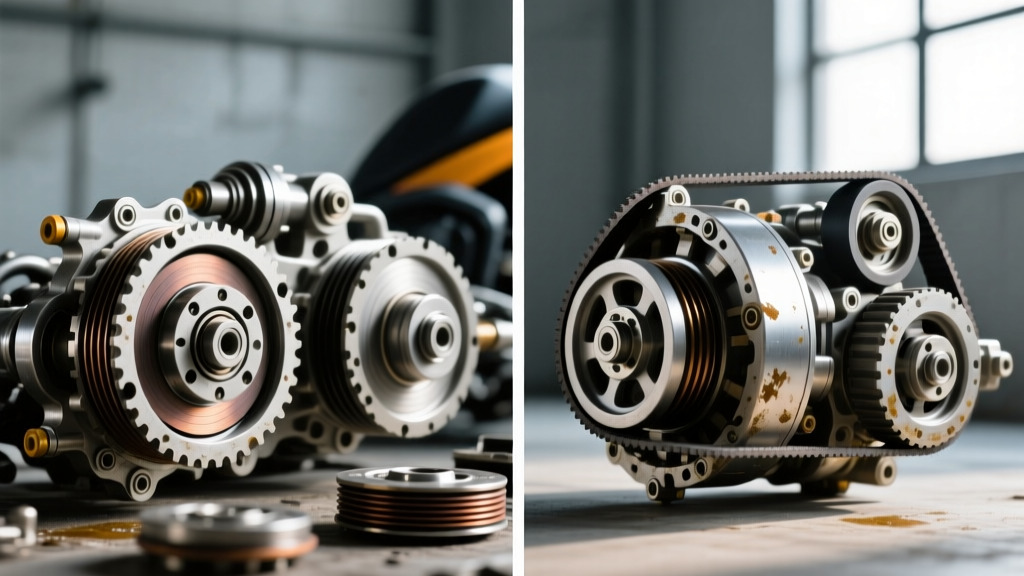
Found in almost all recreational and utility ATVs and UTVs (Polaris, Can-Am, Yamaha, Kawasaki), the CVT uses a centrifugal clutch system paired with variable-diameter pulleys. A drive belt connects the primary (drive) clutch on the engine crankshaft to the secondary (driven) clutch on the transmission input shaft. As engine RPMs rise, flyweights in the primary clutch push the sheave together, forcing the belt outward and altering the gear ratio infinitely. Engagement is handled by a one-way bearing (sprag) or a centrifugal shoe mechanism.
The DCT (Dual Clutch Transmission)
Pioneered in the powersports world by Honda Powersports DCT Technology, the DCT is essentially two manual transmissions in one casing. One clutch pack handles odd gears (1, 3, 5), while the other handles even gears (2, 4, 6). Electro-hydraulic actuators control the clutch engagement and gear shifts via a sophisticated ECU. This provides the mechanical efficiency of a manual gearbox with the convenience of an automatic, making it a staple on heavy touring motorcycles (Gold Wing) and side-by-sides (Pioneer 1000).
Diagnosing ATV & UTV CVT Clutch Problems
CVT systems are brutally simple but operate in harsh, high-friction environments. The most common diagnostic complaints from ATV owners revolve around belt slip, engagement chatter, and loss of top-end speed. According to Polaris Off-Road Engineering guidelines, maintaining proper clutch alignment and sheave cleanliness is critical to preventing catastrophic belt failure.
Symptom 1: RPM Flare and Sluggish Acceleration
If your engine RPMs climb rapidly but vehicle speed does not increase proportionally, your CVT belt is slipping. This is often caused by a glazed drive belt, worn sheave bushings, or a weak secondary clutch spring. Over time, the extreme heat generated by slip melts the belt cord rubber, leaving a burnt odor and black dust inside the clutch cover.
Symptom 2: Engagement Chatter and Clunking
A violent shudder when taking off from a dead stop usually points to the primary clutch's one-way bearing (sprag) or worn centrifugal clutch shoes. If the sprag bearing fails to lock up smoothly, it skips across the inner race, causing a metallic clunking noise. In Can-Am Mavericks, this often requires replacing the entire primary clutch assembly, as the sprag is rarely serviceable as a standalone component without specialized hydraulic presses.
| Symptom | Probable Cause | Diagnostic Fix / Part Check | Est. Repair Cost (2026) |
|---|---|---|---|
| RPM Flare / Belt Slip | Glazed belt, worn sheave bushing | Inspect belt width (replace if under 28mm); clean sheaves with acetone | $120 - $180 (Belt) |
| Takeoff Chatter / Clunk | Failed one-way sprag bearing | Remove primary clutch; check sprag lockup direction and play | $400 - $750 (Clutch) |
| Loss of Top Speed | Weak secondary spring, stuck slider | Check secondary helix for wear; upgrade to Dalton or EPI stiffer spring | $40 - $90 (Spring) |
| Overheating / Burning Smell | Belt dust buildup, poor ventilation | Clear CVT exhaust vents; inspect clutch cover seal | $50 (Maintenance) |
Diagnosing Motorcycle & ATV Dual Clutch (DCT) Faults
DCT systems are sealed, oil-bathed, and electronically controlled. You will not find a drive belt or flyweights here. Instead, DCT diagnostics rely heavily on reading ECU fault codes and analyzing hydraulic pressure data. While incredibly reliable, when a DCT fails, the repair is significantly more complex and expensive than a CVT rebuild.
Actuator and Sensor Failures
The most frequent DCT issue on motorcycles like the Honda Africa Twin or NC750X is actuator motor failure or sensor misalignment. The DCT uses shift drum angle sensors to tell the ECU exactly what gear is engaged. If the sensor gets contaminated with metallic debris from the engine oil, or if the actuator motor brushes wear out, the dashboard will flash the 'N' (Neutral) light or throw a DTC (Diagnostic Trouble Code) like P0810 (Clutch Position Control Error).
Pro Tip: Before tearing into the engine cases, always perform a DCT clutch initialization and calibration using an OBD2 diagnostic tool compatible with Honda's HDS (Honda Diagnostic System) software. Often, a simple recalibration of the clutch touch-point resolves shuddering issues without replacing a single part.
Wet Clutch Pack Glazing and Shudder
Because DCTs slip the clutch packs slightly during low-speed maneuvers and automatic shifts, the friction plates are subjected to immense thermal stress. If the wrong fluid is used—such as an automotive oil with high friction modifiers—the clutch plates will glaze. This results in a low-speed shudder that feels remarkably similar to a failing CVT, but originates from the transmission casing. Always use the manufacturer-specified fluid; for Honda DCTs, this is typically Honda GN4 10W-30 or the specialized HCF-2 fluid, depending on the exact model year and application.
Crucial Torque Specs and Maintenance Data
Whether you are servicing a CVT or a DCT, adhering to exact torque specifications is non-negotiable. Powersports engines operate at high RPMs, and a loose clutch retaining bolt can destroy an engine block in seconds.
- Polaris RZR / Ranger CVT Primary Clutch Retaining Bolt: 40 ft-lbs (54 Nm). Always apply a fresh drop of Red Loctite 272 (high-strength) to the threads. Use a dedicated clutch holding tool (e.g., PU-47966) to prevent binding the crankshaft.
- Honda Pioneer 1000 DCT Clutch Center Locknut: 76 ft-lbs (103 Nm). This requires a specialized locknut wrench and a new staked washer every time it is removed.
- Can-Am Maverick Secondary Clutch Bolt: 44 ft-lbs (60 Nm). Ensure the alignment marks on the secondary sheave are perfectly matched during reassembly to prevent harmonic vibration at 60+ MPH.
When to Rebuild vs. Replace: Cost Breakdown
When facing a major transmission issue, powersports owners must weigh the cost of rebuilding versus replacing. In the dual clutch vs CVT comparison, CVTs are generally much more forgiving to DIY rebuilds. You can purchase a complete primary clutch rebuild kit (weights, spring, bushing, spider) for under $150. Conversely, DCT systems are rarely rebuilt in home garages. If a DCT hydraulic pump fails or the internal shaft bearings score, the standard procedure is to replace the entire transmission sub-assembly, which can cost between $2,500 and $4,000 in OEM parts alone.
Furthermore, diagnosing a DCT requires proprietary software and hydraulic pressure gauges, pushing most riders toward dealership service centers. CVT diagnostics, on the other hand, can be done with a straight edge, a caliper, and a keen eye for belt wear patterns. For a deeper dive into motorcycle transmission engineering, resources like Cycle World Transmission Tech offer excellent teardowns of modern gearbox architectures.
Summary: Choosing and Maintaining Your Drivetrain
Ultimately, the choice between a dual clutch and a CVT comes down to your riding style. If you demand the raw, mechanical connection of geared ratios and engine braking on a heavy adventure motorcycle or utility UTV, the DCT is unmatched. If you prefer the seamless, mud-slogging torque multiplication of a recreational ATV, the CVT remains the undisputed king of the trails.
Regardless of your machine, proactive maintenance is the key to avoiding trail-side breakdowns. Clean your CVT intake vents after every muddy ride, check your drive belt width with digital calipers every 1,000 miles, and never compromise on OEM-specified transmission fluids for your DCT. By understanding the unique symptoms of your specific clutch system, you can catch minor wear before it evolves into a catastrophic, wallet-draining failure.