How Does an Open Differential Work? The Engineering Baseline
When enthusiasts and off-road builders ask, "how does an open differential work," the answer lies in basic planetary gear physics and torque biasing. An open differential is the default drivetrain configuration for 90% of production vehicles, from daily-driver commuter cars to heavy-duty trucks. Its primary engineering goal is to allow the left and right drive wheels to rotate at different speeds during cornering, preventing tire scrubbing and drivetrain binding.
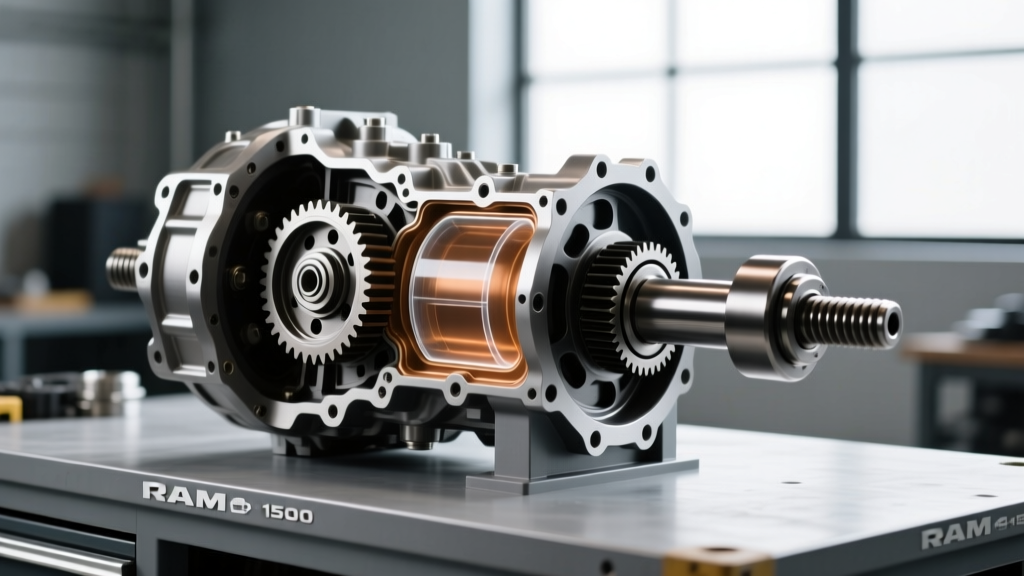
Inside the differential carrier, torque from the driveshaft is transferred to the ring gear, which is bolted to the carrier case. Inside this case sits a cross-pin (or spider gear shaft) holding two or four spider gears. These spider gears mesh with two side gears, which are splined directly to the left and right axle shafts. When the vehicle travels in a straight line with equal traction at both wheels, the spider gears do not rotate on the cross-pin; the entire carrier assembly spins as a single unit, delivering a 50/50 torque split.
However, the fundamental law of the open differential is that torque follows the path of least resistance. If the left wheel encounters ice or lifts off the ground in an off-camber trail scenario, the resistance on that side drops to near zero. The spider gears immediately begin spinning on the cross-pin, sending 100% of the available rotational force to the wheel with zero traction, while the wheel with grip receives nothing. This results in the infamous "one-wheel peel" on the street, or a stranded vehicle on the trail.
The Traction Deficit: Why Open Diffs Fail Off-Road and on Track
While open differentials are perfectly suited for paved roads and fuel economy, they are a massive liability in performance and off-road environments. In high-horsepower applications (such as vehicles equipped with built 6L80 or ZF 8HP transmissions pushing 600+ hp to the wheels), an open rear differential will violently shock-load a single axle shaft during a hard launch, frequently resulting in snapped 30-spline or 33-spline shafts. Off-road, the inability to bias torque to the grounded wheel means you are effectively operating a two-wheel-drive vehicle, regardless of your transfer case gearing.
Expert Insight: Many modern trucks use electronic traction control (eTC) to simulate a locked axle by applying the brake caliper to the spinning wheel, artificially creating resistance so the open diff transfers torque to the grounded wheel. While effective for light trail use, eTC generates immense brake heat and will quickly fade or fail during sustained rock-crawling or deep mud scenarios.
Locking Differential Types: The Performance Upgrade Path
Upgrading from an open differential to a locking differential is the single most transformative traction modification you can make. As of 2026, the aftermarket offers highly reliable solutions tailored to specific use cases. Below is a breakdown of the primary locking differential types.
Selectable Air Lockers (ARB)
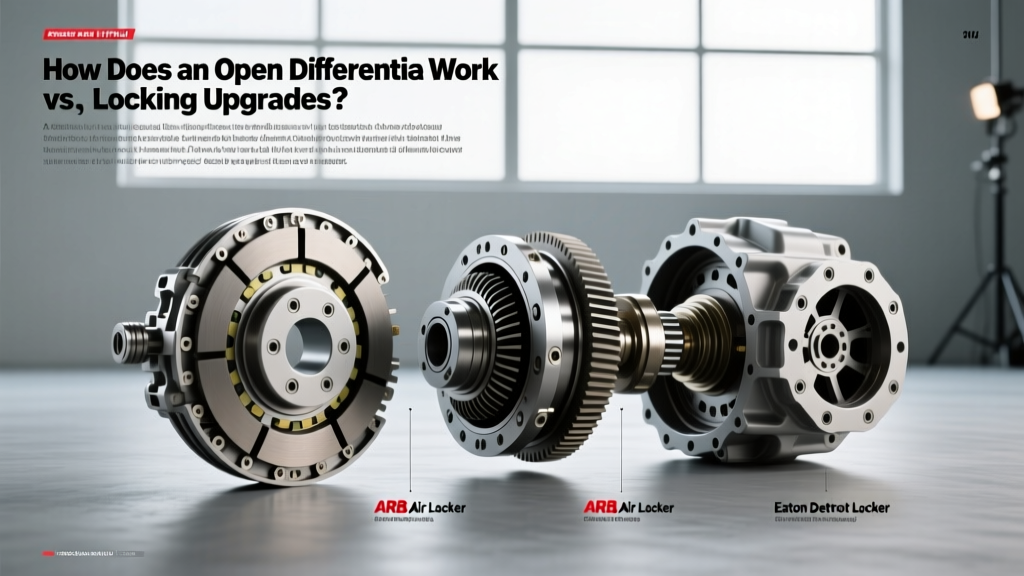
ARB Air Lockers remain the gold standard for hardcore off-road builds. They replace the open carrier with a heavy-duty nodular iron case featuring an internal pneumatic piston. When the driver flips a dashboard switch, an onboard compressor sends 100-150 PSI of air through a sealed bulkhead fitting into the axle tube, engaging a locking collar that binds the side gears to the carrier case, creating a 100% locked spool.
- Popular Part Number: ARB RD116 (Dana 44, 35-spline, Standard Rotation)
- Typical Cost: $950 - $1,100 (Locker only); requires ARB CKSA12 compressor kit (~$320)
- Pros: 100% locked when on, 100% open when off (preserves street manners and steering radius).
- Cons: Requires drilling the axle tube or differential cover for the air line; relies on external compressor hardware.
Selectable Electric Lockers (Eaton E-Locker)
The Eaton E-Locker utilizes an electromagnetic actuator built directly into the carrier. A stationary electromagnet on the axle housing engages a ramp-and-cam mechanism inside the rotating carrier, forcing the side gears to lock to the case. This eliminates the need for air lines and compressors, requiring only a 12V power source, a relay, and a dashboard switch.
- Popular Part Number: Eaton 19902-01 (GM 8.5"/8.6" 10-bolt, 30-spline)
- Typical Cost: $750 - $850
- Pros: Simplified installation (no air lines); instant engagement; OEM-level reliability.
- Cons: Wiring must be routed through the axle tube using a sealed grommet to prevent gear oil contamination; slightly heavier than air lockers.
Automatic Locking Diffs (Detroit Locker)
Automatic lockers, like the legendary Eaton Detroit Locker, require no driver input. They use a ratcheting mechanism with internal springs and clutch cones that automatically lock the axles together under torque, and unlock (ratchet) to allow for cornering when the wheels need to spin at different speeds. According to Spicer Parts and Dana engineering guidelines, these units are exceptionally robust but introduce unique NVH (Noise, Vibration, and Harshness) characteristics.
- Popular Part Number: Eaton 225SL18C (Dana 60, 35-spline)
- Typical Cost: $600 - $750
- Pros: Drop-in installation (replaces the spider gears in the existing open carrier on some models, or replaces the entire carrier); no external wiring or air lines.
- Cons: Audible "clunking" and "ratcheting" during low-speed turns; can induce unpredictable handling on slippery paved roads (ice/snow) due to sudden unlocking.
Selection Matrix: Matching the Locker to Your Build
Choosing the right locker depends heavily on your vehicle's primary operating environment. Use the matrix below to guide your purchasing decision.
| Locker Type | Actuation | Street Manners | Off-Road Performance | Best Application |
|---|---|---|---|---|
| ARB Air Locker | Pneumatic (Air) | Excellent (Open) | Superior | Dedicated rock crawlers, dual-purpose rigs |
| Eaton E-Locker | Electromagnetic | Excellent (Open) | Superior | Overlanders, daily-driven trail rigs |
| Detroit Locker | Automatic (Torque) | Poor (Ratcheting) | Excellent | Mud boggers, drag racing, heavy towing |
| Mini-Spool | None (Solid) | Terrrible (Tire Scrub) | Maximum | Dedicated race trucks, trailer queens |
Installation Realities: Gear Setup, Torque Specs, and Fluid Dynamics
Upgrading your differential is not a simple "drop-in" affair. Replacing an open carrier with a locking unit requires a complete reset of your ring and pinion setup. The aftermarket locker carrier will have different machining tolerances than your OEM open carrier, meaning your existing carrier bearing shims will likely not transfer over directly.
Carrier Bearing Preload and Backlash
When installing an ARB or Eaton locker, you must establish proper carrier bearing preload (typically 0.004" to 0.008" of deflection or drag) and set the ring gear backlash. For most Dana 44 and GM 10-bolt applications, target backlash is between 0.006" and 0.010". Always use a dial indicator mounted to the housing to measure backlash at three distinct points around the ring gear. If the backlash varies by more than 0.002" around the gear, your ring gear is not seated flush against the carrier mating surface, or the carrier itself is warped.
Critical Torque Specifications (Typical):
- Ring Gear Bolts: 70-85 lb-ft (Always clean threads with brake cleaner and apply Red Loctite 272; never use lock washers).
- Bearing Cap Bolts (Dana 44): 60 lb-ft.
- Bearing Cap Bolts (Dana 60): 110 lb-ft.
- Differential Cover Bolts: 25-30 lb-ft (Use a crisscross pattern to prevent warping the stamped steel or cast aluminum cover).
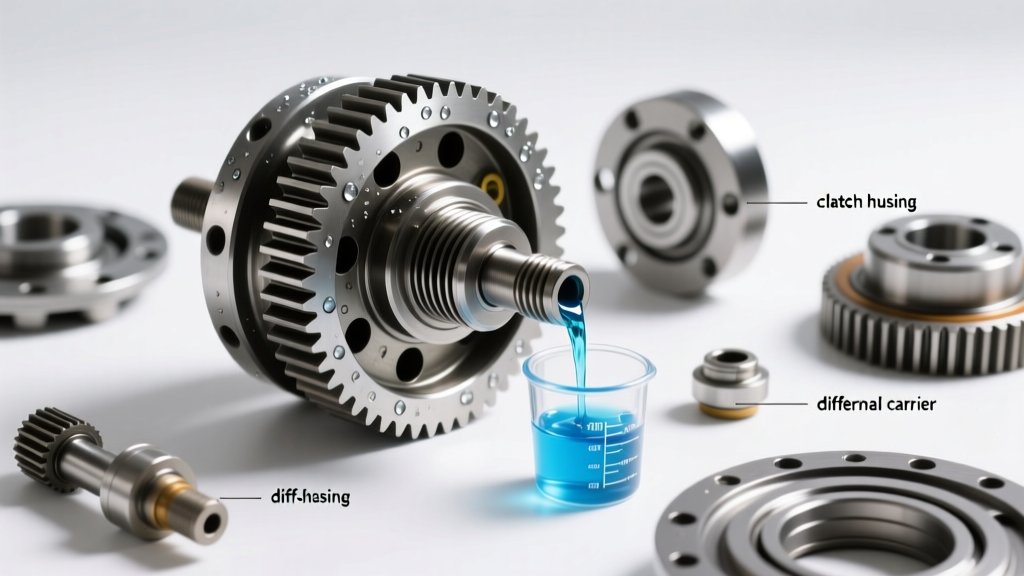
Fluid Selection for Locked Axles: The diff-fluid Perspective
The transition from an open differential to a locking differential drastically alters the thermal and shear environment inside the axle housing. Open diffs generate moderate heat primarily from the ring and pinion mesh. Locking differentials—especially automatics like the Detroit Locker—generate immense localized heat and shear forces when the internal ratcheting mechanisms engage and disengage under heavy load.
For heavy-duty applications (Dana 60, GM 14-bolt, Ford 10.5"), upgrading to a 75W-140 full synthetic gear oil is mandatory. Formulations like Amsoil Severe Gear 75W-140 or Royal Purple Max Gear provide the necessary film strength to protect the ring and pinion teeth from micro-pitting during the shock loads of traction recovery.
WARNING: Never add limited-slip friction modifiers (such as GM EOS or Ford XL-3) to a locking differential or spool. Friction modifiers are designed to allow clutch packs in Limited Slip Differentials (LSDs) to slip smoothly. In a fully locking differential, there are no clutch packs. Adding these modifiers serves no mechanical purpose, reduces the fluid's shear stability under extreme heat, and can lead to premature bearing and gear wear. Always use straight GL-5 rated synthetic gear oil without friction modifiers in locked axles.
For further technical specifications on axle fluid capacities and differential assembly torque charts, consult the ARB 4x4 Accessories installation manuals or your specific OEM service documentation.
Summary
Understanding how an open differential work is the first step in recognizing its limitations in high-performance and off-road scenarios. While open diffs excel on pavement, upgrading to a selectable Air Locker or Electric Locker provides the ultimate compromise: civilized street manners and uncompromising trail traction. By pairing the correct locker type with meticulous gear setup procedures and high-viscosity, non-modifier synthetic gear oil, you ensure your drivetrain can handle the massive torque outputs of modern performance builds for years to come.