The Traction Dilemma: Open vs. Limited Slip Differentials
When an axle assembly fails, or you are looking to upgrade your rig's traction for towing and off-road use, understanding the rear differential replacement cost is only half the battle. The more critical decision lies in selecting the right carrier type. The debate between a limited slip vs open differential is a foundational one in drivetrain engineering, directly impacting not only your vehicle's performance but also your long-term maintenance and fluid requirements.
Whether you are dropping a new crate axle into a classic muscle car or replacing a blown rear end on a daily-driven half-ton pickup, choosing the correct differential internals requires a deep understanding of gear bias, clutch mechanics, and fluid dynamics.
Open Differentials: The Path of Least Resistance
The open differential is the undisputed king of standard OEM manufacturing due to its simplicity, low cost, and predictable on-road manners. Inside an open carrier, a set of spider gears (pinion gears) mounted on a cross pin meshes with two side gears connected to the axle shafts. When driving in a straight line, the spider gears remain stationary relative to the carrier, turning both axle shafts at the exact same speed. When cornering, the spider gears rotate, allowing the outside wheel to spin faster than the inside wheel.
However, the open differential's fatal flaw is its adherence to the path of least resistance. Torque is always distributed equally to both wheels, but if one wheel encounters ice, mud, or a lifted suspension state, it will spin freely while the opposite wheel receives zero torque. For heavy towing or off-road scenarios, an open differential is a severe liability.
Limited Slip Differentials: Bias and Clutch Packs
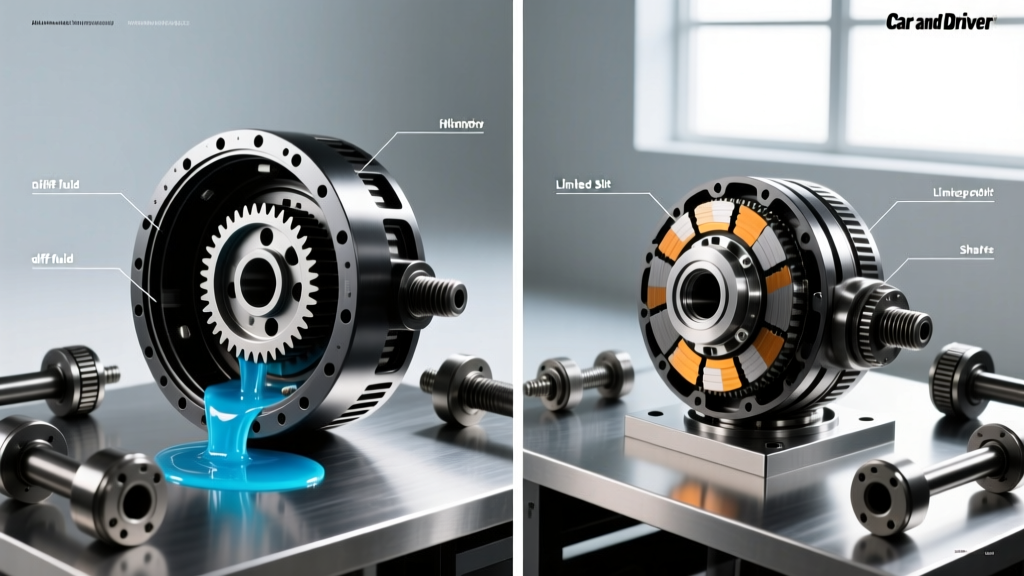
A Limited Slip Differential (LSD) mitigates the one-wheel-peel phenomenon by introducing resistance between the side gears and the carrier. There are two primary schools of thought in LSD design:
- Clutch-Type (e.g., Eaton Positraction, Auburn Pro-Series): These utilize a stack of friction clutches positioned between the side gears and the carrier case. Preload springs and high gear oil pressure force the clutches to lock the axles together under load. When one wheel loses traction, the clutch pack resists the speed differential, transferring torque to the wheel with grip.
- Helical Gear-Type (e.g., Eaton TrueTrac, Torsen): These operate without clutch packs, using complex helical gear sets that bind under torque. They are torque-biasing differentials, meaning they multiply the torque delivered to the slipping wheel by a specific bias ratio (typically 2.5:1 to 4.5:1). They are entirely mechanical, require no special friction modifiers, and operate seamlessly without the low-speed chatter associated with clutch types.
2026 Rear Differential Replacement Cost Breakdown
When budgeting for a drivetrain overhaul, the rear differential replacement cost varies wildly based on whether you are simply swapping a carrier, installing a master rebuild kit, or dropping in a complete remanufactured axle assembly. Below is a realistic 2026 pricing matrix for a standard light-truck or passenger car 8.5-inch to 9.5-inch ring gear application.
| Component / Service | Open Differential | Limited Slip Upgrade (Clutch) | Limited Slip Upgrade (Helical) |
|---|---|---|---|
| Carrier / Center Section | $150 - $250 | $450 - $700 | $650 - $950 |
| Ring & Pinion Set (e.g., 3.73 Ratio) | $180 - $300 | $180 - $300 | $180 - $300 |
| Master Install Kit (Bearings, Seals) | $120 - $160 | $120 - $160 | $120 - $160 |
| Gear Oil & Friction Modifier | $40 - $60 | $60 - $90 | $40 - $60 |
| Shop Labor (Carrier Swap & Setup) | $600 - $900 | $700 - $1,000 | $700 - $1,000 |
| Total Estimated Cost | $1,090 - $1,670 | $1,510 - $2,250 | $1,710 - $2,470 |
Pro-Tip on Complete Replacements: If your ring and pinion are severely damaged or the axle housing is bent, a complete remanufactured rear axle assembly (like those from Yukon Gear & Axle) will push the rear differential replacement cost to between $2,500 and $4,500, including core charges and freight.
The Fluid Factor: Gear Oils and Friction Modifiers
Because this guide heavily intersects with drivetrain fluid dynamics, it is imperative to understand how your choice between an open and limited slip differential dictates your rear differential fluid maintenance.
Viscosity and API GL Ratings
Modern differentials demand high-shear stability. For most street and light-towing applications, a 75W-90 API GL-5 synthetic gear oil is the gold standard. GL-5 indicates a high concentration of extreme pressure (EP) additives, typically zinc dialkyldithiophosphate (ZDDP) and sulfur-phosphorus compounds, which protect the hypoid gear sliding action of the ring and pinion. For heavy-duty towing or severe off-road use, stepping up to a 75W-140 provides a thicker hydrodynamic film at elevated sump temperatures, though it may incur a slight fuel economy penalty due to increased viscous drag.
The Friction Modifier Mandate
If you opt for a clutch-type Limited Slip Differential, the fluid choice becomes a critical operational parameter. Clutch packs require a specific coefficient of friction to engage smoothly. Standard GL-5 gear oils are too 'slippery' and will cause the clutches to grab and release rapidly, resulting in a phenomenon known as 'chatter' or 'judder' during tight, low-speed turns.
To prevent this, you must add a Friction Modifier (FM). Products like AMSOIL Slip Lock or OEM equivalents (e.g., Ford XL-3 or GM 1052358) contain long-chain polar molecules that bond to the friction surfaces of the clutch plates, altering the static-to-dynamic friction ratio. Note: Helical gear LSDs (like the TrueTrac) do not use clutch packs and therefore do not require friction modifiers. Adding them to a helical unit is harmless but entirely unnecessary.
Precision Assembly: Torque Specs and Backlash Tolerances
Whether you are installing an open carrier or an LSD, the setup procedure requires precision measuring tools. A rear differential replacement that ignores tolerances will result in catastrophic gear failure within 1,000 miles. When setting up a standard GM 8.5-inch 10-bolt or Ford 8.8-inch differential, adhere to the following parameters:
- Ring Gear Bolts: Always use new Grade 8 or OEM-equivalent hardware. Clean the threads with brake cleaner, apply a medium-strength threadlocker (like Loctite 242), and torque to 70-85 lb-ft in a crisscross pattern.
- Backlash: Measured with a dial indicator mounted to the carrier bearing cap. Backlash is the clearance between the ring gear and pinion gear teeth. Target 0.006" to 0.010". If backlash is too tight, the gears will overheat and seize; if too wide, the gears will clash and chip under load.
- Pinion Bearing Preload: This is the rotational friction of the pinion bearing assembly without the carrier installed. Using an inch-pound torque wrench, verify that rotational torque falls between 15 and 25 in-lbs for used bearings, or 25-35 in-lbs for new bearings. This is achieved by crushing the pinion crush sleeve or adjusting the pinion shims.
- Cover Bolts: Do not overtighten the differential cover. Torque to 25-35 lb-ft using a star pattern to prevent warping the stamped steel or cast aluminum cover, which will lead to seeping leaks.
Buyer’s Guide: Which Differential Fits Your Drivetrain?
Ultimately, the decision between an open and limited slip differential hinges on your vehicle's primary use case and your willingness to absorb the higher rear differential replacement cost associated with LSDs.
Choose an Open Differential if: You are building a dedicated highway cruiser, a drag car utilizing a spool/locker in the rear, or a budget-conscious daily driver where predictable, low-cost maintenance is the priority. Open diffs are cheap to rebuild and indifferent to fluid brand choices.
Choose a Clutch-Type LSD if: You are building a street-performance car, a drift missile, or a classic muscle car where aggressive, immediate lock-up is desired for launching and corner exit traction. Be prepared for the mandatory fluid maintenance and friction modifier top-offs every 15,000 miles.
Choose a Helical Gear LSD if: You are building an overland rig, a tow vehicle, or an all-weather daily driver. Helical units offer the ultimate 'set it and forget it' traction solution. They operate silently, require no special friction modifiers, and smoothly bias torque to the wheels with grip without the harshness of a locking differential.
By understanding the mechanical differences, the exact torque specifications, and the true rear differential replacement cost in today's market, you can confidently select the carrier that will keep your drivetrain planted, reliable, and optimized for the road ahead.