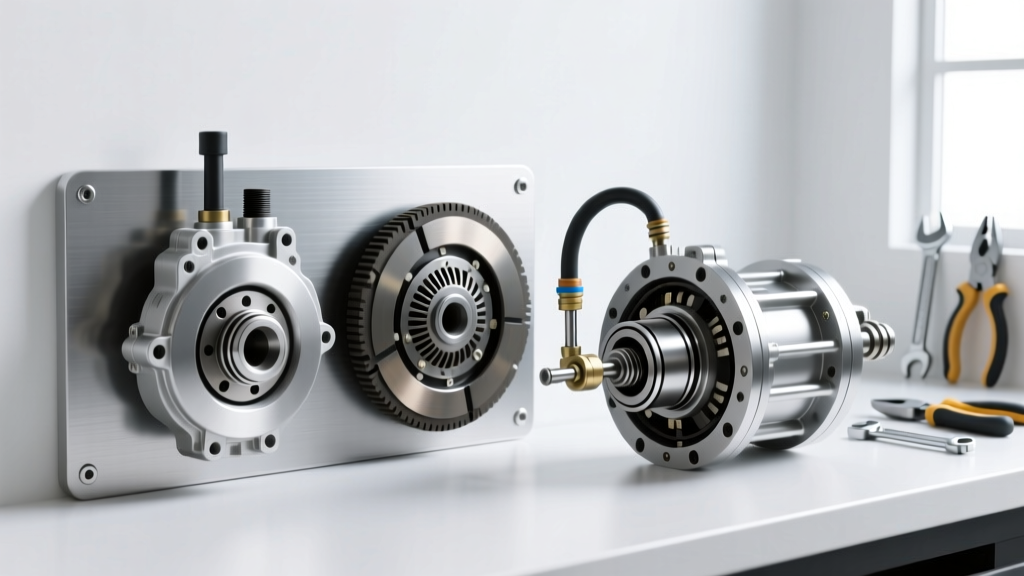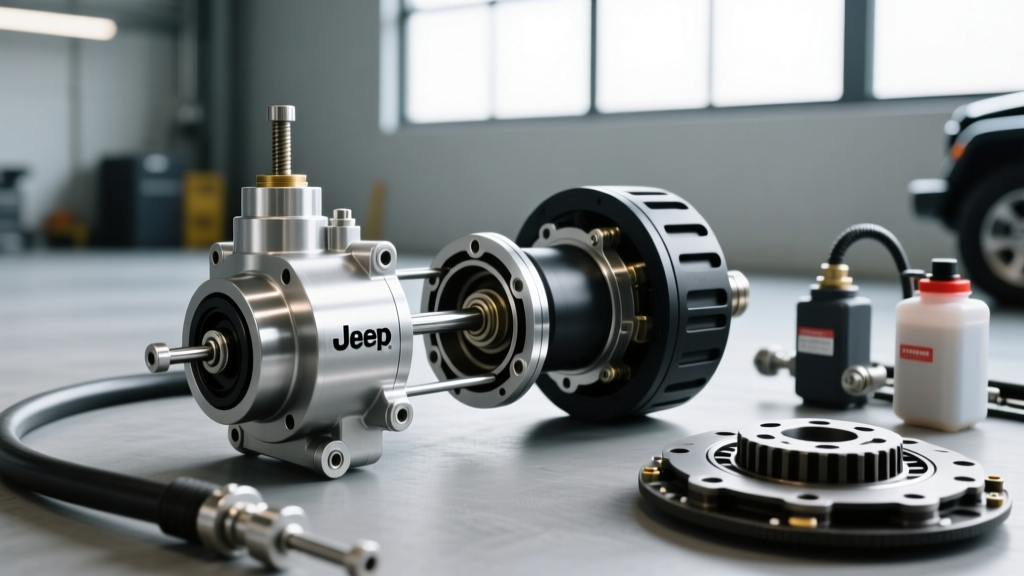
When restoring or modifying a 1987-1995 Jeep Wrangler, the transition from mechanical linkage to hydraulics is a common upgrade. However, diagnosing a failing Jeep YJ clutch master cylinder requires a deep understanding of the clutch slave cylinder types it is paired with. The hydraulic system is a closed loop; the master cylinder's bore size, stroke length, and fluid displacement must perfectly match the slave cylinder's volume requirements. A mismatch or a failure in one component often mimics a failure in the other. In this diagnostic guide, we break down the specific slave cylinder configurations found in OEM YJ setups and modern powertrain swaps, providing exact troubleshooting matrices, torque specifications, and bleeding protocols.
Decoding Clutch Slave Cylinder Types in YJ Setups
To accurately diagnose hydraulic faults, you must first identify which of the three primary slave cylinder types is mated to your Jeep YJ clutch master cylinder.
1. Standard External Push-Type (OEM AX15 / BA10)
The factory 4.0L inline-six YJs utilized the Peugeot BA10/5 (1987-1989) and the Aisin-Warner AX15 (1989-1995) transmissions. These rely on a standard external push-type slave cylinder mounted directly to the bellhousing. The slave features a 3/4-inch bore and a visible 10mm bleeder valve. Because it is exposed to the elements, the piston seal and pushrod bushing are highly susceptible to dirt ingress, leading to external fluid weeping that is often misdiagnosed as a failing master cylinder.
2. External Pull-Type (Heavy-Duty Conversions)
When YJ owners swap in heavier drivetrains or upgraded transfer case adapters, external pull-type slaves are sometimes utilized. Unlike push-types, the pull-type slave's piston retracts to engage the clutch fork. Diagnosing these requires checking the master cylinder's return spring tension, as a weak master return spring will fail to pull the slave piston back, resulting in clutch drag and premature throwout bearing failure.
3. Internal Hydraulic Release Bearings (HRB)
For modern V8 swaps (LS, Coyote) utilizing T56 Magnum or Tremec TKX transmissions, the Internal Hydraulic Release Bearing (HRB) is the standard. The HRB eliminates the external fork and slave entirely, placing the hydraulic piston directly against the clutch pressure plate fingers. HRBs require significantly more fluid displacement than OEM YJ external slaves. If your Jeep YJ clutch master cylinder has a standard 5/8-inch bore, it will likely result in a low pedal engagement point and incomplete disengagement when paired with a high-volume HRB like the Tilton 78000 series.
Symptom Diagnosis Matrix: Master vs. Slave
Use the following diagnostic table to isolate whether your symptoms point to the Jeep YJ clutch master cylinder or the specific slave type installed.
| Symptom | External Slave (AX15/BA10) | Internal HRB (T56/Tremec) |
|---|---|---|
| Spongy Pedal (No Leaks) | Master cylinder internal bypass; cup seal failure. | Air trapped in HRB; requires pressure bleeding at 15 PSI. |
| Fluid Loss at Firewall | Master cylinder rear pushrod seal failure. | Master cylinder failure; check for bent pushrod from HRB bind. |
| Fluid Loss at Bellhousing | Slave cylinder piston seal blowout; replace slave. | HRB O-ring failure; requires transmission removal to diagnose. |
| Incomplete Disengagement | Worn slave pushrod bushing or master stroke limit. | Master cylinder bore too small (needs 3/4' bore for HRB). |
Troubleshooting Fluid Loss and Sponginess by Configuration
Bleeding a hydraulic clutch system is notoriously more difficult than bleeding brakes due to the lack of a residual pressure valve and the complex routing of the hard lines. When diagnosing sponginess in an OEM YJ external slave setup, gravity bleeding is rarely sufficient. The hard line from the master cylinder often dips down and loops back up to the slave, creating a natural trap for air bubbles.
The Vacuum Extraction Method: For external slaves with a 10mm bleeder screw, use a vacuum bleeder (like the Mityvac MV6840) directly at the slave cylinder. Apply 15-20 in-Hg of vacuum while a helper tops off the master cylinder reservoir with fresh DOT 4 fluid. If bubbles persist after 12 ounces of fluid have passed, the internal seals of the Jeep YJ clutch master cylinder are likely scoring the bore, drawing air past the primary cup seal on the return stroke.
HRB Pressure Bleeding: Internal HRBs cannot be vacuum bled effectively because the air naturally rises to the top of the bellhousing, away from the HRB's fluid inlet. You must use a pressure bleeder (such as the Motive Products 0108) set to exactly 12-15 PSI. Pushing fluid from the master cylinder reservoir down to the HRB forces trapped air out through the transmission case access hole. Never exceed 20 PSI, or you risk blowing out the HRB's internal Teflon seals, resulting in a catastrophic fluid dump inside the bellhousing.
Precision Specs: Torque, Fluid, and Part Numbers
Proper installation and diagnosis require adherence to specific hardware and fluid specifications. Using the wrong fluid or over-torquing fragile components is a leading cause of premature hydraulic failure in YJ builds.
Master Cylinder Specifications
- OEM Mopar Part Number: 53003114 (Discontinued, use Dorman M88943 or Centric 136.67004).
- Bore Size: 5/8-inch (OEM AX15), 3/4-inch (Required for most HRB conversions).
- Firewall Mounting Nuts: M6 x 1.0 flange nuts. Torque spec: 7.5 lb-ft (89 in-lbs). Over-torquing will crack the plastic reservoir or warp the aluminum mounting flange.
- Pushrod Play: 0.020' to 0.040' free play at the pedal. Zero free play will cause the master cylinder compensating port to remain blocked, leading to clutch drag and fluid overheating.
Slave Cylinder Specifications
- External Slave (AX15): Dorman CS65004 or OEM Mopar 53003115.
- External Slave Mounting Bolts: M8 x 1.25. Torque spec: 17 lb-ft. Apply medium-strength threadlocker (Loctite 243) as bellhousing vibration frequently backs these out.
- Internal HRB Kits: Tilton 78000-Series or McLeod 1300-Series ($350-$650 range).
Fluid Selection
Always use high-quality DOT 4 synthetic fluid (e.g., Castrol SRF or Valvoline SynPower). DOT 4 has a higher dry boiling point (446°F) compared to DOT 3 (401°F), which is critical in YJs where the slave cylinder sits inches from the exhaust downpipe and catalytic converter. Fluid boiling in the slave cylinder creates vapor lock, presenting as a sudden loss of pedal pressure that mimics a blown master cylinder seal.
Sourcing and Final Diagnostic Verification
When sourcing replacement components, avoid unbranded offshore master cylinders. The internal bypass ports on cheap castings are frequently misaligned, causing immediate engagement issues. Rely on proven suppliers like Quadratec for OEM-spec YJ components, or consult Novak Adapt for specialized master/slave pairing data when executing complex V8 transmission swaps. Furthermore, checking aftermarket catalogs on RockAuto can help you cross-reference bore sizes between different vehicle applications to find a master cylinder that perfectly matches your custom slave cylinder's displacement requirements.
Ultimately, diagnosing a Jeep YJ clutch master cylinder is an exercise in system volume analysis. By identifying your exact clutch slave cylinder type, verifying the bore-to-stroke ratio, and executing the correct bleeding protocol, you can eliminate hydraulic sponginess and achieve a crisp, predictable clutch pedal.