The Spongy Pedal Epidemic: Why Air Traps in Modern Clutch Hydraulics
If you are wrestling with a spongy clutch pedal, delayed disengagement, or gear grinding on a modern manual transmission, you are likely battling air in the hydraulic lines. As we navigate the 2026 automotive landscape, the vast majority of manual transmissions—from the Tremec T56 Magnum to the ZF S6-650 found in heavy-duty applications—rely on internal hydraulic throwout bearings or concentric slave cylinders (CSCs). Unlike traditional external slave setups, these internal units are often mounted inverted or feature complex hydraulic routing that creates natural air traps.
Air in a clutch hydraulic system is compressible. When you press the pedal, the hydraulic pressure compresses the trapped air bubbles instead of transferring force to the clutch fork or pressure plate. While professional shops often rely on $150+ pressure bleeding systems, many DIYers and independent mechanics turn to the Harbor Freight clutch bleeder (specifically the Pittsburgh Automotive Vacuum Brake Bleeder kit, typically priced around $30-$45). When used correctly, this budget tool is highly effective. However, vacuum bleeding introduces unique pitfalls that can trick even seasoned mechanics into thinking air remains in the system when it does not.
Evaluating the Harbor Freight Vacuum Bleeder Toolkit
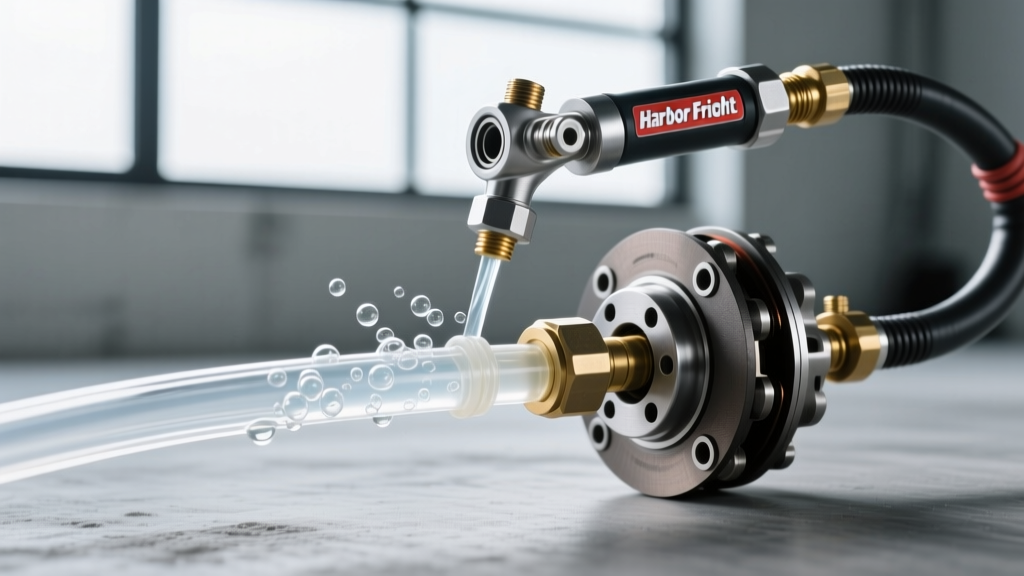
The typical Harbor Freight vacuum bleeder kit includes a hand-held vacuum pump, a fluid catch reservoir, and an assortment of rubber adapters. It operates by creating negative pressure at the bleeder screw, pulling fluid and air down from the master cylinder reservoir.
Expert Insight: The primary flaw of any vacuum bleeder—including the Harbor Freight unit—is thread cavitation. If the bleeder screw threads are not perfectly sealed, the vacuum will pull air down the outside of the threads rather than through the hydraulic line. This results in a steady stream of bubbles in the catch bottle, leading mechanics to falsely diagnose persistent air in the clutch lines.
To use a Harbor Freight vacuum bleeder as an expert, you must eliminate thread cavitation and understand the specific fluid dynamics of your clutch system.
Expert Protocol: Purging Air with a Vacuum Bleeder
Follow this precise, step-by-step methodology to ensure you are actually pulling air from the hydraulic lines and not from the atmosphere.
Step 1: Thread Sealing (The Critical Bypass)
Before attaching the vacuum hose to the slave cylinder bleeder screw, remove the screw entirely. Clean the threads with brake cleaner, then wrap the bleeder screw threads with 2 to 3 layers of PTFE (Teflon) plumber’s tape, or coat them heavily with high-temperature silicone dielectric grease. Reinstall the bleeder screw to the exact torque specification (detailed in the table below). This guarantees that any air pulled into the Harbor Freight reservoir is exclusively from inside the hydraulic line.
Step 2: Fluid Selection and Preparation
Most modern clutch systems share fluid with the brake system or require specific high-temperature fluids. According to Castrol's fluid specifications, DOT 4 fluid offers a higher dry boiling point (230°C / 446°F) compared to DOT 3 (205°C / 401°F), making it superior for clutch hydraulics located near hot exhaust components. Never use DOT 5 (silicone-based) fluid, as it does not absorb moisture and will trap micro-bubbles that are nearly impossible to purge with a vacuum tool.
Step 3: The Vacuum Pull Sequence
- Fill the master cylinder reservoir to the MAX line with fresh DOT 4 or DOT 5.1 fluid.
- Attach the Harbor Freight vacuum hose to the sealed bleeder screw.
- Pump the handle to 20-25 in-Hg of vacuum. Do not exceed this, or you risk collapsing the rubber clutch flex line, which restricts fluid flow and traps air.
- Open the bleeder screw exactly one-quarter turn. Fluid and air will rush into the reservoir.
- Close the screw before the vacuum drops below 10 in-Hg to prevent atmospheric air from being sucked back into the system.
- Repeat until the fluid is entirely free of bubbles, checking the master reservoir every 3 cycles to prevent it from running dry.
Critical Torque Specifications for Clutch Bleeder Valves
Snapping a bleeder screw inside a $180 LUK RepSet concentric slave cylinder or a Dorman master cylinder is a catastrophic and expensive mistake. Clutch bleeder screws are notoriously soft and prone to seizing due to galvanic corrosion between the steel screw and the aluminum cylinder body. Always use a precision 6-point flare nut wrench or a dedicated bleeder wrench, and adhere strictly to these torque limits:
| Thread Size | Common Application | Torque Spec (Nm) | Torque Spec (in-lbs) | Breakaway Risk Factor |
|---|---|---|---|---|
| M7 x 1.0 | GM Concentric Slaves, Honda Masters | 6 - 8 Nm | 53 - 70 in-lbs | High (Easily strips aluminum) |
| M8 x 1.0 | Ford MT-82, Tremec External Slaves | 8 - 10 Nm | 70 - 88 in-lbs | Moderate |
| M10 x 1.0 | Heavy Duty / Commercial Clutches | 10 - 14 Nm | 88 - 123 in-lbs | Low |
Pro Tip: If the bleeder screw refuses to budge, apply localized heat using a butane micro-torch to the aluminum housing (avoiding the rubber flex line) to break the corrosion bond before applying torque.
Troubleshooting Persistent Sponginess
If you have successfully executed the vacuum bleed with the Harbor Freight tool, verified your thread seal, and the pedal still feels spongy, you are likely dealing with one of three advanced mechanical issues rather than simple air in the lines.
1. The Master Cylinder Bypass Port Blockage
Clutch master cylinders feature a tiny compensating (bypass) port that allows fluid to return to the reservoir when the pedal is released. If the clutch pedal pushrod is misadjusted and holds the piston slightly depressed at rest, this port is blocked. Fluid becomes trapped, heats up, expands, and causes the clutch to drag. Conversely, a worn return spring can cause the piston to flutter, drawing microscopic air bubbles past the primary cup seal into the line.
2. Flex Line Delamination
The rubber hydraulic flex line connecting the chassis to the transmission bellhousing degrades internally over time. As noted in various Hagerty technical teardowns, internal delamination creates a one-way valve effect or a spongy pocket that mimics air in the lines. If your clutch line is over 7 years old, replace it with a stainless steel braided line (e.g., Russell or Goodridge) to eliminate hose expansion under pressure.
3. Inverted Slave Cylinder Air Pockets
On vehicles where the bleeder screw sits physically lower than a loop in the hard line, a vacuum bleeder will pull fluid past the air pocket without extracting it. In these scenarios, vacuum bleeding fails. You must perform a reverse bleed. This involves using a syringe and a length of clear tubing to push fresh fluid UP from the slave cylinder bleeder screw into the master cylinder reservoir, forcing the trapped air upward against its natural buoyancy. While pressure bleeding specialists often recommend specialized reverse-flush caps for the master cylinder, a simple 60mL veterinary syringe attached to the Harbor Freight hose adapter works perfectly for pushing fluid upward.
Final Verdict on the Harbor Freight Clutch Bleeder
The Harbor Freight vacuum bleeder is an exceptionally capable tool for diagnosing and fixing air in clutch hydraulic lines, provided the user respects the physics of vacuum cavitation. By sealing the bleeder threads, adhering to strict torque specifications, and understanding the limitations of inverted concentric slave cylinders, you can achieve a rock-solid, factory-spec clutch pedal feel without investing in professional-grade pressure bleeder equipment. Always prioritize fresh, high-quality DOT 4 or DOT 5.1 fluid, and remember that in modern hydraulics, mechanical binding and bypass port blockages are just as common as trapped air.