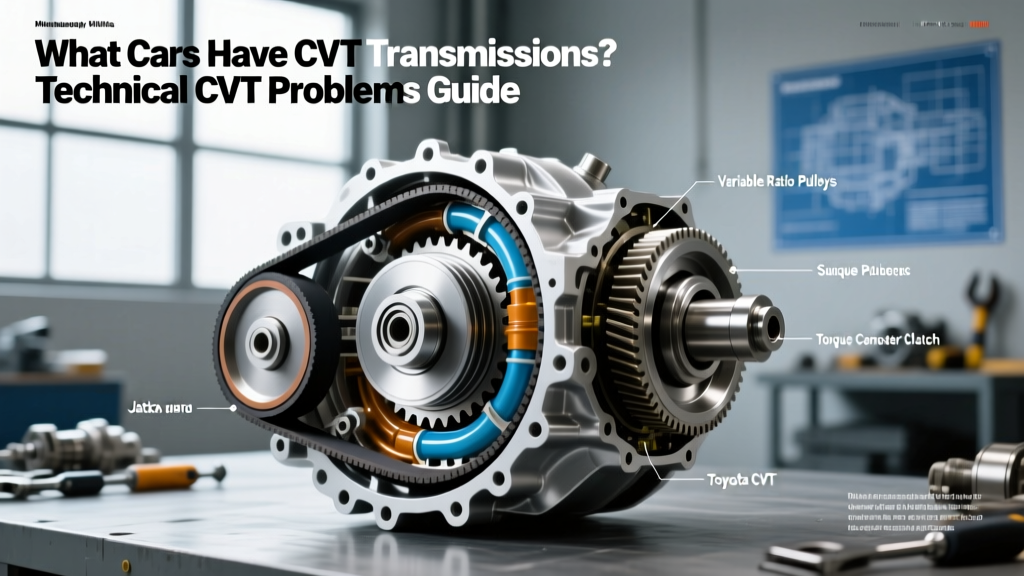
The CVT Landscape: What Cars Have CVT Transmissions?
When automotive technicians and consumers ask, what cars have CVT transmissions, the answer spans nearly every major global automaker. As of 2026, Continuously Variable Transmissions (CVTs) dominate the compact, mid-size, and hybrid segments due to their unparalleled ability to keep internal combustion engines within their optimal brake-specific fuel consumption (BSFC) islands. However, the pursuit of infinite gear ratios has introduced unique metallurgical and hydraulic vulnerabilities.
Unlike traditional planetary automatics (such as the ZF 8HP or GM 10L90) that rely on discrete gear sets and clutch packs, CVTs utilize variable-diameter pulleys and a high-tension steel push-belt or chain. This fundamental difference in power transfer dictates entirely different failure modes. Below, we map the most prominent CVT-equipped vehicles and dissect the engineering flaws that lead to catastrophic failures, backed by field data and SAE International tribology studies.
Market Overview: Major CVT Applications
| Manufacturer | Transmission Model | Common Vehicle Applications | Drive Mechanism |
|---|---|---|---|
| Nissan / Mitsubishi | Jatco JF011E / JF016E | Altima, Rogue, Outlander | LuK Push-Belt |
| Subaru | Lineartronic TR690 / TR580 | Outback, Forester, Ascent | LuK Chain |
| Toyota | K120 (Direct Shift-CVT) | Corolla, RAV4, Camry | Push-Belt + Launch Gear |
| Honda | Honda G-Design CVT | Civic, CR-V, Accord | LuK Push-Belt |
Technical Deep-Dive: Common CVT Failure Modes by Manufacturer
Nissan / Jatco (JF011E & JF016E): The Stepper Motor and Valve Body Crisis
The Jatco JF011E (Nissan designation RE0F10A) is arguably the most infamous CVT in modern automotive history. According to CarComplaints databases and NHTSA recall archives, the primary failure point is not the belt itself, but the hydraulic control system—specifically the line pressure control stepper motor (Part # 31036-1XF0A).
The Failure Mechanism: The stepper motor adjusts the pressure control valve to modulate pulley clamping force. Over time, the internal bearings of this motor degrade, shedding microscopic ferrous particulates directly into the valve body. Because the JF011E valve body features incredibly tight hydraulic tolerances (often measured in microns), this metal ingestion scores the valve bores. The Transmission Control Module (TCM) detects a step-loss or pressure discrepancy, triggering DTC P0868 (Secondary Pressure Down) and initiating a fail-safe limp mode.
Once clamping pressure drops below the required 40-50 bar threshold during high-load acceleration, the push-belt slips against the variator cones. This slip causes severe galling, effectively destroying the belt and the pulleys in a matter of seconds.
Subaru Lineartronic (TR690): Chain Wear and Solenoid Clogging
Subaru’s High-Torque Lineartronic TR690 was designed to handle the torque output of the 2.4L Turbo (FA24) engine found in the Outback XT and Ascent. Instead of a push-belt, it uses a heavy-duty LuK chain. While chains are inherently stronger, the TR690 suffers from thermal degradation and solenoid failures.
The Failure Mechanism: The chain relies on a specific friction coefficient between the chain pins and the variator cones, maintained by Subaru High Torque CVTF. Under sustained high-load conditions (e.g., towing or aggressive mountain driving), the fluid experiences thermal shear. Without an auxiliary transmission cooler, fluid temperatures exceed 130°C (266°F), breaking down the friction modifiers. The resulting chain slip scores the cones, generating brass and steel debris that clogs the lock-up damper solenoids in the valve body. Technicians frequently find the TR690’s internal filter (which is not serviceable without teardown) completely packed with metallic sludge, leading to starved lubrication at the front differential bearings.
Toyota Direct Shift-CVT (K120): Launch Gear Actuator Synchronization
Toyota revolutionized the CVT market with the K120 Direct Shift-CVT by integrating a physical mechanical first gear (Launch Gear) to eliminate the traditional 'rubber-band' effect off the line. While highly reliable in terms of belt longevity, the K120 introduces complex electromechanical shift synchronization issues.
The Failure Mechanism: The transition from the mechanical launch gear to the belt-driven variators occurs between 35-40 mph. This hand-off requires precise synchronization between the launch gear actuator motor and the primary pulley hydraulic pressure. As the actuator motor's internal carbon brushes wear, or as the shift solenoid valves accumulate varnish from oxidized CVTF FE fluid, the hand-off timing delays by milliseconds. This results in a harsh shift shock, a momentary loss of drive torque, and eventually triggers DTC P2714 (Pressure Control Solenoid Performance). Repeated shift shocks can prematurely wear the splines on the launch gear engagement dog.
Diagnostic Data: Fluid Analysis and Telemetry
Proper diagnosis of CVT problems requires moving beyond standard OBD-II scanning. Advanced bidirectional scanners must be used to monitor pulley ratio sensors and line pressure solenoid duty cycles. Furthermore, fluid analysis is the most accurate predictor of impending mechanical failure.
| Diagnostic Metric | Normal Operating Parameter | Failure Indicative Value | Associated Component |
|---|---|---|---|
| Primary/Secondary Pressure Ratio | 0.45 - 2.10 (Load Dependent) | Stuck at 1.00 (Limp Mode) | Valve Body / Stepper Motor |
| CVTF Temperature Sensor | 70°C - 95°C (158°F - 203°F) | > 125°C (257°F) Sustained | Cooler Lines / Heat Exchanger |
| Fluid Friction Coefficient (Lab Test) | > 0.12 µ | < 0.08 µ (Severe Shear) | Push-Belt / Chain Integrity |
Maintenance Interventions: Fluid Specs, Capacities, and Torque Values
Preventative maintenance is the only viable defense against catastrophic CVT failure. Unlike traditional automatics where a 'flush' might be debated, CVTs require strict adherence to drain-and-fill intervals using only OEM-specified friction-modified fluids. Using incorrect fluid (e.g., mixing Nissan NS-2 with NS-3, or using a universal multi-vehicle CVTF) will alter the clamping pressure algorithms and induce immediate belt slip.
- Nissan NS-3 (Part # 999MP-NS300P): Required for JF016E. Drain and fill capacity is approximately 5.2 quarts. Pan bolt torque spec: 7.9 Nm (70 in-lb). Over-torquing will strip the aluminum casing.
- Subaru High Torque CVTF (Part # SOA868V9270): Required for TR690. Total dry capacity is 12.2 quarts, but a standard drain/fill yields 5.5 quarts. Drain plug torque spec: 25 Nm (18.4 ft-lb) with a mandatory new aluminum crush washer (Part # 803918060).
- Toyota CVTF FE (Part # 08886-02105): Required for K120. Drain and fill capacity is 4.8 quarts. Overflow plug torque spec: 17 Nm (12.5 ft-lb).
Expert Warning: Never perform a pressurized CVT fluid flush. The high-pressure flow can dislodge metallic debris trapped in the valve body labyrinth and force it into the solenoid screens, causing immediate hydraulic blockages.
Cost Breakdown: Repair vs. Replacement in 2026
The financial reality of CVT ownership in 2026 is stark. Due to the precision machining required for variator cones and the proprietary nature of LuK push-belts, internal rebuilds are rarely cost-effective for independent shops. Most repairs involve swapping the valve body or replacing the entire assembly with a remanufactured unit.
- Nissan Valve Body Replacement: $1,100 - $1,600 (Includes OEM valve body, stepper motor, and 2 hours of labor). This is viable only if the belt has not yet slipped.
- Subaru TR690 Remanufactured Unit: $4,200 - $5,800 (Includes core exchange, torque converter, and fluid). Dealership installations often push the upper end of this spectrum due to mandatory AWD system recalibrations.
- Toyota K120 Launch Gear Actuator: $900 - $1,300. If caught early, replacing the actuator and performing a software flash via Techstream can resolve shift shock without removing the transmission.
- Complete Jatco JF011E Replacement: $3,500 - $4,800. Given the age of most JF011E-equipped vehicles on the road today, this repair often exceeds the vehicle's residual value, leading to a high rate of insurance total-loss declarations.
Conclusion
Understanding what cars have CVT transmissions is only the first step; understanding the precise hydraulic and metallurgical limitations of those specific units is what separates informed owners from those facing unexpected five-figure repair bills. Whether it is monitoring the thermal limits of a Subaru TR690 or ensuring the stepper motor health in a Nissan Rogue, proactive, spec-compliant maintenance remains the ultimate safeguard in the continuously variable era.