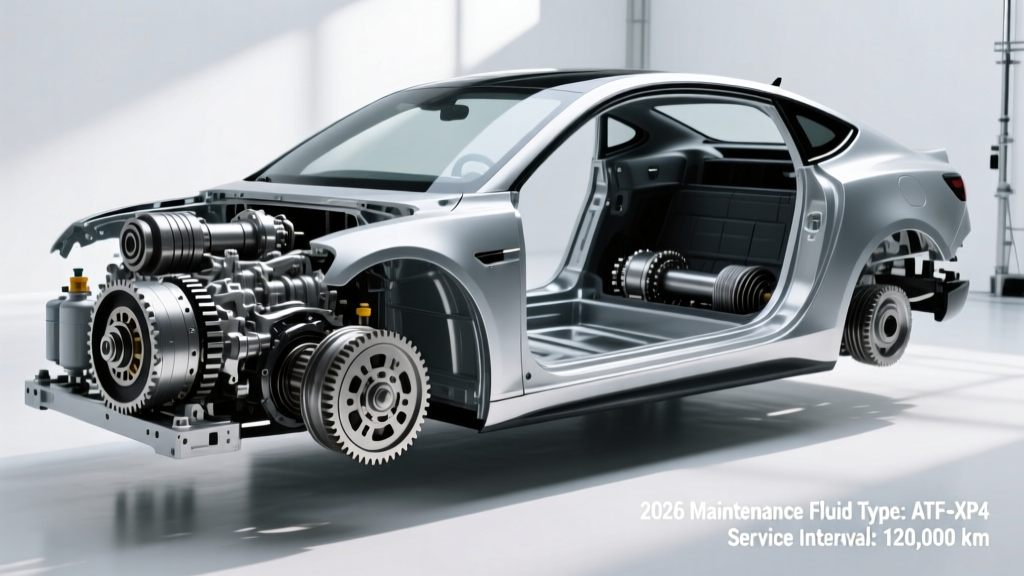
Decoding the CVT Landscape: Why Driving Habits Dictate Lifespan
When enthusiasts and daily commuters alike ask, what cars use CVT transmissions, the answer spans nearly every major non-commercial automaker in 2026. From the Nissan Altima to the Subaru Outback and Toyota Corolla, Continuously Variable Transmissions dominate the market due to their seamless power delivery and fuel efficiency. However, as an automotive transmission specialist, I see a stark reality in the repair bay: CVT longevity is not just about manufacturing quality; it is intrinsically tied to model-specific driving habits.
Unlike traditional planetary automatics (like the ZF 8HP or GM 6L80) that use torque converters and fixed gear sets, CVTs rely on variable pulleys, steel push-belts, or chains. This fundamental mechanical difference means that a driving technique that is harmless in a traditional automatic can be catastrophic in a CVT. Below is a model-specific repair and driving guide designed to keep your CVT out of the scrapyard and on the road.
Nissan & Jatco JF011E/JF016E: Overcoming Stepper Motor and Belt Slip
Nissan's partnership with Jatco produced the ubiquitous JF011E and its successor, the JF016E. These units are found in millions of vehicles, including the Rogue, Altima, and Sentra. While later iterations improved upon early flaws, specific driving habits still trigger premature failures.
The Repair Reality: Stepper Motor and Pressure Codes
The most common failure point in the JF011E is the stepper motor (OEM Part #31942-1XF00), which controls the hydraulic pressure to the pulleys. When this motor fails, or when the pressure sensor degrades, you will see OBD2 codes like P0746 or P0868. Without proper hydraulic pressure, the belt slips against the conical pulleys, scoring the metal surfaces and generating metallic debris that destroys the valve body. A stepper motor replacement costs between $450 and $650, but if belt slip occurs, you are looking at a $4,500+ full rebuild.
Model-Specific Driving Tips for Nissan/Jatco
- Avoid Lugging Under Load: Do not accelerate heavily from low RPMs (e.g., 1,200 RPM). The Jatco units struggle to build instantaneous line pressure at low engine speeds. Feather the throttle to allow RPMs to climb past 2,000 before demanding heavy acceleration.
- Stop Power-Braking: Holding the brake pedal while simultaneously pressing the accelerator (brake-torquing) generates immense heat in the CVT fluid. Nissan NS-3 fluid degrades rapidly above 240°F (115°C), losing its friction modifiers and leading to clutch pack burnout.
- The 3-Second Rule for Direction Changes: When shifting from Reverse to Drive, come to a complete, verified stop. Wait three full seconds before accelerating. Shifting while rolling backward forces the forward clutch pack to absorb the kinetic energy of the vehicle's mass, glazing the clutch plates.
Subaru Lineartronic TR-580/TR-690: Chain Stretch and Valve Body Survival
Subaru utilizes the Lineartronic CVT, specifically the TR-580 (medium torque) and TR-690 (high torque) models. Unlike the steel push-belt design in Nissan's Jatco units, Subaru employs a LuK chain drive. This allows for higher torque capacity, making it suitable for the Outback, Forester, and Ascent, but it introduces unique wear characteristics.
The Repair Reality: Chain Wear and Solenoid Fatigue
While the chain itself is robust, the hydraulic control system is sensitive. Over time, microscopic metal wear from the chain and pulleys circulates through the fluid, clogging the fine mesh screens in the valve body and causing solenoid fatigue. Replacing a Subaru CVT valve body (Part #31700AA040 series) typically runs $1,400 to $1,900 in 2026. Furthermore, aggressive driving can lead to chain stretch, requiring a $3,000+ teardown.
Model-Specific Driving Tips for Subaru
- Mitigate the Subaru Creep: Subaru CVTs are programmed to simulate a traditional automatic's creep function when you lift off the brake. Avoid using the accelerator to hold the car stationary on an incline. This slips the forward clutch continuously. Always use the brake pedal or Auto Vehicle Hold (AVH) to maintain your position.
- Respect the Cold Start Lockout: Subaru's ECU intentionally limits RPMs and alters shift logic when the CVTF is below 104°F (40°C). Do not force heavy acceleration during this warm-up phase, as the fluid viscosity is too high to provide adequate lubrication to the chain links and pulley bearings.
- Towing Within Strict Limits: If you tow near the 3,500 lb limit, install an aftermarket CVT cooler. The TR-690 generates massive heat under sustained towing loads, and thermal breakdown of the Subaru High Torque CVTF is the leading cause of pulley scoring in towing applications.
Toyota Direct Shift-CVT (K120/K313): Protecting the Launch Gear
Toyota revolutionized the CVT market with the K120 Direct Shift-CVT, found in the Corolla, RAV4, and Prius (eCVT variants differ, but the K120 is the focus here). By integrating a physical first gear (launch gear), Toyota eliminated the traditional CVT rubber-band effect off the line. However, this mechanical addition requires specific driving awareness.
The Repair Reality: Launch Gear Shear and Transition Clutch Burn
The transition from the mechanical launch gear to the CVT pulley system occurs around 25-35 MPH. This handoff is managed by a multi-plate transition clutch. Aggressive driving during this exact speed window causes the clutch to slip and burn. Additionally, shock-loading the launch gear via hard launches can shear gear teeth, necessitating a complete transmission replacement costing upwards of $5,000.
Model-Specific Driving Tips for Toyota
- Smooth Out the 30 MPH Handoff: Be conscious of the gear transition. Avoid abruptly lifting off the throttle or stomping on it exactly when the vehicle shifts from the physical gear to the pulley system (usually around 30 MPH). Smooth inputs preserve the transition clutch.
- No Drag Racing Launches: The physical launch gear is robust, but it is not designed for the shock load of a 3,000 RPM brake-torque launch. The torsional dampener in the torque converter will eventually fail, sending harmonic vibrations through the gear set.
Crucial Maintenance Data: Fluids, Capacities, and Torque Specs
Proper fluid maintenance is the ultimate driving tip for CVT longevity. Using the wrong fluid or failing to adhere to torque specifications during a drain-and-fill will result in immediate hydraulic failure. Below is the definitive 2026 service chart for these popular units.
| Transmission Model | OEM Fluid Specification | Drain/Refill Capacity | Drain Plug Torque | Fluid Temp Check Range |
|---|---|---|---|---|
| Nissan Jatco JF011E / JF016E | Nissan NS-3 | 5.5 - 6.0 Quarts | 31 ft-lbs (42 Nm) | 104°F - 113°F (40°C - 45°C) |
| Subaru Lineartronic TR-580 | Subaru CVTF (Lineartronic II) | 5.0 - 6.5 Quarts | 31 ft-lbs (42 Nm) | 104°F - 122°F (40°C - 50°C) |
| Toyota K120 Direct Shift | Toyota CVTF FE | 4.5 - 5.2 Quarts | 29 ft-lbs (39 Nm) | 95°F - 113°F (35°C - 45°C) |
Note: Always verify fluid levels using the OEM scan tool to read the exact transmission fluid temperature sensor data. Checking the dipstick or overflow plug at ambient temperature will result in severe under-filling.
Universal CVT Driving Rules to Avoid the Scrapyard
Regardless of whether you drive a Nissan, Subaru, or Toyota, certain universal truths apply to all belt and chain-driven continuously variable transmissions:
- Never Tow in Overdrive or Eco Modes: Eco modes force the CVT to keep engine RPMs artificially low to save fuel. When towing or climbing steep grades, this causes severe pulley clamping pressure and heat. Always use Sport mode or manually select a lower simulated ratio to keep RPMs and fluid pressure high.
- Warm Up the Drivetrain in Winter: CVT fluid is highly viscous when cold. Allow the vehicle to idle for 60 seconds and drive gently for the first 3 miles to circulate fluid to the chain/belt and bearings before applying heavy loads.
- Adhere to 30,000-Mile Fluid Intervals: While many owner's manuals claim the fluid is lifetime, independent transmission rebuilders universally agree that CVT fluid must be changed every 30,000 to 60,000 miles. The friction modifiers in CVTF degrade rapidly, and once they are gone, belt slip is inevitable.
Final Thoughts on CVT Longevity
Understanding what cars use CVT transmissions is only the first step. The true secret to avoiding a $5,000 replacement bill lies in adapting your driving style to the specific mechanical realities of your vehicle's transmission. Treat the pulleys, chains, and transition clutches with respect, adhere strictly to OEM fluid specifications, and your CVT will easily surpass the 150,000-mile mark without missing a beat.